The maintenance manager first detected vibrations which produced a low-frequency rumble that began in March and continued to escalate during the month of April. The 75-horsepower cooling water pump experienced such severe shaking in May that the pipe flanges began to separate from their connections. The primary source of the problem stemmed from components other than the pump bearings and the impeller imbalance. The motor-pump system had a rigid coupling which operated at 0.015 inches of parallel misalignment. The system experienced catastrophic failure because the coupling type required zero misalignment while equipment standards deemed the misalignment level as acceptable. The emergency repair expenses reached $47,000 because of emergency labor costs, production losses, and pump housing secondary damage.
Industrial couplings serve to transmit mechanical power between rotating shafts while handling different degrees of misalignment and vibration and shock load conditions. The application of an incorrect coupling type results in a concealed risk which ultimately results in equipment damage through excessive wear and vibration and disastrous equipment breakdowns. The guide offers engineers essential engineering knowledge together with selection methods and application instructions which maintenance engineers and equipment designers need to select industrial couplings with complete assurance.
You will discover the main distinctions which exist between rigid coupling designs and flexible coupling designs. You will learn how to determine torque needs by using service factors and which coupling types handle misalignment while other types create problems through it. The 316L stainless steel couplings function as essential components in environments where corrosive materials exist. The guide provides users with reliable methods which guarantee power transmission performance across multiple years in both chemical plant pump-motor systems and food processing facility conveyor drive systems.
What Are Industrial Couplings?

Function and Purpose in Power Transmission
An industrial coupling serves as a mechanical device that establishes a link between two rotating shafts in order to transmit torque from a driver (which typically includes electric motors engines or turbines) to a driven machine (which includes pumps, compressors, conveyors, fans, and gearboxes). The coupling performs three essential functions: it transmits rotational power to the equipment while it accommodates shaft misalignment through its flexible types, and it protects equipment from shock loads and vibration.
Most industrial applications rely on couplings because they create connections between motor and equipment shafts, which require proper alignment for direct shaft connections to work. The coupling must handle the full torque output of the driver while operating at design speed — which typically runs at 1,800 or 3,600 RPM for standard motors — without creating excessive wear or heat or losing efficiency.
The torque transmission path varies by coupling type. Rigid couplings create a strong mechanical bond that transmits 100% of the torque between connected systems. Flexible couplings use elastomeric elements (which can take the form of jaw tires or bellows designs) and metallic flexure (which includes disc or diaphragm elements) and mechanical components (which can be gear or grid systems) to transmit torque while absorbing misalignment and shock. Each design carries trade-offs between torque capacity, misalignment tolerance, and maintenance needs and expenses.
Key Performance Parameters
Selecting an industrial coupling requires understanding four critical performance parameters that define whether a coupling will survive in your application.
Torque Rating: Couplings are rated by nominal torque (continuous operating torque) and peak torque (momentary overload capacity). Torque is calculated as:
T (lb-in) = 63,025 × HP / RPM
Or in metric units:
T (N·m) = 9,549 × kW / RPM
Always apply a service factor (typically 1.5 to 3.0 depending on application severity) to the calculated torque before selecting a coupling size.
Speed Capability: The maximum RPM ratings of couplings depend on their balance grade and centrifugal stress limitations. High-speed applications (above 3,600 RPM) require precision-balanced couplings to prevent bearing damage through vibration which occurs during operation.
Misalignment Accommodation: The different coupling types exhibit wide variations in their ability to handle misalignment situations. Rigid couplings tolerate essentially zero misalignment. Flexible jaw couplings accommodate up to 1° angular and 0.5mm parallel misalignment. Disc couplings handle 0.5° angular and 0.2mm parallel. Gear couplings can operate with 1.5° angular misalignment.
Service Environment: Temperature extremes and chemical exposure and washdown requirements and food contact regulations all affect the material selection process and the design of couplings.
Materials of Construction
Industrial couplings are manufactured from materials selected for strength, durability, and environmental compatibility.
Carbon Steel: The standard material for industrial couplings provides excellent strength and cost-effectiveness. Hubs and sleeves are made from Grade 1045 or 4140 steel. Carbon steel couplings suit most industrial applications where corrosion is not a concern.
Stainless Steel: 316L stainless steel (UNS S31603) provides corrosion resistance for chemical processing, food manufacturing, marine, and washdown environments. The low-carbon content prevents sensitization during welding. Stainless couplings cost 3-5× more than carbon steel but eliminate corrosion failures in aggressive environments.
Aluminum: Lightweight aluminum couplings reduce inertia and are preferred for high-speed, low-torque applications such as encoder drives and instrumentation. Aluminum provides adequate strength for light-duty service but cannot match steel torque capacity.
Cast Iron: Some coupling components use cast iron for vibration damping and cost reduction. Cast iron works well for low-speed, high-inertia applications but lacks the fatigue resistance of steel for cyclic loading.
Types of Industrial Couplings

Industrial couplings fall into two fundamental categories — rigid and flexible — with multiple subtypes within the flexible category optimized for specific application requirements.
Rigid Couplings
Rigid couplings create a solid inflexible connection which connects two shafts that have been precisely aligned. The system transmits complete input torque to its output without any backflow problems while needing very little upkeep work but it can only handle precise shaft alignment.
Sleeve or Muff Couplings: The simplest rigid coupling uses a hollow cylinder (sleeve) which fits over the abutting shaft ends and secures with keys and set screws or clamping force. Sleeve couplings function as low-cost compact solutions which lack ability to handle misalignment problems and present challenges during maintenance removal process.
Clamp or Split Couplings: A split sleeve design uses two halves bolted together around the shafts. Clamp couplings provide easier installation and removal processes compared to solid sleeves yet they require exact shaft alignment. The system operates in vertical pump applications and light-duty horizontal applications.
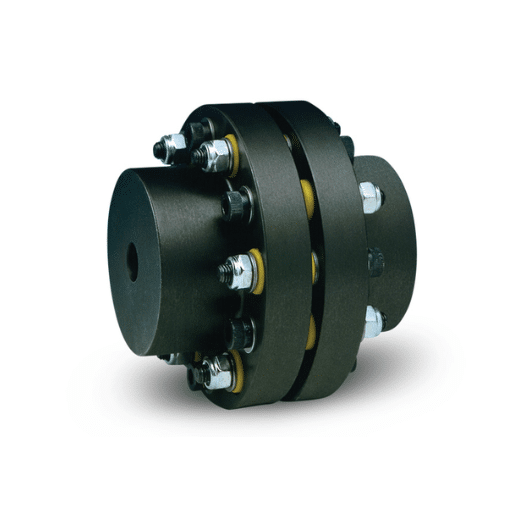
Flange Couplings: Two flanged hubs bolt together face-to-face. Flange couplings handle high torque and are easily disassembled for maintenance. The precision-machined flange couplings maintain concentricity within 0.001 inches when shafts are perfectly aligned during installation.
When to Specify Rigid Couplings: The situation requires rigid couplings when shafts exist in precise alignment which allows only 0.002 inches of parallel movement and 0.05° of angular movement and when systems need to show no backflow for precision positioning and when shafts require support through bearings located near the coupling to avoid deflection problems.
Flexible Jaw Couplings
Jaw couplings (also called spider or Lovejoy couplings after the dominant manufacturer) use two metal hubs with interlocking jaws separated by an elastomeric insert called a spider.
Construction: The two hubs which use cast iron or steel materials have three curved jaws which connect with three matching jaws on their opposing hub. The rubber or polyurethane spider fits between the jaws which transmits torque through elastomer compression. The spider system provides shock protection while controlling vibration and allowing for misalignment.
Misalignment Capacity: Standard jaw couplings tolerate up to 1° angular misalignment, 0.5mm (0.020 inches) parallel offset, and 0.5mm axial float. The design of curved jaw systems allows better handling of misalignment compared to straight jaw systems.
Torque and Speed: Jaw couplings operate between 0.25 horsepower and 3000 horsepower capacity. The maximum speeds of the system usually operate between 3,600 and 6,000 RPM depending on the system’s dimensions and balance grade.
Spider Materials:
- Nitrile rubber (Buna-N): Standard duty, -40°C to 80°C, oil-resistant
- Polyurethane: Higher torque, abrasion-resistant, -30°C to 90°C
- Hytrel: High torque, chemical resistant, -40°C to 120°C
- Bronze: Non-elastomeric, high temperature, electrically conductive
Applications: Jaw couplings dominate general industrial applications — pumps, blowers, compressors, conveyors, and machine tools — where moderate misalignment exists and some vibration damping is beneficial.
Gear Couplings
Gear couplings transmit torque through meshed gear teeth with crowned profiles that accommodate angular misalignment while maintaining high torque capacity.
Construction: The system creates two hubs which operate by using external gear teeth that interact with internal teeth on a sleeve or two flanged hubs. The crowned tooth profile enables the teeth to maintain contact while showing angular misalignment through their ability to rock back and forth. Some designs use two flex hubs with a spacer sleeve between them (spacer couplings) to allow axial separation for equipment maintenance.
Misalignment Capacity: Gear couplings accommodate up to 1.5° angular misalignment per flex point. Double-engagement designs (with two flex hubs) can handle parallel offset by combining angular misalignment at each end. The design allows different axial capacities which range from 2 to 6 millimeters.
Torque Capacity: The gear coupling system which connects two shafts creates the most efficient torque transmission capability of all existing coupling systems. A gear coupling half the size of an equivalent jaw coupling can transmit the same torque. Gear couplings serve as vital components for high-power systems which operate in steel mill drives, marine propulsion systems, and large compressor units.
Maintenance: Gear couplings require lubrication (grease or oil) to prevent wear. The seals function to contain lubricant while stopping outside contaminants from entering. The maintenance schedule needs to be performed at different times which range from 6 months to 2 years based on how harsh the work environment becomes.
Applications: The system supports operations in heavy industrial equipment, steel mills, paper machines, marine drives, and any location where high torque needs to be transmitted through major equipment misalignment.
Disc Couplings
Disc couplings use thin metal discs (diaphragms) flexing to accommodate misalignment while transmitting torque mechanically rather than through elastomeric elements.
Construction: The process uses thin stainless steel discs which workers bolt together at two separate hubs to create a flexible component. The discs flex in bending to accommodate angular, parallel, and axial misalignment. Disc packs use multiple layers (3-8 discs) to distribute load while creating redundant systems.
Misalignment Capacity: Disc couplings accommodate 0.5-1.0° angular 0.2-0.5mm parallel and 1-3mm axial misalignment according to disc thickness and diameter. The thinner discs enable users to achieve greater flexibility however their torque capacity decreases.
Advantages: Disc couplings require no lubrication and operate at high temperatures (up to 400°C with appropriate materials) which enables them to achieve infinite fatigue life when properly sized. The system operates without backlash which makes it appropriate for applications needing precise positioning.
Limitations: Disc couplings cannot handle misalignment as effectively as jaw or gear couplings and they also provide less effective vibration damping. They also cost more than elastomeric couplings do.
Applications: The system operates in high-temperature environments while it provides accurate movement control for motor-generator sets and API 610 pump applications which need reliable performance.
Grid Couplings
Grid couplings (also called resilient or Falk couplings) use a spring steel grid weaving between slotted hubs to transmit torque.
Construction: Two slotted hubs with matching grooves face each other. A serpentine spring steel grid snakes through the grooves, which transmits torque through the grid’s engagement with the hub teeth. The grid flexes to accommodate misalignment and cushions shock loads.
Misalignment Capacity: Grid couplings handle up to 0.5° angular and 0.4mm parallel misalignment. The typical axial capacity ranges between 3 millimeters and 6 millimeters.
Torque and Damping: Grid couplings provide excellent shock load protection. The spring steel grid deforms under overload because it absorbs energy which would damage rigid couplings or overstress elastomeric ones. The grid returns to its original shape after overload occurs.
Maintenance: Grid couplings require periodic lubrication. The grid can be replaced without moving connected equipment by removing the cover and sliding out the old grid.
Applications: Crushers, pulverizers, reciprocating pumps and compressors, and any application with high shock loads or torque fluctuations.
Elastomeric Bellows Couplings
Bellows couplings use a flexible elastomeric sleeve (bellows) bonded to two hubs to transmit torque while accommodating all types of misalignment.
Construction: The system uses a molded rubber or polyurethane bellows which includes internal reinforcement cords and connects to aluminum or steel hubs through bonding. The bellows transmits torque through its twisting motion while it flexes to adapt to misalignment conditions.
Misalignment Capacity: Bellows couplings excel in accommodating parallel misalignment — up to 2mm or more depending on size. The system supports 2-3° of angular movement and 2-5mm of axial movement.
Advantages: Bellows couplings require no lubrication, provide good vibration damping, and tolerate significant misalignment in all directions. The system maintains electrical isolation which stops galvanic corrosion and produces quiet operation through its design that avoids metal-to-metal contact.
Limitations: Bellows couplings have lower torque capacity than jaw or gear couplings of equivalent size. The temperature range of the elastomer material extends from -30°C to 100°C. The bellows material experiences degradation when exposed to ultraviolet radiation and specific chemical substances.
Applications: The system serves encoder drives and light-duty pumps and blowers and applications which emphasize silent operation and maintenance-free performance above torque density.
Rigid vs Flexible Coupling Selection

Choosing between rigid and flexible couplings fundamentally determines whether your power transmission system will tolerate misalignment or demand perfection.
When to Specify Rigid Couplings
Rigid couplings are the right choice when precise shaft alignment is achievable and maintainable, and when the benefits of rigid connection outweigh installation precision requirements.
Precision Alignment Available: Use rigid couplings when you can achieve and maintain alignment within 0.002 inches (0.05mm) parallel and 0.05° angular. This typically requires laser alignment tools, rigid foundations, and thermal growth analysis to ensure alignment holds across operating temperature ranges.
Zero Backlash Required: Servo motor positioning systems, machine tool drives, and precision indexing applications require zero backlash that only rigid couplings provide. Even “zero-backlash” flexible couplings have measurable wind-up under load.
Simple Construction Preferred: Rigid couplings have no wearing parts, require no lubrication, and are less expensive than flexible alternatives. For light-duty, well-aligned applications, rigid couplings minimize maintenance and cost.
Shaft Support Close to Coupling: When bearings support shafts close to the coupling (short bearing spans), shaft deflection is minimized and rigid couplings perform reliably. Long spans between bearings cause shaft sag that makes rigid couplings unsuitable.
When Flexible Couplings Are Required
Flexible couplings are mandatory when misalignment exists, when vibration isolation is needed, or when equipment protection is prioritized.
Misalignment Exists: In real-world industrial installations, perfect alignment is difficult to achieve and maintain. Thermal growth, foundation settling, pipe strain, and bearing wear all introduce misalignment. Flexible couplings accommodate these real-world conditions without failure.
Vibration Isolation Needed: Elastomeric flexible couplings (jaw, tire, bellows) dampen torsional vibration from engines, reciprocating pumps, and variable frequency drives. This protects bearings and extends equipment life.
Shock Load Protection: Applications with frequent starts, stops, or load variations (crushers, conveyors, compressors) benefit from flexible couplings that absorb shock loads that would damage rigid connections.
Equipment Protection Priority: The cost of coupling replacement is far less than the cost of replacing a damaged pump or motor. Flexible couplings act as a mechanical fuse, absorbing misalignment and overload that would otherwise transmit to expensive equipment.
Misalignment Accommodation Comparison
Different coupling types accommodate misalignment through different mechanisms with varying capacity:
Industrial Coupling Misalignment Capacity Comparison
| Coupling Type | Angular (per flex point) | Parallel | Axial | Mechanism |
|---|---|---|---|---|
| Rigid | 0° | 0 mm | 0 mm | None — requires perfect alignment |
| Jaw/Spider | 1.0° | 0.5 mm | 0.5 mm | Elastomer compression |
| Gear | 1.5° | 0.4 mm* | 6 mm | Crowned gear teeth rocking |
| Disc | 0.5° | 0.2 mm | 1-3 mm | Metal disc bending |
| Grid | 0.5° | 0.4 mm | 3-6 mm | Spring steel flexing |
| Bellows | 2-3° | 2.0 mm | 2-5 mm | Elastomer flexure |
*Gear coupling parallel capacity achieved through double-engagement design with angular misalignment at each end
Torque Transmission Efficiency
All couplings absorb some energy, but efficiency varies significantly by type:
- Rigid couplings: 99%+ efficiency — essentially no losses
- Disc couplings: 98-99% efficiency — minimal hysteresis in metal flexure
- Gear couplings: 97-98% efficiency — gear tooth friction and lubricant drag
- Jaw couplings: 95-97% efficiency — elastomer hysteresis
- Grid couplings: 95-97% efficiency — grid flexing and friction
- Bellows couplings: 94-96% efficiency — elastomer torsional wind-up
For most industrial applications, these efficiency differences are negligible. However, for large power transmission (100+ horsepower) or continuous operation, cumulative energy costs can justify selecting higher-efficiency coupling types.
Coupling Selection Methodology

Proper coupling selection follows a systematic five-step process that ensures the coupling will survive and perform in your specific application.
Step 1: Calculate Required Torque
Start with the driver power and speed to determine nominal torque, then apply appropriate service factors.
Calculate Nominal Torque:
For US customary units:
T (lb-in) = 63,025 × HP / RPM
Example: A 50 HP motor at 1,800 RPM:
T = 63,025 × 50 / 1,800 = 1,751 lb-in
For metric units:
T (N·m) = 9,549 × kW / RPM
Example: A 37 kW motor at 1,500 RPM:
T = 9,549 × 37 / 1,500 = 236 N·m
Apply Service Factor: Multiply nominal torque by a service factor based on application severity. The service factor accounts for startup loads, vibration, shock, and safety margin.
AGMA Service Factor Guidelines
| Driven Equipment | Uniform Load (SF) | Moderate Shock (SF) | Heavy Shock (SF) |
|---|---|---|---|
| Centrifugal pump, fan | 1.0 | 1.25 | 1.5 |
| Conveyor, gear drive | 1.25 | 1.5 | 1.75 |
| Reciprocating pump, compressor | 1.5 | 1.75 | 2.0 |
| Crusher, pulverizer | 1.75 | 2.0 | 2.25 |
Select a coupling with torque rating equal to or greater than calculated torque × service factor. In our 50 HP example driving a centrifugal pump with moderate shock: 1,751 × 1.25 = 2,189 lb-in minimum coupling rating.
Step 2: Determine Speed and Service Factor
Coupling speed affects selection through centrifugal stress and balance requirements.
Maximum Speed Ratings: The coupling manufacturers present maximum RPM limits which they assign to each coupling size. The system will suffer total destruction when users exceed operational limits because of centrifugal forces. The maximum speed of a coupling decreases when its size becomes larger.
Balance Requirements: Applications which operate above 3,600 RPM need couplings which have been designed for precise balancing. The API 610 standard which governs petrochemical pump operation and other specifications require specific balance grades to be followed. High-speed operations of unbalanced couplings create vibrations which result in bearing damage and equipment lifespan reduction.
Cyclic and Reversing Loads: The equipment which operates through frequent starts and stops and uses indexing drives or reciprocating equipment requires either increased service factors or specific coupling designs which can withstand high fatigue levels.
Step 3: Assess Misalignment Conditions
Realistic assessment of misalignment is critical for coupling longevity.
Measure or Estimate Misalignment: If equipment is already installed, use dial indicators or laser alignment tools to measure actual misalignment. For new installations, estimate based on:
- Foundation rigidity and expected settling
- Thermal growth of motor and driven equipment
- Pipe strain on pumps and compressors
- Manufacturing tolerances in equipment and bases
Select Appropriate Coupling Type: Choose a coupling with misalignment capacity exceeding your measured or estimated misalignment by at least 50% margin. If you measure 0.3° angular misalignment, select a coupling rated for at least 0.5°.
Consider Thermal Growth: Operating temperature changes shaft positions. A pump and motor at ambient temperature may align perfectly, but at operating temperature differential thermal growth can create significant misalignment. Calculate thermal growth and select couplings that accommodate the range.
Step 4: Evaluate Environmental Factors
The operating environment significantly influences coupling material and design selection.
Temperature Extremes: Standard elastomeric couplings use materials rated for -30°C to 80°C. High-temperature applications require metallic disc couplings or specialized high-temperature elastomers. Extremely cold environments require low-temperature-rated elastomers that remain flexible.
Chemical Exposure: Chemical plants, wastewater facilities, and coastal environments expose couplings to corrosive agents. 316L stainless steel couplings resist most chemicals and saltwater exposure. Standard carbon steel couplings fail quickly in corrosive environments.
Washdown and Sanitary: Food, pharmaceutical, and sanitary applications require couplings that withstand high-pressure washdown and resist bacterial growth. Stainless steel with smooth surfaces and food-grade lubricants are mandatory.
Explosive Atmospheres: Hazardous locations may require non-sparking materials (brass, aluminum, or stainless) rather than ferrous materials that could create sparks if the coupling fails.
Step 5: Verify Space and Installation Constraints
Physical envelope and maintenance access affect coupling selection.
Space Limitations: Some coupling types require significant length between shaft ends. Gear and grid couplings with spacer sleeves can be quite long. Disc and jaw couplings are more compact. Verify available space against coupling dimensions.
Maintenance Access: Couplings that require lubrication (gear, grid) need access for greasing. Couplings with replaceable elements (jaw spiders, grid springs) need clearance for element replacement. Ensure the coupling location allows future maintenance.
Shaft Sizes: Coupling hubs must accommodate motor and equipment shaft diameters. Verify bore sizes and keyway dimensions. Some couplings offer tapered bushings for flexible shaft fit.
Spacer Requirements: Pumps and compressors often require spacer couplings that allow removal of the rotating element without moving the motor. Verify if spacer couplings are needed for maintenance access.
Materials and Corrosion Resistance

Coupling material selection determines durability in aggressive environments.
Carbon Steel Couplings (Standard Duty)
Carbon steel is the default material for industrial couplings, providing excellent strength and cost-effectiveness.
Common Grades:
- 1045 medium carbon steel — good strength, readily machined
- 4140 alloy steel — higher strength and fatigue resistance
- Cast steel — economical for complex hub shapes
Surface Protection: Carbon steel couplings receive protective coatings — zinc plating, black oxide, or paint — to prevent rust during storage. These coatings are not sufficient for corrosive service; they merely prevent rust before installation.
Applications: General industrial machinery in controlled environments — manufacturing plants, HVAC systems, and material handling where exposure to moisture and chemicals is minimal.
Limitations: Carbon steel corrodes rapidly in chemical exposure, saltwater, washdown, or outdoor environments. Corrosion weakens the coupling and can cause failure. Once corrosion starts, it accelerates as rust expands and cracks protective coatings.
Stainless Steel Couplings (Corrosion-Resistant)
Stainless steel couplings provide corrosion immunity that carbon steel cannot match in aggressive environments.
316L Stainless Steel (UNS S31603): The standard for corrosion-resistant couplings contains 16-18% chromium, 10-14% nickel, and 2-3% molybdenum. The molybdenum provides resistance to chlorides and pitting corrosion. The low carbon (≤0.03%) prevents sensitization during welding.
304 Stainless Steel (UNS S30400): Lower cost than 316L but lacks molybdenum. Suitable for general corrosion resistance but vulnerable to chloride pitting. Use 304 for mild chemical exposure; specify 316L for coastal, marine, and chloride-rich environments.
Surface Finish: Stainless steel couplings for food and pharmaceutical service receive surface finishes to Ra ≤ 0.8μm to prevent bacterial adhesion. Passivation after machining restores the chromium oxide layer for maximum corrosion resistance.
Cost Premium: Stainless steel couplings cost 3-5× more than carbon steel equivalents. The premium is justified when coupling replacement costs exceed the material cost difference — which they almost always do in corrosive service.
Applications: Chemical processing, food manufacturing, pharmaceutical production, marine and offshore, wastewater treatment, and any environment with washdown, saltwater, or chemical exposure.
Aluminum Couplings (Lightweight)
Aluminum couplings reduce weight and inertia for high-speed, light-duty applications.
Properties: Aluminum provides approximately one-third the weight of steel with adequate strength for light-duty service. Anodizing improves surface hardness and corrosion resistance.
Torque Capacity: Aluminum has lower strength than steel; aluminum couplings are typically smaller and lower torque than steel equivalents. They are not suitable for high-torque industrial drives.
Applications: Encoder drives, instrumentation, small pumps and blowers, and high-speed applications where low inertia is critical. Aluminum is also non-magnetic and non-sparking for specialized applications.
Coating and Surface Treatment Options
When stainless steel is cost-prohibitive, surface treatments can extend carbon steel coupling life in mildly corrosive environments.
Zinc Plating: Electroplated zinc provides sacrificial corrosion protection. Zinc corrodes preferentially, protecting the steel substrate. Zinc plating suits mild indoor environments with occasional humidity.
Nickel Plating: Nickel provides harder, more durable corrosion protection than zinc. Nickel-plated couplings resist washdown and mild chemical exposure better than zinc.
Epoxy Coatings: Powder coating or epoxy painting provides a barrier coating. Coatings must remain intact; any chip or scratch allows corrosion to start and spread under the coating.
Passivation: For stainless steel couplings, passivation in nitric acid removes surface iron contamination and enhances the natural chromium oxide layer for maximum corrosion resistance.
Applications by Industry

Different industries impose unique requirements that influence coupling selection.
Pump and Motor Connections
Pump-motor drives represent the most common coupling application, with specific requirements for reliability and maintenance access.
Centrifugal Pumps: Smooth, continuous operation with minimal shock loads. Jaw couplings are the standard choice for their cost-effectiveness, misalignment capacity, and vibration damping. Service factor 1.0-1.25.
Positive Displacement Pumps: Reciprocating and rotary PD pumps create pulsating torque. Grid couplings or elastomeric couplings with high damping capacity absorb these pulsations. Service factor 1.5-2.0.
API 610 Petrochemical Pumps: High-power, critical-service pumps require disc couplings or gear couplings meeting API 610 specifications. These couplings must pass rigorous balance and documentation requirements.
Spacer Couplings for Pump Maintenance: Chemical and petrochemical plants specify spacer couplings that allow removal of pump internals without disturbing motor alignment. The spacer sleeve bolts between two flex hubs; removing the sleeve creates access to the pump.
Chemical Duty: Chemical plant pump couplings must resist corrosive atmospheres. 316L stainless steel couplings are standard for chemical service, eliminating corrosion failures that plague carbon steel.
Conveyor and Material Handling
Conveyor drives experience high shock loads, frequent starts and stops, and dirty environments.
Shock Load Protection: Jaw and grid couplings absorb shock loads from material impact on the conveyor. The elastomeric element cushions torque spikes that would damage gearboxes and motors.
Dust and Debris: Material handling environments are dusty and dirty. Couplings with exposed elastomeric elements (some jaw designs) can degrade from ozone and contamination. Enclosed grid couplings or metallic disc couplings resist contamination better.
Outdoor Exposure: Outdoor conveyors face temperature extremes and precipitation. Stainless steel couplings eliminate corrosion concerns in outdoor and partially sheltered installations.
Reversing Drives: Conveyors that reverse direction require couplings with zero backlash or backlash-tolerant design. Jaw couplings with compression-loaded spiders handle reversing better than tension-loaded designs.
Food and Pharmaceutical Processing
Food and pharmaceutical manufacturing demands couplings that withstand aggressive washdown and meet regulatory standards.
316L Stainless Steel: Food-grade couplings must be 316L stainless steel to resist high-pressure washdown with caustic and acidic cleaning agents. Carbon steel corrodes rapidly; plated steel eventually fails as coatings degrade.
Surface Finish: Couplings must have smooth surfaces (Ra ≤ 0.8μm) that do not harbor bacteria or product residue. Rough surfaces or crevices violate sanitary design principles.
Food-Grade Lubrication: Lubricated couplings (gear types) must use food-grade (H1) lubricants registered with NSF. Standard industrial lubricants are toxic and prohibited in food contact zones.
Elastomer Materials: Elastomeric elements must be FDA-compliant for incidental food contact. Standard nitrile rubber may contain plasticizers that migrate; food-grade formulations use approved additives.
Cleanability: Couplings should be accessible for cleaning and inspection. Designs that trap product or cleaning agents violate sanitary principles. Smooth, self-draining designs are essential.
Chemical and Corrosive Environments
Chemical plants expose couplings to corrosive vapors, splash, and temperature extremes.
Material Selection: 316L stainless steel is the default material for chemical plant couplings. The molybdenum content resists chlorides, sulfates, and most industrial chemicals. Duplex stainless steel (2205) provides even higher corrosion resistance for severe service.
Sealed Designs: In heavily corrosive atmospheres, sealed coupling designs prevent corrosive vapors from entering lubricated gear couplings. Labyrinth seals or positive seals extend lubricant life and prevent contamination.
Temperature Extremes: Chemical processes may operate at elevated temperatures. Disc couplings with high-temperature alloys or metallic bellows couplings tolerate temperatures beyond elastomer limits.
Safety Critical: Chemical plant coupling failures can release hazardous materials or cause fires. Coupling selection includes safety factors beyond standard industrial practice.
Marine and Offshore Applications
Marine environments impose saltwater corrosion, limited maintenance access, and regulatory requirements.
Corrosion Resistance: Seawater and salt spray rapidly attack carbon steel. 316L stainless steel couplings are mandatory for marine applications. Even 316L may require cathodic protection in submerged service.
Limited Maintenance Access: Offshore platforms and shipboard machinery have restricted maintenance windows. Maintenance-free coupling designs (disc, lubricated-for-life gear) reduce maintenance burden.
Shock and Vibration: Marine propulsion and deck machinery experience shock loads from waves and vessel motion. Couplings with high shock capacity (grid, jaw with high-damping spiders) protect connected equipment.
Classification Society Requirements: Marine couplings may require approval from classification societies (ABS, DNV, Lloyd’s). Documentation of material certifications and testing supports classification approval.
Installation and Alignment

Proper installation determines coupling longevity. Even the best coupling fails if misalignment exceeds its capacity.
Alignment Tolerance Specifications
Each coupling type has specific alignment tolerances that must not be exceeded.
Industrial Coupling Alignment Tolerances
| Coupling Type | Angular Misalignment | Parallel Offset | Axial Float |
|---|---|---|---|
| Rigid | 0.05° (0.001 in/in) | 0.002″ (0.05mm) | 0 |
| Jaw (standard) | 1.0° | 0.015″ (0.38mm) | 0.020″ (0.5mm) |
| Jaw (high-flex) | 1.5° | 0.030″ (0.76mm) | 0.040″ (1.0mm) |
| Gear (single) | 0.5° | 0.005″ (0.13mm) | 0.25″ (6mm) |
| Gear (double) | 1.5° | 0.015″ (0.38mm) | 0.25″ (6mm) |
| Disc (standard) | 0.5° | 0.008″ (0.2mm) | 0.060″ (1.5mm) |
| Disc (high-flex) | 1.0° | 0.015″ (0.38mm) | 0.12″ (3mm) |
| Grid | 0.5° | 0.015″ (0.38mm) | 0.25″ (6mm) |
Exceeding these tolerances reduces coupling life exponentially. A jaw coupling operated at 2° angular misalignment (double rated capacity) may fail in weeks rather than years.
Laser Alignment Procedures
Modern coupling installation uses laser alignment tools that provide precision impossible with dial indicators or straightedge methods.
Laser Alignment Process:
- Mount laser transmitter on one shaft and receiver on the other
- Rotate both shafts simultaneously (coupled or uncoupled) through 360°
- Laser system calculates angular and parallel misalignment
- System provides live correction values as you adjust equipment position
- Achieve specified tolerances and record final alignment values
Benefits of Laser Alignment:
- Precision: Measures to 0.001 inches — far exceeding coupling requirements
- Speed: Reduces alignment time by 50-75% compared to dial indicators
- Documentation: Records alignment data for maintenance files
- Soft Foot Detection: Identifies machine frame distortion that causes alignment to shift
Cost Justification: Laser alignment tools cost 5,000−15,000butpayforthemselvesquicklybypreventingasinglecouplingfailurethatcouldcost5,000−15,000butpayforthemselvesquicklybypreventingasinglecouplingfailurethatcouldcost50,000+ in repairs and lost production.
Soft Foot Correction
Soft foot — when one motor foot does not sit flat on the base — causes alignment to change as bolts are tightened and during operation.
Detecting Soft Foot: Loosen each motor foot bolt one at a while while monitoring alignment. If alignment changes significantly when a specific bolt is loosened, that foot has soft foot.
Correcting Soft Foot: Shim under low feet until all four feet sit flat with minimal shimming. Use pre-cut stainless steel shims in graduated thicknesses (0.001″, 0.002″, 0.005″). Avoid stacking more than 3-4 shims.
Consequences of Uncorrected Soft Foot: Soft foot distorts the motor frame, causing bearing preload, vibration, and premature bearing failure. Even perfect coupling alignment cannot compensate for soft foot-induced frame distortion.
Thermal Growth Considerations
Operating temperature changes shaft positions, potentially converting perfect cold alignment into destructive hot misalignment.
Calculating Thermal Growth: Shaft center height changes as temperature increases according to:
Growth (inches) = Height (inches) × CTE (in/in-°F) × ΔT (°F)
For steel (CTE = 6.5×10⁻⁶ in/in-°F), a 20-inch tall motor heated 100°F above ambient grows:
20 × 0.0000065 × 100 = 0.013 inches
Thermal Alignment Targets: Align equipment with intentional offset (typically low by the expected growth amount) so shafts become aligned at operating temperature. For motor-pump sets, the motor often runs hotter than the pump, requiring the motor to be set slightly low during cold alignment.
Hot Alignment Checks: Use temporary laser alignment equipment or dial indicators to measure actual alignment at operating temperature. Compare to cold alignment and adjust targets accordingly for future installations.
Maintenance and Troubleshooting

Proactive maintenance prevents catastrophic coupling failures that damage connected equipment.
Visual Inspection Checkpoints
Regular visual inspection catches problems before they cause failures.
Monthly Inspection:
- Check for visible cracks in elastomeric elements (jaw spiders, tire couplings, bellows)
- Inspect for lubricant leakage at seals (gear, grid couplings)
- Look for rust or corrosion on coupling components
- Verify coupling guard is in place and secure
Quarterly Inspection:
- Check bolt tightness on clamp-type and flange couplings
- Inspect disc couplings for disc pack fatigue (discoloration, cracks)
- Verify alignment has not shifted (check coupling gap uniformity)
- Listen for abnormal noise during operation (squealing, rattling, clicking)
Annual Inspection:
- Measure alignment and compare to baseline
- Replace elastomeric elements on schedule (before failure)
- Change lubricant in gear and grid couplings per manufacturer schedule
- Document coupling condition with photographs
Vibration Analysis for Coupling Health
Vibration monitoring provides early warning of coupling problems.
Vibration Signatures:
- Angular misalignment: High vibration at 1× and 2× running speed, axial direction dominant
- Parallel misalignment: High vibration at 1× and 2× running speed, radial direction dominant
- Worn elastomeric coupling: Increased vibration across all frequencies, may smell rubber
- Loose coupling bolts: Impact vibration at 1× speed, irregular pattern
Vibration Limits: General Machinery ISO 10816 standards provide vibration velocity limits (typically 0.28 in/sec or 7.1 mm/s RMS for general industrial equipment). Exceeding these limits indicates problems requiring investigation.
Continuous Monitoring: Critical equipment uses permanently mounted vibration sensors with trending software. Rising vibration trends trigger maintenance before failure.
Common Failure Modes and Causes
Understanding failure modes helps diagnose root causes.
Elastomeric Element Failure (jaw, tire, bellows couplings):
- Symptoms: Visible cracking, chunking, or missing pieces; vibration increase
- Causes: Age degradation, chemical exposure, temperature extremes, overloading
- Prevention: Scheduled replacement before failure; specify correct elastomer for environment
Disc Pack Fatigue (disc couplings):
- Symptoms: Disc pack fracture, disc bending, coupling noise
- Causes: Excessive misalignment, torque overload, fatigue from cyclic loading
- Prevention: Proper alignment; verify torque rating includes service factor
Gear Tooth Wear (gear couplings):
- Symptoms: Metallic debris in lubricant, vibration increase, backlash increase
- Causes: Insufficient lubrication, contamination, misalignment overload
- Prevention: Regular lubricant changes; maintain alignment; use proper seals
Grid Spring Failure (grid couplings):
- Symptoms: Grid fracture, metallic noise, vibration
- Causes: Fatigue from overload, misalignment, or excessive shock
- Prevention: Proper sizing for shock loads; scheduled grid replacement
Rigid Coupling Failure:
- Symptoms: Bolt loosening, cracked hubs, shaft damage at keyways
- Causes: Misalignment overload, thermal growth not accommodated, excessive torque
- Prevention: Never use rigid couplings where misalignment exists
Preventive Replacement Intervals
Scheduled replacement prevents unexpected failures during critical production periods.
Elastomeric Couplings: Replace elastomeric elements every 3-5 years or 10,000-20,000 operating hours, whichever comes first. High-temperature or high-cycle applications require more frequent replacement.
Gear and Grid Couplings: Inspect annually; rebuild every 5-8 years with new seals, bearings (if equipped), and lubricant. Replace grid springs every 3-5 years regardless of apparent condition.
Disc Couplings: Inspect annually for disc pack fatigue. Replace disc packs every 7-10 years or when fatigue signs appear. Disc couplings show gradual degradation rather than sudden failure, allowing planned replacement.
High-Cycle Applications: Couplings on equipment with frequent starts (more than 10 per day) or continuous reversing should use shortened replacement intervals. Fatigue damage accumulates faster with cyclic loading.
Quality Verification and Procurement

Specifying and procuring quality couplings ensures reliable service life.
Torque Rating Verification
Verify that coupling torque ratings match your calculated requirements with appropriate safety margins.
Rating Documentation: Coupling manufacturers publish torque ratings in catalogs and technical manuals. Verify ratings are based on AGMA, ISO, or DIN standards, not arbitrary manufacturer claims.
Service Factor Application: Confirm your service factor calculations and that selected coupling rated torque exceeds calculated torque × service factor. A 20% margin beyond minimum requirements provides additional safety.
Peak Torque Capacity: Some applications (crushers, reciprocating pumps) have torque spikes many times nominal torque. Verify coupling peak torque rating exceeds expected spikes. Elastomeric couplings tolerate spikes better than rigid couplings.
Material Certification Requirements
Critical applications require material traceability and certification.
Mill Test Reports (MTRs): For stainless steel couplings, request MTRs documenting chemical composition and mechanical properties. Verify material grade (316L, 304, etc.) matches specification.
Material Traceability: Serial numbers on coupling hubs should link to material heat numbers for full traceability. This is mandatory for nuclear, aerospace, and some pharmaceutical applications.
Surface Finish Certification: For food and pharmaceutical service, request surface roughness measurement reports verifying Ra ≤ 0.8μm on all product contact surfaces.
Elastomer Certifications: FDA compliance letters and USP Class VI test results for elastomeric elements used in food and pharmaceutical applications.
Balance Specifications for High-Speed Service
High-speed couplings require precision balancing to prevent vibration.
Balance Grades: ISO 1940 defines balance quality grades. General industrial couplings use G6.3 or G16. High-speed or precision applications require G2.5 or G1.0. API 610 specifies balance requirements for petrochemical pump couplings.
Balance Verification: Request balance certificates for high-speed couplings (above 3,600 RPM) showing measured balance grade. Balance should be performed with full-key correction (half-key for two-key couplings).
Field Balance: If vibration problems occur, field balancing can correct residual unbalance. However, factory balancing is always preferred for best results.
Custom Coupling Manufacturing Options
Standard catalog couplings do not meet all application requirements.
Special Bore Sizes: Non-standard shaft diameters require custom-bored hubs. Manufacturers can machine hubs to exact shaft dimensions with custom keyways.
Spacer Lengths: Standard spacer couplings come in standard lengths. Custom spacer lengths can be manufactured for specific equipment separation requirements.
Material Upgrades: Standard carbon steel couplings can be manufactured in 316L stainless steel or other alloys for corrosive service.
Special Coatings: Food-grade coatings, corrosion-resistant platings, or special paint systems can be applied per specification.
Zhongzheng provides custom industrial couplings manufactured to specification, with material certifications, balance certification, and documentation packages to meet project requirements. Our engineering team reviews your torque calculations, misalignment conditions, and environmental factors to confirm coupling selection before manufacturing.
FAQ
What distinguishes a clutch from a coupling?
A coupling establishes a permanent linkage which connects two shafts to transmit continuous torque from the driver according to their rotational movement. A clutch enables users to connect or disconnect the connection through three different methods: manual operation and automatic operation and torque overload protection (torque-limiting clutches). Couplings maintain connection; clutches control connection. Some devices combine functions — overrunning clutches act as couplings in one direction while freewheeling in the other, and torque-limiting couplings disconnect when overload occurs.
Is it possible to fix major misalignment problems through the use of a flexible coupling?
No. Flexible couplings accommodate minor misalignment that occurs naturally in installed equipment — thermal growth, foundation settling, and minor installation tolerances. The equipment requires authentic equipment mounting because they need to fix major misalignment which exists between bent shafts and actual equipment mounting and serious foundation problems. The installation of a flexible coupling on equipment which has major misalignment leads to two results: the coupling experiences early failure and it fails to safeguard the bearings. The origin of all major misalignment should be corrected while flexible couplings should only be used to handle slight misalignment issues.
What formula should I use to determine thermal expansion changes, which will affect my alignment points?
The formula for thermal growth calculation requires you to multiply height by coefficient of thermal expansion and temperature difference. The 24-inch motor mounting height requires 0.012 inches of expansion because steel material expands at a rate of 6.5×10⁻⁶ in/in-°F under 80°F temperature increase. The motor requires an alignment of 0.012 inches below the expected position for cold alignment because it will automatically move into its correct operating position at higher temperatures. The alignment process requires you to calculate three separate materials because net growth difference between steel motor and cast iron pump needs to be aligned.
What factors lead to coupling bolt loosening, and what strategies exist to stop this from happening?
The combination of vibration and thermal cycling and insufficient initial torque creates a situation where coupling bolts become loose. The prevention of loosening requires the following actions: (1) The correct bolt torque needs to be applied through manufacturer specifications which require a calibrated torque wrench for tightening. (2) Non-critical couplings require the installation of lock washers or thread-locking compound. (3) Critical high-torque couplings require fitted bolts which have interference fit or hydraulic tensioners. (4) The process needs to check and retorque bolts after the first operation which should occur between 24 and 48 hours after thermal cycling has ended. (5) The process needs to discard torque-to-yield bolts because they should not be reused but require replacement with new hardware.
When should I specify a stainless steel coupling versus carbon steel?
The selection of stainless steel couplings (the 316L type is preferred) becomes necessary when these conditions exist: (1) Washdown environment with water or cleaning chemicals; (2) Food or pharmaceutical processing requiring corrosion resistance and cleanability; (3) Chemical plant atmospheres with corrosive vapors; (4) Marine, coastal, or offshore saltwater exposure; (5) Outdoor installations subject to weather; (6) High humidity environments with frequent condensation. The use of carbon steel couplings applies to spaces that include indoor settings with dry conditions and maintain protection from all chemical substances. The 3-5× cost premium for stainless steel is recovered through extended life in corrosive environments.
What is the highest operational speed that industrial couplings can achieve?
The highest operational speed for any coupling depends on its specific design and size and its balance rating. The maximum operational velocity for jaw couplings ranges between 3600 and 6000 RPM based on the specific size of the coupling. The maximum operational velocity for gear couplings reaches 3600 RPM to 10000 RPM while their advanced balance systems allow for higher speeds. The maximum operational velocity for disc couplings reaches between 6000 RPM and any RPM above that which depends on the specific design of the coupling. The maximum operational velocity for grid couplings reaches between 3600 RPM and 5000 RPM. The maximum operational velocity for bellows couplings exceeds 10000 RPM because of their lightweight design. High-speed applications require precise balancing which must achieve ISO G2.5 standards or higher while they may need dynamic balancing across two different planes. The manufacturer speed ratings provide essential information which protects specific coupling models.
Which frequency should I use to examine coupling elastomers and perform their replacement?
The visual inspection of elastomeric coupling elements requires execution every 3 to 6 months to check for Cracks and hardening and deformation. The preventive maintenance schedule includes replacement of elastomers every 3 to 5 years or 10000 to 20000 operating hours even when the elastomers look acceptable. The procedure for replacing equipment needs to be performed at higher frequency between 1 and 3 years when devices operate in high-temperature environments or experience multiple cycles or contact with chemicals. The visible failure point should not be used as a threshold because cracked elastomers already indicate that the coupling system has reached its operational limits. The organization should maintain a stock of spare elastomer sets which will allow for immediate replacement during inspection periods.
Conclusion
The type of industrial coupling which you select for your equipment will determine if your machinery operates smoothly for extended periods with little maintenance or if it breaks down early resulting in expensive repair costs. The decision between using rigid or flexible systems and choosing between jaw or disc or gear systems needs to match your specific torque requirements and misalignment conditions and environmental exposure. A coupling which you select based on its price or convenience will function as the most vulnerable component in your power transmission system.
Key specification takeaways:
- Calculate torque with service factors (1.5-3.0× nominal) based on application severity
- Never exceed coupling misalignment ratings — alignment tolerances are maximums, not targets
- Specify 316L stainless steel for corrosive, washdown, or food/pharmaceutical environments
- Laser alignment pays for itself by preventing the failures that misalignment causes
- Schedule elastomer replacement every 3-5 years — preventive maintenance costs less than failure
Zhongzheng produces industrial couplings from carbon steel and 316L stainless steel at our Wenzhou facility while offering custom bore machining and special spacer lengths and material certifications. Our engineering team reviews your torque calculations, verifies alignment conditions, and confirms coupling selection before manufacturing — submit your motor and equipment specifications, shaft dimensions, and operating conditions for application-specific coupling recommendations.