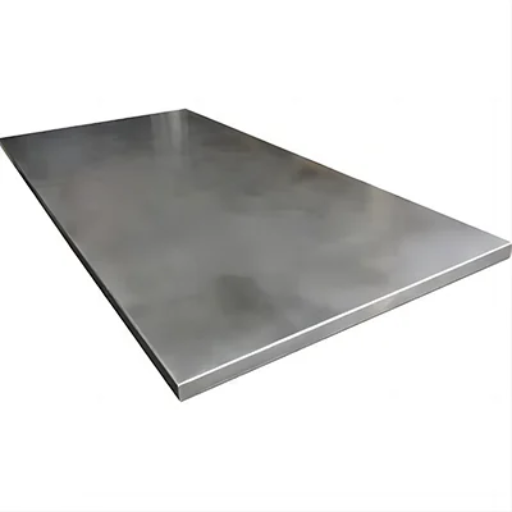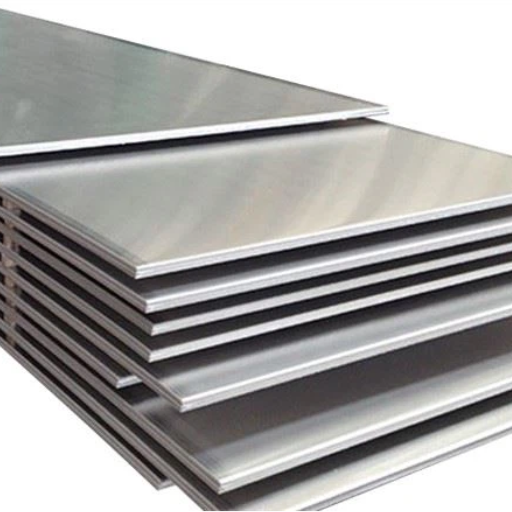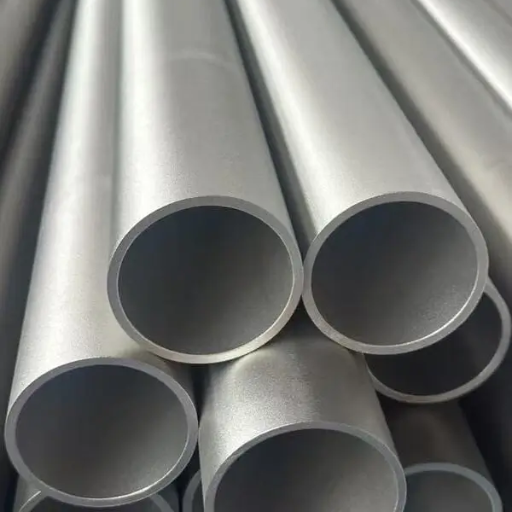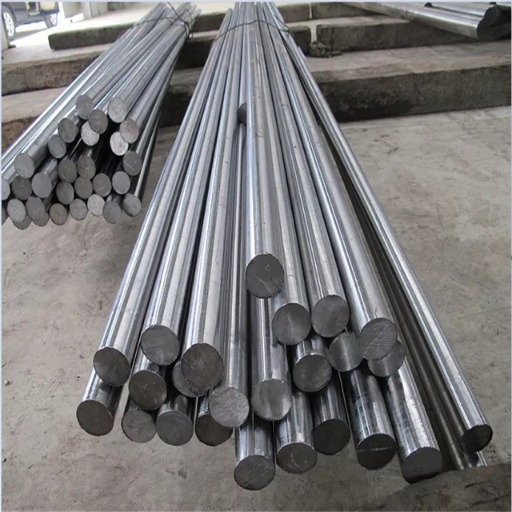
347 stainless steel is a niobium-stabilized austenitic grade, UNS S34700, covered by ASTM A312 for pipe, A213 for boiler and heat-exchanger tube, and A269 for general-service tube. It is specified for welded high-temperature service where 304 would sensitize. It is not a seawater alloy, and it is not a more corrosion-resistant 304.
Most buyers order 347 for the wrong reason. They see “stabilized” on a data sheet and read it as “better.” Then they pay a niobium premium and expect the pipe to survive a chloride line, a coastal cooling loop, or a seawater exchanger. It won’t. In chlorides, 347 behaves like 304 with an extra element.
The right reason is narrower. 347 keeps chromium in solution when a weld sits at temperature, and it resists polythionic acid cracking in refinery service. That is the purchase.
If your line stays below roughly 425 °C and sees no chlorides, 304 is cheaper and adequate. If it cycles through 425–815 °C, or holds there, the weld heat-affected zone in 304 is where the first leak starts. This guide covers the grade decisions, the pipe and tube specifications, and the goods-in checks that prove the niobium is actually there.
Key Takeaways
- 347 is 304 plus niobium. Niobium is specified at 10 × carbon minimum and capped at 1.00% in A312. Carbon is still allowed up to 0.08%, so 347 is not a low-carbon grade.
- The sensitization band is roughly 425–815 °C. Below it, 304 or 321 usually costs less and performs the same. Above roughly 870 °C, 310S takes over.
- 347 has roughly 304-level chloride resistance. PREN is about 18, with no molybdenum. It is not a seawater or high-chloride alloy.
- 347H is the creep grade. Carbon runs 0.04–0.10%, niobium 8 × carbon minimum, and grain size must be ASTM No. 7 or coarser. Room-temperature minimums do not change.
- The MTR must show the niobium-to-carbon ratio. A312 limits niobium; A213 limits niobium plus tantalum; a handheld XRF cannot verify carbon.
Specifying TP347 for a line? Send the line list with design pressure, design temperature, and the governing code. Our technical team will confirm the grade, wall, heat treatment, and test requirements, and reply within 24 hours. Request a line-list review.
What Is 347 Stainless Steel?
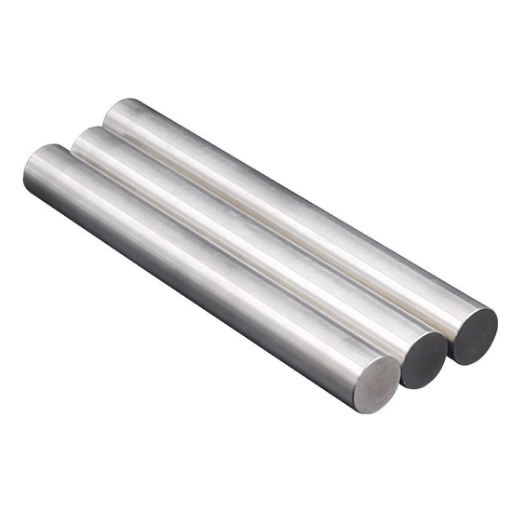
347 stainless steel is a niobium-stabilized austenitic stainless steel with about 18% chromium and 9–13% nickel. Niobium ties up carbon as stable niobium carbide, so chromium stays in solution and the weld heat-affected zone keeps its corrosion resistance after high-temperature exposure.
UNS S34700. EN 1.4550, X6CrNiNb18-10. JIS SUS347. The higher-carbon version is 347H, UNS S34709, EN 1.4912. The fine-grain A213 variant is TP347HFG, UNS S34710.
The grade is a member of the 18-8 family, not a separate alloy system. Take 304, add niobium at not less than ten times the carbon content, cap the niobium at 1.00%, and you have 347. The chromium and nickel ranges are close to 304. The molybdenum is absent. That last point decides most of the corrosion questions later.
The product forms matter. A312 covers seamless and welded pipe in NPS and schedule sizes. A213 covers minimum-wall boiler, superheater, and heat-exchanger tube, including 347H and 347HFG. A269 covers general-service tube, including instrument and hydraulic lines. Related product standards include A358 for electric-fusion-welded pipe, A249 for welded heat-exchanger tube, A240 for plate, A182 for forgings, and A403 for fittings.
Zhongzheng lists 347 and 347H among its austenitic grades for A312, A213, and A269 pipe and tube. Send the line list and we will confirm the size, schedule, finish, and test package.
For the titanium-stabilized alternative, the 321 stainless steel pipe guide covers the same high-temperature decision from the other side.
347 Stainless Steel Composition and Properties
The composition table is the one to keep. Read the niobium row first, then the carbon row, then check which standard governs the purchase order.
| Element, % | 347 (S34700) | 347H (S34709) | 347HFG (S34710) | 321 (S32100) | 304 (S30400) | 316L (S31603) |
|---|---|---|---|---|---|---|
| Carbon | 0.08 max | 0.04–0.10 | 0.06–0.10 | 0.08 max | 0.08 max | 0.035 max |
| Chromium | 17.0–19.0 | 17.0–19.0 | 17.0–19.0 | 17.0–19.0 | 18.0–20.0 | 16.0–18.0 |
| Nickel | 9.0–13.0 | 9.0–13.0 | 9.0–13.0 | 9.0–12.0 | 8.0–11.0 | 10.0–14.0 |
| Molybdenum | … | … | … | … | … | 2.00–3.00 |
| Titanium | … | … | … | 5×(C+N) min, 0.70 max | … | … |
| Niobium + tantalum | 10×C min, 1.00 max | 8×C min, 1.0 max | 8×C min, 1.10 max | … | … | … |
| Manganese | 2.00 max | 2.00 max | 2.00 max | 2.00 max | 2.00 max | 2.00 max |
| Silicon | 1.00 max | 1.00 max | 1.00 max | 1.00 max | 1.00 max | 1.00 max |
| Phosphorus | 0.045 max | 0.045 max | 0.045 max | 0.045 max | 0.045 max | 0.045 max |
| Sulfur | 0.030 max | 0.030 max | 0.030 max | 0.030 max | 0.030 max | 0.030 max |
Two rows carry the commercial risk. Carbon must stay at or below 0.08% for 347, and niobium must be at least ten times the carbon. A mill certificate that says “347” without a niobium value has not proven the grade.
There is a standards trap in the niobium row. A312-25 limits niobium only: 10×C minimum and 1.00% maximum for TP347, 8×C and 1.0% for TP347H. A213-25 limits niobium plus tantalum: 10×C to 1.10% for TP347, 8×C to 1.10% for TP347H and TP347HFG. If you compare a tube certificate against a pipe table, you can reject a conforming heat or accept a nonconforming one. Quote the standard on the purchase order, and check the certificate against that standard.
The mechanical table is simpler, and it contains one contrast worth noting.
| Property, specified minimum | 347 / 347H | 347HFG | 304 | 316L |
|---|---|---|---|---|
| Tensile strength | 515 MPa (75 ksi) | 550 MPa (80 ksi) | 515 MPa | 485 MPa |
| Yield strength, 0.2% offset | 205 MPa (30 ksi) | 240 MPa (35 ksi) | 205 MPa | 170 MPa |
| Elongation in 50 mm | 35% | 35% | 35% | 35% |
| Hardness, max | 192 HBW / 90 HRB | 192 HBW / 90 HRB | 90 HRB | 90 HRB |
The 321 grade has a heavy-wall exception in A312: above 9.5 mm nominal wall, the specified tensile and yield drop to 485 MPa and 170 MPa. That exception applies to TP321 and TP321H only. It does not apply to 347. A heavy-wall 347 pipe stays at 515 MPa / 205 MPa, so do not copy a 321 wall calculation into a 347 line.
A269 is different again. It has no tensile table. TP347 is accepted on hardness, 192 HBW / 200 HV or 90 HRB maximum, plus flaring, flange, and reverse-flattening tests. If someone sends an A269 certificate quoting 515 MPa tensile, the number may be true of the heat, but it is not the A269 acceptance basis. The distinction matters when the line is bought to A269 for general service and the buyer assumes an A312 mechanical package.
The physical properties are typical of the 18-8 family:
| Property | Value |
|---|---|
| Density | 7.96 g/cm³ |
| Mean coefficient of thermal expansion | 20.5 µm/m·°C (0–871 °C) |
| Thermal conductivity | 16.3 W/m·K at 100 °C |
| Modulus of elasticity | 193 GPa |
| PREN (Cr + 3.3Mo + 16N) | ~18 |
| Magnetic behavior | Non-magnetic annealed; slightly magnetic after cold work |
The PREN is the number to remember. With 18% chromium, no molybdenum, and no deliberate nitrogen, 347 sits at about 18. That is 304 territory, not 316L territory. It is the reason the grade loses in chlorides, and the reason a “stabilized” label should never be read as “seawater-ready.”
For pipe dimensions, A312 follows ASME B36.19M: NPS 1/8 through 30, schedules 5S, 10S, 40S, and 80S, with 40S matching schedule 40 up to NPS 10. Custom dimensions are available by agreement. The seamless stainless steel pipe range covers the construction side; the ASTM A312 pipe guide covers the standard.
Why Niobium Matters: Sensitization, Weld Decay, and Knife-Line Attack
The problem 347 solves starts at a grain boundary.
When unstabilized austenitic stainless steel is held or cooled through roughly 425–815 °C, carbon and chromium combine as chromium carbide at the grain boundaries. The carbide takes chromium out of the surrounding matrix. If the local chromium falls below the level needed to rebuild the passive film, the boundary becomes an easy path for corrosion. That is sensitization. In a weld, the damaged zone is the heat-affected band just outside the fusion line. The failure mode is weld decay.
Niobium changes the competition. Niobium has a stronger affinity for carbon than chromium does, so niobium carbide forms first and keeps chromium in solution. The steel still contains carbon, but the carbon is tied up. The weld HAZ retains its corrosion resistance without a post-weld anneal. That is the whole reason 347 exists.
It is not the same mechanism as 304L. Low-carbon grades reduce the amount of carbon available to form chromium carbide. Stabilized grades keep the carbon but sequester it. 304L is the cheaper answer when the wall is thin and the service is moderate. 347 is the answer when the carbon level or the thermal history makes low carbon insufficient, or when the fabrication cannot be solution annealed after welding.
The standard test is ASTM A262 Practice E, run on a sensitized specimen for stabilized grades. When the purchase order calls for it, the mill or fabricator must show that the heat passes. It is not a routine test on every order, but it is the test that proves the stabilization works after the thermal cycle the part will actually see.
Knife-line attack: more resistant, not immune
Knife-line attack is the narrow-band cousin of weld decay. Welding raises a thin zone next to the fusion line above roughly 1,200–1,250 °C. At that temperature, niobium carbide dissolves back into solution. If the same zone is later exposed to 450–850 °C, chromium carbide can precipitate at the grain boundaries faster than niobium carbide re-forms. The result is a narrow sensitized band that corrodes preferentially, often looking like a knife cut along the weld.
347 is more resistant to this than 321 because niobium carbide is more stable than titanium carbide. It is not immune. The niobium carbide still dissolves at the top of the welding thermal cycle, and a multi-pass weld or a stress relief in the carbide range can still set up the conditions. The remedy is a full solution anneal at 1,040 °C or above, followed by rapid cooling. A routine stress relief at 870 °C is not a substitute. It may relieve residual stress and still leave the knife-line band sensitized.
Scenario: the heavy weldment that cannot be annealed. A fabricator builds a 347 process vessel with thick-section nozzles and multi-pass welds. The shop cannot solution-anneal the finished vessel, so the specification relies on the stabilized grade to protect the as-welded HAZ. That is a valid use of 347, but only if the procedure controls heat input and the MTR shows the niobium ratio. If the same vessel is later stress-relieved at 870 °C and put into wet sulfur service, the knife-line band is the first place to inspect. The grade buys tolerance, not a waiver from welding procedure control.
347 vs 304 vs 321 vs 316L vs 347H
The grade decision is easier when you separate the four questions: temperature, chloride, creep, and weldability.
347 vs 304
347 is 304 with niobium. The chromium and nickel ranges overlap, the room-temperature minimums are the same, and the general corrosion resistance is close. The difference is what happens after the weld sees heat. 304 sensitizes in the 425–815 °C band; 347 does not, because the niobium ties up the carbon.
Below that band, 304 is the better buy. It costs less, welds easily, and is available in more sizes. The niobium premium is real: 347 typically runs 15–20% above 304 at vendor level. If the line stays at ambient or moderate temperature and sees no chlorides, the premium buys nothing.
347 vs 321
Both are stabilized. 321 uses titanium at 5×(C+N) minimum; 347 uses niobium at 10×C minimum. Titanium carbide is less stable at the top of the temperature range, and 321 is more susceptible to knife-line attack. 347 is the more robust choice for severe cycling, the top of the band, and refinery service where polythionic acid is a risk. 321 is usually cheaper, typically 10–15% below 347, and is adequate for the middle of the band: 425–815 °C, clean service, moderate cycling.
If the choice is close, ask two questions. Will the weld be repeatedly heated into the carbide range? If yes, 347. Is the service at the top of the range or in a refinery sulfur stream? If yes, 347. Otherwise, 321 or 304L is likely the better value.
347 vs 316L
316L adds 2–3% molybdenum. That raises the PREN to roughly 24–26 and changes the chloride performance. 347 has no molybdenum and a PREN near 18. In chloride pitting or chloride stress-corrosion service, 316L is the better alloy, and duplex or super duplex is better again. In high-temperature stabilized service, 347 is the better alloy. They are not substitutes.
This is the most common specification error in the family. A coastal cooling-water line, a seawater exchanger, or a chloride-bearing process stream is not a 347 application just because the temperature is elevated. If chlorides are present, start with 316L or duplex, then check the temperature limit of that grade. Do not start with 347 and assume stabilization covers chlorides.
347 vs 347H
347H is the higher-carbon version. Carbon runs 0.04–0.10% instead of 0.08% maximum, niobium is 8×C minimum instead of 10×C, and the grain size must be ASTM No. 7 or coarser in A312. The coarser grain structure improves creep and stress-rupture strength at high temperature.
The room-temperature minimums do not change. 347H is not stronger at 20 °C, and it is not a corrosion upgrade. It is the grade for superheater tubing, high-pressure steam pipe, and other components where the design is governed by creep above roughly 537 °C. If the design temperature is below that, 347 is usually sufficient and easier to weld.
347HFG: the fine-grain variant
TP347HFG is an A213 grade, not a synonym for 347H. It is cold-finished, solution-annealed at 1,175 °C, and controlled to a grain size of ASTM No. 7–10. The fine grain improves steam-side oxidation resistance in superheater tubing, as Nippon Steel’s TP347HFG product data describes for the power-generation market. Its specified tensile minimum is 550 MPa, higher than standard 347.
Use 347HFG only when the product form is A213 tube and the application is superheater service where steam oxidation matters. Do not order it as a generic “better 347” for pipe. It is a different product with a different heat treatment and a different grain-size requirement.
| Service condition | First choice | Why |
|---|---|---|
| Ambient to ~425 °C, no chlorides | 304 / 304L | Lowest cost, adequate corrosion resistance |
| 425–815 °C, moderate cycling, clean service | 321 | Titanium stabilization at lower cost |
| 425–900 °C, severe cycling, heavy weldments, refinery sulfur service | 347 | Niobium stabilization, better knife-line resistance |
| Above ~537 °C where creep governs | 347H | Higher carbon, coarser grain, creep/rupture strength |
| Superheater tube, steam-side oxidation | 347HFG | Fine grain, 1,175 °C solution anneal, A213 tube |
| Chlorides, seawater, pitting service | 316L or duplex | Molybdenum, higher PREN |
| Above ~870 °C in air | 310S or nickel alloy | Higher chromium/nickel oxidation resistance |
Scenario: the coastal cooling loop specified as 347. A project specifies 347 for a cooling-water line because the line is near a furnace and “stabilized sounds safer.” The water carries more than 100 ppm chloride at 60 °C. The 347 pipe meets A312 and passes hydrotest. Two years later, the pitting starts at the weld HAZ. The grade was never the problem; the chloride was. The correct specification was 316L or duplex, with the temperature checked against that grade’s limit. Stabilization protects against sensitization, not against chloride pitting.
The 304 vs 316 stainless steel comparison covers the molybdenum side of this decision. The stainless steel grade chart gives the cross-grade numbers if you need to compare more than these five.
347 Stainless Steel Temperature and Corrosion Limits
No ASTM standard sets a maximum service temperature for 347. A312, A213, and A269 control chemistry, mechanical properties, heat treatment, dimensions, and testing. They do not certify an oxidation ceiling. Any single “maximum temperature” is therefore a mill or industry recommendation, not a code limit.
The most useful published figure comes from TWI’s oxidation guidance: 871 °C for long-term exposure to air, reduced by 38 °C for steam service, which gives about 833 °C. Rolled alloys rate 347 as useful to 816 °C (1,500 °F). Some datasheets quote 925 °C for intermittent service. The spread is real, and it reflects the difference between continuous and cyclic exposure, dry and moist atmospheres, and the mechanical load on the part.
A practical statement is this: 347 is a long-term air-service grade to roughly 870 °C, a steam-service grade to roughly 830 °C, and a conservative design choice to 816 °C when the atmosphere or cycling is uncertain. Above that, 310S or a nickel alloy is the better starting point.
The corrosion limits are just as important as the temperature limit.
347 is a 304-level alloy in aqueous chlorides. It is susceptible to chloride stress-corrosion cracking above roughly 60 °C under tensile stress, and it is not recommended for seawater. The niobium stabilization does not change the pitting resistance, because pitting resistance is driven by chromium, molybdenum, and nitrogen. 347 has chromium and no molybdenum; its PREN is about 18. If the service is chloride pitting, 316L, duplex 2205, or super duplex 2507 is the correct family.
Where 347 does earn a corrosion advantage is polythionic acid stress-corrosion cracking. Refinery piping that sees sulfur-bearing streams and shutdown moisture can crack along sensitized grain boundaries. The stabilized chemistry is why 347 and 321 are specified there. Rolled Alloys also notes that 347 has slightly better corrosion resistance than 321 in strongly oxidizing environments. That is a narrow advantage, not a general license to use 347 in oxidizers.
| Environment | 347 verdict |
|---|---|
| Dry air, long-term, to ~870 °C | Good, with the 816 °C conservative design limit |
| Steam, long-term, to ~830 °C | Good; 347H for creep, 347HFG for superheater oxidation |
| Refinery sulfur streams, polythionic acid risk | Good; stabilized chemistry is the reason |
| Strongly oxidizing environments | Slightly better than 321; verify the specific chemistry |
| Chlorides above ~60 °C, pitting service | Not recommended; use 316L or duplex |
| Seawater | Not recommended |
| Strong reducing acids | Not the first choice; verify with corrosion data |
Welding and Heat Treatment
347 stainless steel welds well by all standard fusion processes. Use ER347 or E347 filler, which is the matching filler listed in A312 Table 6. No preheat is required. Keep heat input under control, especially on multi-pass work, and clean the joint properly. Post-weld heat treatment is not normally required; the stabilization is what allows the as-welded HAZ to keep its corrosion resistance.
The heat treatment that matters is the solution anneal. A312, A213, and A269 all require 1,040 °C minimum followed by water or rapid cooling. For 347H, A312 splits the temperature by finish: 1,100 °C for cold-finished pipe, 1,050 °C for hot-finished pipe. For 347HFG, A213 requires 1,175 °C and a cold-finished product, with a softening treatment at least 50 °C above the solution temperature before cold working.
A stabilization anneal is a different treatment. It is typically run at 870–900 °C for 2–4 hours, followed by air cooling. A312 Supplementary Requirement S6 and A213 S2 both set the stabilization temperature “as agreed” between purchaser and vendor; 870–900 °C is the conventional range, not a fixed standard value. A stabilization anneal does not undo knife-line attack. If the HAZ has already been sensitized by a high-temperature weld cycle, a full solution anneal is the remedy.
A213 Footnote H adds a caveat that belongs on the purchase order. Solution treating above 1,065 °C may impair resistance to intergranular corrosion after subsequent sensitizing exposure in the indicated grades. When the purchaser specifies it, a lower-temperature stabilization or re-solution anneal must follow the higher-temperature solution anneal. The clause exists because the standard knows the trade-off: a higher solution temperature can improve other properties while making the IGC resistance harder to guarantee.
Scenario: the stress relief that was not a solution anneal. A fabricator completes a 347 weld, then stress-relieves the assembly at 870 °C for two hours and records the heat treatment as “annealed.” The stress is relieved, but the knife-line band next to the fusion line is still sensitized. If the part goes into wet sulfur service, the inspection should focus on that band, not on the weld metal. The fix is a full solution anneal at 1,040 °C or above with rapid cooling, or a change to a fabrication sequence that avoids the high-temperature weld cycle. A stress relief is not a substitute.
The solution annealing heat treatment guide covers the furnace cycle in more detail. If the weld procedure is the open question, the seamless vs welded pipe comparison explains where the construction choice changes the heat-treatment risk.
How to Specify and Verify 347 Pipe and Tube
The purchase order is where most 347 stainless steel problems are prevented. Put these fields on it:
- Grade and UNS number: TP347 / S34700, TP347H / S34709, or TP347HFG / S34710.
- Product standard: A312 for pipe, A213 for boiler and heat-exchanger tube, A269 for general-service tube.
- Size and schedule: NPS and schedule for A312 pipe; OD and minimum wall for A213/A269 tube.
- Construction: seamless, welded, or heavily cold worked, as applicable.
- Heat treatment: solution anneal at the standard minimum; stabilization anneal only if specified, with the temperature and time.
- Testing: hydrostatic or nondestructive electric test; A262 Practice E if intergranular corrosion resistance must be demonstrated.
- Certification and marking: mill test report, heat number, grade, UNS, standard, size, schedule, heat-treatment lot.
Then check the MTR against the standard, not against a generic grade page.
For ASTM A312 TP347, carbon must be 0.08% or below and niobium must be at least 10×C, with a maximum of 1.00%. For TP347H, carbon must be 0.04–0.10% and niobium at least 8×C. For TP347 to A213, the requirement is niobium plus tantalum, 10×C to 1.10%; for TP347H and TP347HFG, 8×C to 1.10%. If the certificate reports only “Nb” and the standard requires “Nb + Ta,” ask for the tantalum value.
The carbon side of the ratio is the part a handheld XRF cannot verify. XRF can detect niobium and titanium, so it can separate 347 from 321 on a loading dock. It cannot measure carbon at the 0.08% level with the accuracy needed to prove the 10×C ratio. If the ratio is critical, order a laboratory combustion analysis for carbon and pair it with the certified niobium value. A PMI gun that shows niobium is a screening tool, not a grade certificate.
The same logic applies to 347 versus 347H. The two grades look identical on a PMI screen. The difference is carbon, and carbon is the one element the handheld gun cannot resolve. If the purchase order says 347H for creep service, the MTR must show carbon in the 0.04–0.10% range and the grain size must meet ASTM No. 7 or coarser. Do not accept a certificate that says “347/347H” without the carbon and grain-size values.
Common mistakes to avoid:
- Specifying 347 for a chloride line because “stabilized” sounds corrosion-resistant.
- Accepting a certificate that says “347” with no niobium value.
- Using 304 or 321 filler on a 347 joint without procedure qualification.
- Assuming 347H is stronger at room temperature. It is not; it is stronger in creep.
- Ordering 347 when 304L or 321 would meet the service at lower cost.
- Treating EN 1.4550 as 347H. 1.4550 is 347; 1.4912 is 347H.
- Applying the A312 heavy-wall strength reduction for 321 to a 347 pipe. The exception does not apply.
Ready to check a certificate? Send the MTR and the purchase order specification. We will compare the carbon, niobium, heat treatment, and test results against the governing standard and reply within 24 hours. Request an MTR review.
The quality control process at Zhongzheng describes the spectrographic, ultrasonic, and hydraulic checks behind the certificate.
Where 347 Stainless Steel Pipe and Tube Earn Their Place
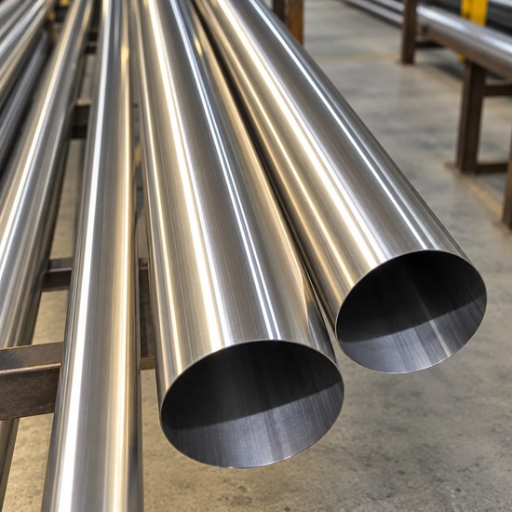
347 is a refinery and boiler grade first. Rolled Alloys lists oil refineries, fluid catalytic cracking units, hanger rods, recuperator tube sheets, fired heater tubes, distributor trays, thermowells, and reactor internals. Penn Stainless adds heat-exchanger tubes, high-pressure steam pipe, radiant superheaters, and boiler tubes. Those applications share the same logic: a welded component sees the carbide range, and a post-weld anneal is either impractical or insufficient.
The second cluster is thermal cycling. Aircraft exhaust stacks, manifolds, bellows, expansion joints, stack liners, and furnace fixtures use 347 for oxidation resistance plus a stabilized weld HAZ. The third is heavy weldments that cannot be solution-annealed after fabrication. That is the purest use of the grade: the specification is buying as-welded HAZ corrosion resistance, not a higher general corrosion rate.
The grade is not the default for food, dairy, or pharmaceutical tubing. 316L remains the hygienic choice because of its molybdenum content and its established finish routes. 347 is a high-temperature grade, not a sanitary upgrade.
Zhongzheng’s 347 and 347H pipe and tube are produced to A312, A213, and A269. The heat exchanger tube range is the natural home for 347HFG and 347H in boiler service; the seamless pipe range covers the A312 side.
FAQ
What is 347 stainless steel?
347 stainless steel is a niobium-stabilized austenitic grade, UNS S34700, with about 18% chromium and 9–13% nickel. Niobium ties up carbon as niobium carbide, which keeps chromium in solution and protects the weld heat-affected zone from sensitization. It is covered by ASTM A312 for pipe, A213 for boiler and heat-exchanger tube, and A269 for general-service tube.
Is 347 stainless steel better than 304?
Only where the weld sees the carbide range. 347 and 304 have similar room-temperature strength and general corrosion resistance, but 304 sensitizes after exposure to roughly 425–815 °C and 347 does not. Below that band, 304 is cheaper and adequate. Above it, 347 earns its niobium premium.
Is 347 stainless steel suitable for seawater?
No. 347 has no molybdenum and a PREN of about 18, which is 304-level chloride resistance. It is susceptible to chloride stress-corrosion cracking above roughly 60 °C and is not recommended for seawater or high-chloride pitting service. Use 316L, duplex 2205, or super duplex 2507 instead.
What is the difference between 347 and 347H?
347H has higher carbon, 0.04–0.10% instead of 0.08% maximum, and a niobium minimum of 8×C instead of 10×C. A312 also requires a grain size of ASTM No. 7 or coarser. The room-temperature minimums are the same; 347H buys creep and stress-rupture strength above roughly 537 °C.
Is 347 better than 321?
347 is more resistant to knife-line attack and holds up better at the top of the temperature range because niobium carbide is more stable than titanium carbide. 321 is usually cheaper and adequate for 425–815 °C service with moderate cycling. Choose 347 for severe cycling, heavy weldments, refinery sulfur service, or the top of the band.
What is the maximum temperature for 347 stainless steel?
No ASTM standard sets one. TWI gives 871 °C for long-term exposure to air and about 833 °C for steam. Rolled Alloys rates 347 useful to 816 °C. Some datasheets quote 925 °C intermittent. For design, use the lower end of the range and confirm the atmosphere, cycling, and load with the mill.
The Decision Is Narrower Than the Label
347 stainless steel is not a premium version of 304. It is a specific answer to a specific failure: chromium depletion in a weld that cannot avoid the carbide range. Buy it when the weld will sit in or cycle through 425–815 °C, when the fabrication cannot be solution-annealed, or when refinery sulfur service makes polythionic acid cracking a risk. Do not buy it for chlorides, for seawater, or for a line that 304L or 321 already handles.
The four decisions are simple. Temperature band: 304 below, 321 in the middle, 347 at the top. Chlorides: 316L or duplex, not 347. Creep: 347H above roughly 537 °C. Superheater steam oxidation: 347HFG, not generic 347. Then verify the certificate: carbon, niobium, the ratio the standard actually requires, heat treatment, and grain size where the H grade applies.
If you are specifying TP347 pipe or tube, send the line list with design pressure, design temperature, and the governing code. We will confirm the grade, wall, heat treatment, and test package, and reply within 24 hours. Send your line list.