
Stainless steel pipe pressure rating depends on four variables: pipe schedule (wall thickness), material grade, operating temperature, and quality factor (seamless vs welded construction). A Schedule 40S NPS 2″ 304 stainless steel pipe has a pressure rating of approximately 2,500 psi at room temperature. At 400°F, that same pipe derates to approximately 2,100 psi. If the pipe is ERW welded rather than seamless, the rating drops another 15% due to the quality factor. Engineers who look up pressure ratings without accounting for all four variables risk specifying a pipe that passes a hydrotest but fails in service.
In 2022, a petrochemical contractor in Texas designed a 400 psig nitrogen system using NPS 3″ Sch 40S stainless steel pipe. The engineer pulled the pressure rating from a generic online table that didn’t specify the grade or temperature. At 400°F operating temperature, the 304 pipe’s allowable stress had derated by 18%. During the hydrostatic test at 1.5 times design pressure, three joints leaked. The investigation revealed that Sch 40S was adequate at room temperature but marginally insufficient at 400°F. The replacement with Sch 80S cost $15,000 and delayed commissioning by ten days. Temperature derating is not a footnote. It is a design requirement.
This guide provides the complete stainless steel seamless pipe pressure rating data engineers need, plus the calculation methodology to verify those ratings against actual design conditions. You will learn how stainless steel pipe pressure rating is calculated, how temperature affects capacity, how to select the right schedule for your application, and how to verify that the pipe you receive matches your design assumptions.
Key Takeaways
- Stainless steel pipe pressure rating is determined by schedule, grade, temperature, and quality factor, not schedule alone.
- 304 and 316L have identical pressure ratings at room temperature, but 316L maintains higher allowable stress above 800°F.
- Welded ERW pipe carries a quality factor E = 0.85, reducing pressure capacity by 15% compared to seamless pipe.
- ASME B31.3 requires corrosion allowance to be added to calculated wall thickness before selecting a standard schedule.
- Always verify actual wall thickness and yield strength on the Mill Test Report against your design basis before installation.
How Stainless Steel Pipe Pressure Ratings Work

The Barlow Formula Foundation
All stainless steel pipe pressure rating tables are derived from the Barlow formula, the fundamental equation for thin-wall pressure vessel design. The simplified form is:
P = 2 × S × t × E / D
Where P is internal pressure, S is allowable stress, t is wall thickness, E is quality factor, and D is outside diameter. The complete ASME B31.3 formula adds a temperature coefficient and corrosion allowance term, but the Barlow relationship shows the core truth: pressure capacity is directly proportional to wall thickness and allowable stress, and inversely proportional to pipe diameter.
This is why a Schedule 40S NPS 1″ pipe can hold far more pressure than a Schedule 40S NPS 12″ pipe. The schedule designation implies the same nominal wall thickness ratio, but the actual wall thickness and the D/t ratio change dramatically with NPS. Engineers who assume “Sch 40S is good for 500 psi” without specifying NPS are making a dangerous generalization.
For the ASTM A312 stainless steel pipe material requirements that underpin these calculations, see our complete standard guide.
Allowable Stress from ASME B31.3
Allowable stress is the maximum stress permitted in a piping component under operating conditions. ASME B31.3 derives allowable stress from the material’s yield strength and tensile strength, applying safety factors that account for material variability, fabrication effects, and long-term performance.
For standard austenitic grades at room temperature, the allowable stress is approximately 20,000 psi. This value comes from the 30 ksi minimum yield strength specified in ASTM A312, divided by a safety factor of roughly 1.5. The exact value varies slightly by code edition and material specification, but 20,000 psi is the design basis most engineers use for 304 and 316L process piping.
Quality Factor (E)
The quality factor E accounts for the reduced structural integrity of welded construction compared to seamless. Under ASME B31.3:
- Seamless pipe: E = 1.0 (full rating)
- ERW welded pipe: E = 0.85 (15% reduction)
- Double-submerged arc welded: E = 0.95
This factor reflects the statistical probability of weld seam defects and the stress concentration at the weld line. For high-pressure service, seamless construction is the default specification. Welded pipe is acceptable for lower-pressure applications where the 15% reduction still provides adequate margin. For more on this distinction, see our seamless vs welded stainless steel pipe guide.
Temperature Derating
Allowable stress decreases as temperature increases. The mechanism is straightforward: higher temperatures reduce the material’s yield strength, so the stress that would be safe at room temperature may cause deformation or rupture at elevated temperature.
For 304 stainless steel, the allowable stress of 20,000 psi at 100°F drops to approximately 18,000 psi at 400°F, 16,000 psi at 800°F, and 14,000 psi at 1,000°F. For 316L, the decline is less severe: approximately 18,500 psi at 400°F, 17,500 psi at 800°F, and 16,000 psi at 1,000°F. This is the primary reason 316L is preferred for high-temperature service above 800°F.
Need help selecting the right schedule for your design pressure and temperature? Send us your operating conditions, design code, and corrosion allowance. Our technical team will calculate the required wall thickness and recommend the appropriate schedule within 24 hours.
Stainless Steel Pipe Pressure Rating Tables
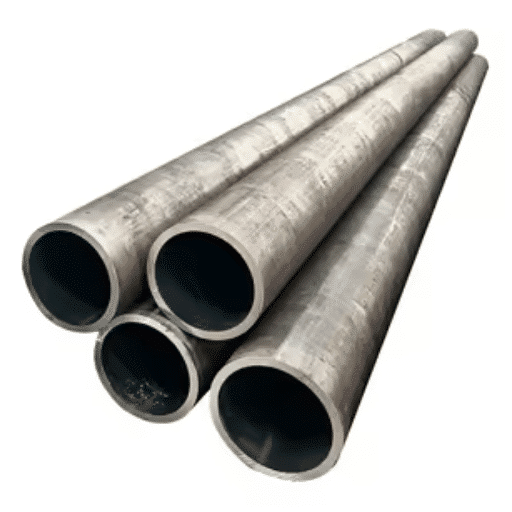
The following stainless steel pipe pressure chart shows approximate pressure ratings in psi for common schedules at room temperature (100°F) for seamless pipe (E = 1.0). Ratings are calculated using ASME B31.3 allowable stress values and B36.19M dimensions.
Schedule 5S and 10S (Light Wall)
| NPS | OD (in) | 5S Wall (in) | 5S Rating (psi) | 10S Wall (in) | 10S Rating (psi) |
|---|---|---|---|---|---|
| 1/2″ | 0.840 | 0.065 | 2,900 | 0.083 | 3,800 |
| 1″ | 1.315 | 0.065 | 1,900 | 0.109 | 3,200 |
| 2″ | 2.375 | 0.065 | 1,050 | 0.109 | 1,800 |
| 3″ | 3.500 | 0.083 | 900 | 0.120 | 1,300 |
| 4″ | 4.500 | 0.083 | 700 | 0.120 | 1,000 |
| 6″ | 6.625 | 0.109 | 630 | 0.134 | 770 |
| 8″ | 8.625 | 0.109 | 480 | 0.148 | 650 |
Schedule 40S (Standard Wall)
The stainless steel pipe schedule 40 pressure rating is the most commonly requested value in process piping design. The following table shows ratings for standard wall pipe:
| NPS | OD (in) | Wall (in) | Rating (psi) |
|---|---|---|---|
| 1/2″ | 0.840 | 0.109 | 5,000 |
| 1″ | 1.315 | 0.133 | 4,000 |
| 2″ | 2.375 | 0.154 | 2,500 |
| 3″ | 3.500 | 0.216 | 2,400 |
| 4″ | 4.500 | 0.237 | 2,000 |
| 6″ | 6.625 | 0.280 | 1,600 |
| 8″ | 8.625 | 0.322 | 1,450 |
| 10″ | 10.750 | 0.365 | 1,330 |
| 12″ | 12.750 | 0.375 | 1,150 |
Schedule 80S (Extra Strong)
| NPS | OD (in) | Wall (in) | Rating (psi) |
|---|---|---|---|
| 1/2″ | 0.840 | 0.147 | 6,800 |
| 1″ | 1.315 | 0.179 | 5,400 |
| 2″ | 2.375 | 0.218 | 3,600 |
| 3″ | 3.500 | 0.300 | 3,400 |
| 4″ | 4.500 | 0.337 | 2,900 |
| 6″ | 6.625 | 0.432 | 2,500 |
| 8″ | 8.625 | 0.500 | 2,300 |
Important: These ratings are approximate and based on seamless pipe at 100°F. Always verify against the current ASME B31.3 allowable stress table for your specific design temperature. For the dimensional data behind these tables, see our stainless steel pipe schedule guide.
304 vs 316L Pressure Ratings
Are They Different?
At room temperature, the 304 stainless steel pipe pressure rating and the 316L stainless steel pipe pressure rating are essentially identical. Both grades have the same minimum yield strength (30 ksi) and the same ASME B31.3 allowable stress (20,000 psi). If you are designing a system that operates below 300°F, the pressure rating difference between 304 and 316L is negligible.
The difference appears at elevated temperature. 316L’s molybdenum content stabilizes the austenitic structure against thermal degradation, allowing it to retain higher allowable stress at temperatures above 800°F. At 1,000°F, 316L maintains approximately 14% higher allowable stress than 304. For systems operating continuously above 800°F, this advantage may justify the grade upgrade on pressure capacity grounds alone.
Grade Selection by Temperature
| Temperature Range | Recommended Grade | Pressure Rating Consideration |
|---|---|---|
| Up to 300°F | 304 or 316L | Identical pressure capacity; choose by corrosion requirements |
| 300°F to 800°F | 304 or 316L | 316L offers modest advantage; corrosion resistance usually drives choice |
| 800°F to 1,000°F | 316L preferred | 316L maintains ~14% higher allowable stress |
| Above 1,000°F | 321 or 347 | Stabilized grades for high-temperature creep resistance |
For detailed 304 stainless steel seamless pipe specifications, see our grade-specific guide. For 316L seamless stainless steel pipe pressure and corrosion data, see the dedicated 316L article.
Schedule Selection Methodology for Stainless Steel Pipe Pressure Ratings
Step-by-Step Process
Selecting the correct schedule is a four-step calculation, not a table lookup:
- Determine design pressure and temperature for your stainless steel pipe pressure rating. Use the maximum anticipated operating pressure, not the normal operating pressure. Apply the design temperature, including upset conditions.
- Look up allowable stress (S) at design temperature from ASME B31.3 Table A-1. For 304 at 400°F, S = 18,000 psi. For 316L at 400°F, S = 18,500 psi. The ASME B31.3 pressure rating stainless steel tables are the authoritative source for these values.
- Calculate required wall thickness including corrosion allowance: t = (P × D) / (2 × S × E + 2 × y × P) + c, where y = 0.4 for austenitic steels below 900°F, and c is corrosion allowance (typically 1/16″ for process piping).
- Select the next-higher standard schedule from ASME B36.19M. If the calculation requires 0.200″ and Sch 40S provides 0.216″, Sch 40S is adequate. If the calculation requires 0.250″ and Sch 40S provides 0.216″, you must step up to Sch 80S. For a complete stainless steel pipe schedule dimensional reference, see our schedule guide.
Common Selection Mistakes
A food processing engineer in California calculated that NPS 2″ Sch 10S 304 pipe was adequate for her 150 psig CIP system. She forgot to add the 1/16″ corrosion allowance required by her company’s piping specification. With corrosion allowance, the required wall exceeded Sch 10S. The pipe was installed, passed hydrotest, and operated for eight months before a wall thickness inspection revealed thinning below minimum. The line had to be re-piped with Sch 40S during a planned shutdown. Corrosion allowance is not optional. It is part of the required wall.
Other common mistakes include using carbon steel schedule references (Schedule 40 without the “S” suffix references ASME B36.10M, not B36.19M), ignoring temperature derating, and designing to exact rating without safety margin. Good engineering practice maintains at least a 10% margin between operating pressure and rated pressure at design temperature.
Welded vs Seamless: Impact on Stainless Steel Pipe Pressure Rating

Quality Factor E in Practice
A water treatment plant in Australia procured NPS 6″ Sch 40S ERW 316L pipe for a 300 psig reverse osmosis system. The designer assumed all Sch 40S pipe had the same rating. During code review, the inspector applied the welded pipe quality factor E = 0.85. The effective pressure rating dropped from 420 psi to 357 psi, below the 300 psig operating pressure with required safety margin. The entire ERW order had to be rejected and replaced with seamless pipe.
The designer’s error was twofold: not specifying seamless construction when pressure margin was tight, and not applying the quality factor during initial schedule selection. For ASME B31.3 code-compliant design, seamless pipe is the default for high-pressure service. Welded pipe is acceptable where the 15% reduction still leaves adequate margin, or where the design code explicitly permits welded construction with the reduced quality factor.
When Welded Pipe Is Acceptable
Welded stainless steel pipe is acceptable for low to moderate pressure service where the E = 0.85 factor still provides adequate capacity. Many water treatment, HVAC, and low-pressure process applications operate well within the reduced welded pipe ratings. The key is calculating with the correct quality factor during schedule selection, not discovering the limitation during code review.
Hydrostatic Test Pressure vs Design Pressure
Test Pressure Formula
ASME B31.3 requires hydrostatic testing at 1.5 times the design pressure for most process piping systems. ASTM A312 specifies an alternative test pressure calculated at 60% of the specified minimum yield strength. The more conservative of the two values governs.
For a 304 pipe with 30 ksi yield strength, the ASTM A312 hydrotest pressure stresses the pipe to 18 ksi (60% of yield). The actual test pressure in psi depends on the pipe dimensions. What hydrostatic testing proves is pressure integrity at the test pressure. What it does not prove is that the pipe is free of internal defects or that the wall thickness is uniform throughout.
When Test Pressure Dictates Schedule
Some systems are limited by hydrotest capability rather than operating pressure. If your hydrotest pump can only achieve 750 psi, and 1.5 times design pressure requires 900 psi, you have a problem. In these cases, the schedule must be selected to ensure both operating pressure adequacy and hydrotest achievability. This consideration is particularly relevant for large-diameter, thin-wall pipe where the test pressure may approach the pipe’s rated capacity.
How to Verify Stainless Steel Pipe Pressure Rating at Receiving Inspection
Check the MTR
The Mill Test Report is your verification that the pipe you received matches your design basis. For pressure rating confirmation, verify three items:
- Yield strength must meet or exceed the design basis (30 ksi minimum for standard austenitic grades). Premium mills often deliver 35-40 ksi, which provides additional margin.
- Wall thickness must satisfy the minimum required by calculation. Remember that ASTM A312 permits wall thickness 12.5% below nominal, so measure actual wall, not nominal.
- Hydrotest pressure documentation must show the pipe was tested at or above the pressure required by your specification.
Field Verification
Before installation, use ultrasonic thickness measurement to confirm actual wall thickness at multiple points along each length. A single measurement at one end is insufficient; wall thickness varies along the pipe. Compare measured thickness against your calculated minimum required wall. If measured thickness is below calculated minimum, the pipe does not meet your design and must be rejected.
For critical applications, dimensional inspection should also verify OD tolerance, ovality, and straightness, all of which affect pressure capacity and fitting compatibility.
Ready to specify with confidence? Send Zhongzheng your design pressure, temperature, NPS, grade, and corrosion allowance. Our technical team will calculate the required wall thickness, confirm the appropriate schedule per ASME B36.19M, and return a complete quotation with dimensional data and weight estimates within 24 hours. Every order includes full Mill Test Reports with yield strength verification.
Conclusion
Stainless steel pipe pressure rating is not a single number you look up in a table. It is a calculated value that depends on schedule, grade, temperature, and quality factor. It is a calculated value that depends on schedule, grade, temperature, and quality factor. The Schedule 40S pipe that holds 2,500 psi at room temperature may only hold 1,800 psi at 800°F. The seamless pipe rated for 400 psi may fail at 340 psi if it is welded construction and the quality factor was ignored.
The correct approach is calculation discipline. Start with design pressure and temperature. Look up allowable stress for your grade at that temperature. Apply the quality factor for your construction type. Add corrosion allowance. Calculate required wall thickness. Select the next-higher standard schedule. Verify actual wall thickness and yield strength on the MTR. Measure wall thickness in the field before installation.
When you are ready to procure stainless steel seamless pipe to verified pressure ratings, send us your complete specification: design pressure, temperature, NPS, grade, schedule, and applicable design code. Our technical team will confirm schedule adequacy, verify material compliance, and return a complete quotation within 24 hours. For duplex and super duplex applications requiring higher pressure capacity, see our duplex stainless steel seamless pipe guide for PREN data and offshore pressure ratings.
Frequently Asked Questions
What is the stainless steel pipe pressure rating of schedule 40 304?
The pressure rating varies by NPS. At room temperature, NPS 2″ Sch 40S 304 seamless pipe is rated at approximately 2,500 psi. NPS 4″ Sch 40S is rated at approximately 2,000 psi. NPS 6″ Sch 40S is rated at approximately 1,600 psi. Always verify against ASME B31.3 for your specific design temperature, as ratings decrease with temperature.
Does 316L have a higher pressure rating than 304?
At room temperature, 304 and 316L have essentially identical pressure ratings because they share the same minimum yield strength. At temperatures above 800°F, 316L maintains a higher allowable stress and therefore a higher pressure rating. For most process piping applications below 300°F, corrosion resistance, not pressure capacity, should drive the grade selection.
How does temperature affect stainless steel pipe pressure rating?
Allowable stress decreases as temperature increases, which reduces pressure capacity. For 304, the allowable stress drops from 20,000 psi at 100°F to approximately 14,000 psi at 1,000°F, a 30% reduction. For 316L, the drop is less severe: from 20,000 psi to approximately 16,000 psi at 1,000°F. Always apply temperature derating factors from ASME B31.3 Table A-1.
What is the difference between design pressure and hydrotest pressure?
Design pressure is the maximum pressure the piping system is expected to experience during normal operation. Hydrotest pressure is the pressure applied during field or shop testing to verify integrity, typically 1.5 times design pressure per ASME B31.3. A pipe must withstand hydrotest pressure without leakage, but it is not designed to operate continuously at that pressure.
Can I use welded stainless steel pipe for high-pressure service?
Welded ERW pipe carries a quality factor E = 0.85 under ASME B31.3, meaning its pressure capacity is 15% lower than seamless pipe of the same schedule and grade. Welded pipe is acceptable for moderate pressure service where the reduced capacity still provides adequate margin. For high-pressure applications approaching the limits of a schedule, seamless construction is the conservative and code-preferred choice.
How do I calculate the required schedule for my application?
Use the ASME B31.3 thickness formula: t = (P × D) / (2 × S × E + 2 × y × P) + c. Determine your design pressure (P) and temperature, look up allowable stress (S) for your grade at that temperature, apply the quality factor (E) for seamless (1.0) or welded (0.85) construction, add corrosion allowance (c), then select the next-higher standard schedule from ASME B36.19M that provides the required wall thickness.
Reference Sources
- ASME B31.3, Process Piping Code, Allowable stress tables and pressure design basis
- ASME B36.19M, Stainless Steel Pipe, Dimensional standards and schedule wall thicknesses
- ASTM A312/A312M, Standard Specification for Austenitic Stainless Steel Pipes, Material yield strength and hydrotest requirements