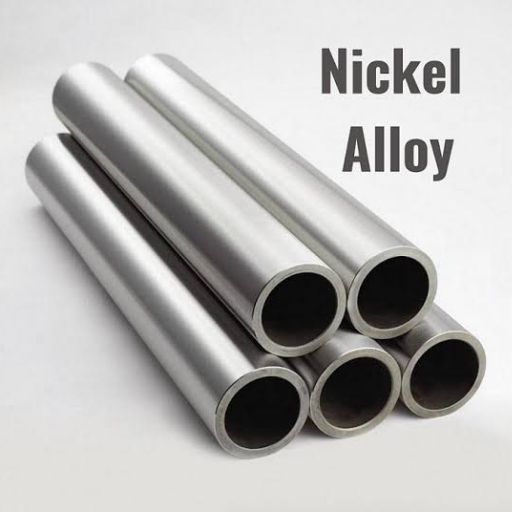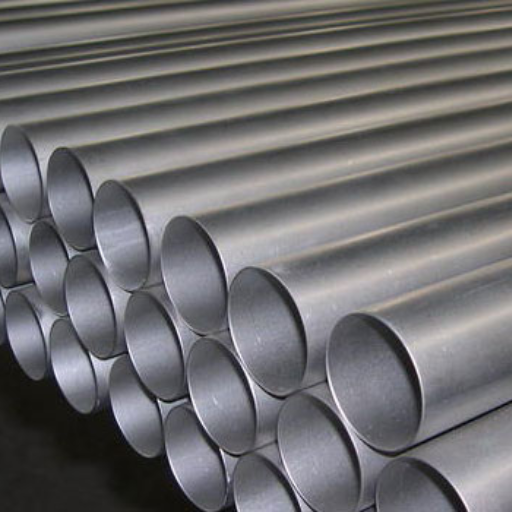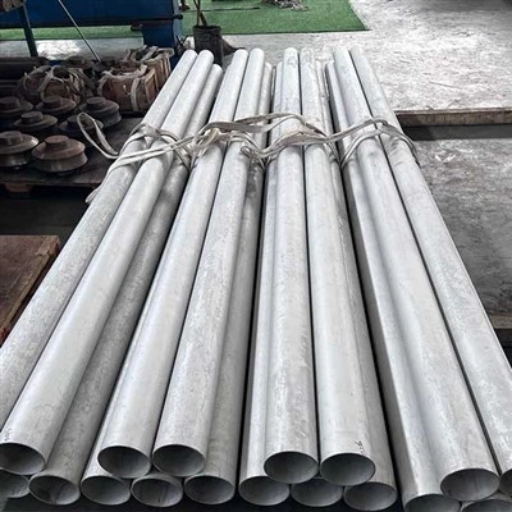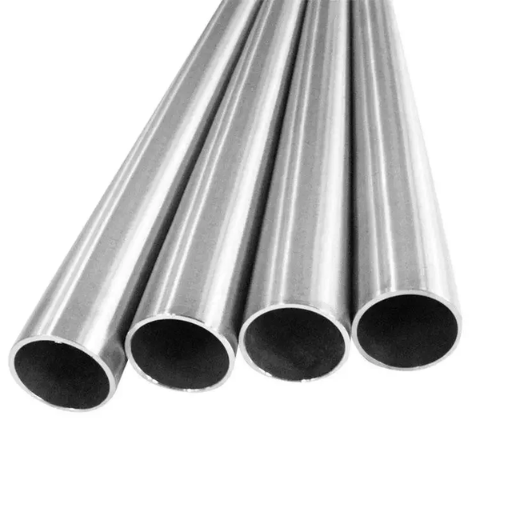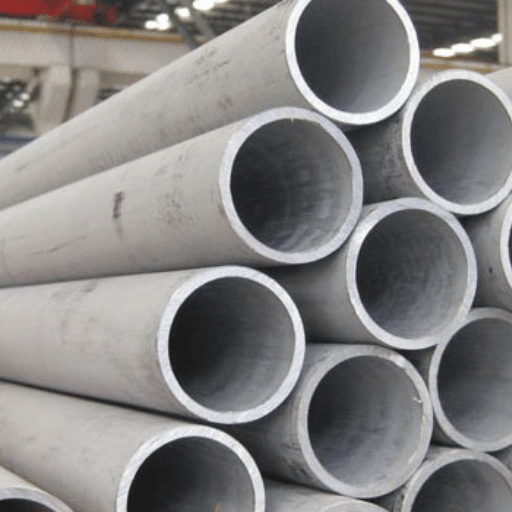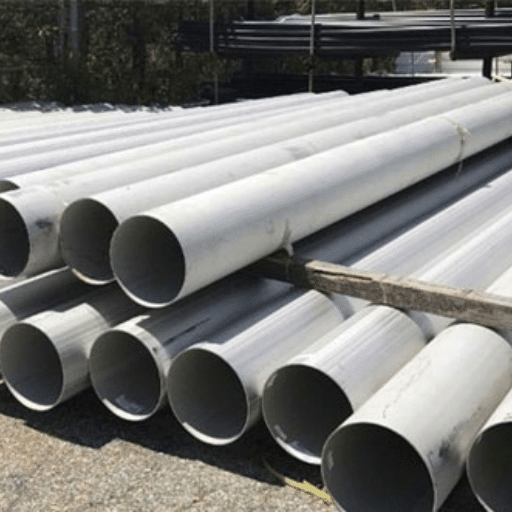
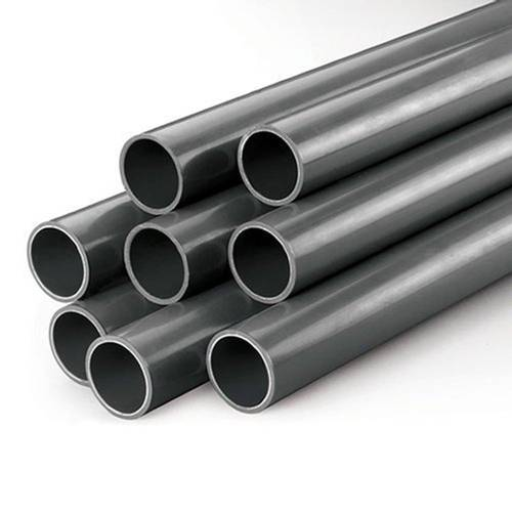
Nickel 200 pipe is a commercially pure wrought nickel (UNS N02200) seamless or welded pipe covered by ASTM B161, used above all for hot caustic soda and other alkali service where austenitic stainless steels crack. Nickel 201 (UNS N02201) is the same alloy with the carbon lowered from 0.15% to 0.02%, which is the only thing that lets it work above roughly 315 °C without embrittling.
That single number, the carbon content, decides more Nickel 200/201 projects than any other variable. Get it wrong in the high-temperature direction and the pipe graphitizes internally long before it visibly corrodes. Get the standard wrong and the correct pipe arrives with the wrong paperwork.
In 2019, a caustic evaporator at a chlor-alkali plant in Southeast Asia was being retubed for the third time in six years. The maintenance team had been replacing 316L heat-exchanger tube on a corrosion-rate argument that no longer held. When an outside corrosion engineer plotted the operating point against the Nickel Institute isocorrosion diagram, the conclusion flipped: the corrosion rate was low, but the 316L was failing on caustic stress corrosion cracking at the 118 °C evaporator outlet. They specified Nickel 200 for the lower stages and Nickel 201 for the final concentrator stage that ran at 360 °C. The retube frequency stopped.
This guide gives you the ASTM B161 limits, the 200-versus-201 decision and the 315 °C line, the form-to-standard map that most supplier pages get wrong, the caustic-service data, the honest limits, and the 2026 price bands. Every number here is one a corrosion engineer will check, so we have stated the source. If you are specifying pure nickel, this is the page to keep open next to your line list.
Key Takeaways
- Nickel 200 and 201 differ only in carbon (0.15% vs 0.02% max). Every other ASTM B161 limit is identical. That one number sets the temperature ceiling.
- Nickel 200 is limited to about 315 °C. Above that, carbon precipitates as graphite, the metal embrittles, and intergranular attack begins. Above ~300–315 °C, specify Nickel 201.
- The correct standard depends on the product form: seamless pipe and tube is ASTM B161, seamless heat-exchanger tube is B163, welded pipe is B725, welded tube is B730. B725 is shared with Monel 400.
- Nickel 200/201 are essentially immune to caustic stress corrosion cracking to ~290 °C and hold corrosion under 0.025 mm/y up to ~73% NaOH, which is why they exist in hot caustic service.
- They are not cheap. At ~99% nickel, the price tracks LME nickel almost 1:1. The case for Nickel 200 is technical (caustic immunity and thermal conductivity), not cost.
- XRF cannot distinguish 200 from 201. Only optical emission spectrometry (OES) reads carbon. Require an OES carbon value on the MTR.
What Is Nickel 200 Pipe?
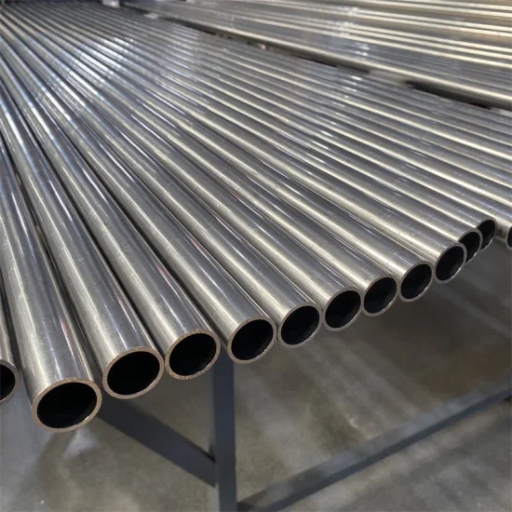
Nickel 200 pipe is pipe manufactured from commercially pure wrought nickel, specified as UNS N02200 (EN 2.4066, Ni 99.2). It contains a minimum of 99.0% nickel and is the least-alloyed pipe grade that still counts as a nickel alloy. Nickel 201 is the same material with a low carbon restriction, UNS N02201 (EN 2.4068).
Pure nickel sits at the base of the nickel-alloy family. Unlike the Inconel, Incoloy, Hastelloy and Monel grades, it contains no deliberate chromium, molybdenum or tungsten additions. Its corrosion resistance comes from nickel itself, which is why it excels against alkalis and reducing media but fails against oxidizing acids.
Do not confuse it with Monel 400. Monel 400 is a nickel-copper alloy (UNS N04400) built for seawater, hydrofluoric acid, and chloride service. Nickel 200 is pure nickel built for caustic and heat transfer. They are different metals for different duties; see Monel 400 pipe for seawater and HF service for that comparison. To see where pure nickel sits among all the families, read our complete nickel alloy pipe guide and our breakdown of comparing the nickel alloy families.
Nickel 200 vs Nickel 201: The Carbon Difference That Sets the Temperature Limit
The only intentional difference between Nickel 200 and Nickel 201 is carbon content. Nickel 200 permits up to 0.15% carbon; Nickel 201 permits up to 0.02%. Every other element limit in ASTM B161 is the same.
That difference exists for one reason: graphitization. In a high-carbon nickel exposed to elevated temperature, carbon migrates to the grain boundaries and precipitates as graphite. Once graphite forms along the boundaries, the material loses ductility and becomes prone to intergranular cracking. Elongation, normally around 45% for annealed Nickel 200, can collapse toward zero. The failure is latent, not gradual, which is what makes it dangerous.
Nickel 200 is therefore approved for service to about 315 °C (600 °F). Nickel 201, with its low carbon, is stable to roughly 600 °C and beyond in specific services, and some references cite stability in molten caustic to about 580 °C.
For caustic service, ASME’s practical rule is Nickel 201 above about 300–315 °C. That matters because chlor-alkali final concentrators routinely run at 350–400 °C. Those stages are Nickel 201 by default, and a fabricator who specifies 200 there has specified a pipe that will embrittle in service.
| Decision factor | Nickel 200 (N02200) | Nickel 201 (N02201) |
|---|---|---|
| Carbon, max | 0.15% | 0.02% |
| Max service temperature | ~315 °C (600 °F) | ~600 °C and above (by service) |
| Graphitization risk | Above ~315 °C | Negligible |
| Strength | Marginally higher | Marginally softer, better formability |
| Typical use | Caustic service to ~315 °C; heat transfer; electronics | Caustic and chlor-alkali above ~315 °C |
The one-line rule: at or below ~315 °C, Nickel 200 is correct and marginally stronger; above ~315 °C, Nickel 201 is mandatory.
Nickel 200 Chemical Composition and Properties
ASTM B161 sets the composition limits below. Note that the only figure that changes between the two grades is carbon.
| Element (wt%) | Nickel 200 (N02200) | Nickel 201 (N02201) |
|---|---|---|
| Ni | 99.0 min | 99.0 min |
| C | 0.15 max | 0.02 max |
| Cu | 0.25 max | 0.25 max |
| Fe | 0.40 max | 0.40 max |
| Mn | 0.35 max | 0.35 max |
| Si | 0.35 max | 0.35 max |
| S | 0.01 max | 0.01 max |
Three things matter in that table. The 99.0% nickel content drives both the corrosion behaviour and the cost. The carbon drives the temperature ceiling. The controlled residuals (Cu, Fe, Mn, Si, S) keep the metal fabricable and weldable. Some European datasheets quote tighter figures, such as carbon at 0.10% max and silicon at 0.10% max; always order against the edition your project cites rather than a single datasheet.
Mechanical properties for annealed material per ASTM B161 are modest by superalloy standards but perfectly adequate for the duties this grade carries.
| Property | Minimum (annealed) |
|---|---|
| Tensile strength | 462 MPa (67 ksi) |
| Yield strength (0.2% offset) | 148 MPa (21.5 ksi) |
| Elongation | 45% |
| Hardness (typical, annealed) | ~45–80 HB |
The physical properties are where Nickel 200 separates itself from every other pipe grade in this cluster. Density is 8.89 g/cm³, roughly 11% heavier than 316L at the same OD × Wall Thickness. That means a metre of Nickel 200 pipe weighs more than the stainless pipe it replaces, which affects support spacing, structural loads and freight. Our nickel alloy pipe weight chart carries the density and weight relationships; use it rather than scaling stainless figures.
The two headline physical values are thermal conductivity at approximately 70 W/m·K and high electrical conductivity (resistivity around 9.6 µΩ·cm). Nickel 200 is also ferromagnetic below a Curie temperature of about 360 °C, unique among the common corrosion-resistant pipe grades.
Nickel 200 equivalent grades
| System | Nickel 200 | Nickel 201 |
|---|---|---|
| UNS | N02200 | N02201 |
| EN / W.Nr. | 2.4066 (Ni 99.2) | 2.4068 |
| BS | NA11 | n/a |
| JIS | NW2200 | n/a |
| GOST | NP-2 | n/a |
ASTM B161, B163, B725 and B730: Which Standard for Which Form
This is the section that decides whether your order arrives with the right certificate. Pure nickel pipe and tube are covered by several ASTM standards, and the correct one depends entirely on the product form. Mapping the standard to the form incorrectly is the single most common and most consequential error on competitor pages.
| Product form | Standard |
|---|---|
| Seamless pipe and tube | ASTM B161 / ASME SB161 |
| Seamless condenser and heat-exchanger tube | ASTM B163 / ASME SB163 |
| Welded pipe | ASTM B725 / ASME SB725 |
| Welded tube | ASTM B730 / ASME SB730 |
| Electric-fusion-welded (EFW), large diameter | ASTM B474 / ASME SB474 |
| General requirements, seamless | ASTM B829 |
| General requirements, welded pipe | ASTM B775 |
| General requirements, welded tube | ASTM B751 |
Three traps live inside that table.
B163 is seamless, not welded. B163 covers seamless condenser and heat-exchanger tube. Listing it in a welded column, as some grade tables do, is wrong. If your product is welded tube, the correct standard is B730.
B622 does not cover pure nickel. ASTM B622 is a seamless pipe and tube standard for the nickel-molybdenum and nickel-chromium-molybdenum alloys such as C-276 and C-22. It does not apply to Nickel 200 or 201. A page that cites B622 for pure nickel is wrong on both the product form and the alloy.
B725 is shared with Monel 400. The welded pipe standard for Nickel 200/201 is the same one that covers Monel 400 (N04400). That is why our Monel 400 article and this one must agree on B725; they do.
For the full all-standards picture across every nickel alloy, including the standards that do not apply to pure nickel, see our nickel alloy pipe standards index.
Within ASTM B161, the material must pass chemical analysis, tensile testing, a hydrostatic test or an equivalent nondestructive electric test, and flattening and flare tests. General requirements are governed by B829 for seamless product. Dimensions for nickel-alloy pipe follow ASME B36.19; ASME B36.10 is the carbon and alloy steel dimensional standard and citing it for a nickel alloy is another common error.
Specifying a caustic line? Send us your caustic concentration, service temperature and required standard, and our technical team will confirm whether Nickel 200 or 201 is correct and respond within 24 hours.
Seamless vs Welded Nickel 200 Pipe
Seamless Nickel 200 pipe is produced from a pierced and rolled billet, so it has no weld seam and no weld-related inspection or corrosion liability along its length. Welded Nickel 200 pipe, made to ASTM B725, is formed from strip and longitudinally welded. Both are legitimate; the choice depends on pressure, temperature and inspection philosophy.
Seamless carries roughly a 20–40% cost premium over welded for comparable size, driven by the more demanding manufacturing route. Where the duty is high pressure, hot caustic at temperature, or where the weld seam would represent an inspection and corrosion liability, seamless is the correct answer. For lower-pressure service, general transfer lines and large diameters, welded pipe to B725 delivers the same alloy performance at a lower cost.
For large-diameter, lower-pressure service, electric-fusion-welded pipe to ASTM B474 extends the welded range beyond what B725 covers.
Corrosion Performance: Where Nickel 200 Wins and Where It Does Not
Caustic and alkali service: the flagship application
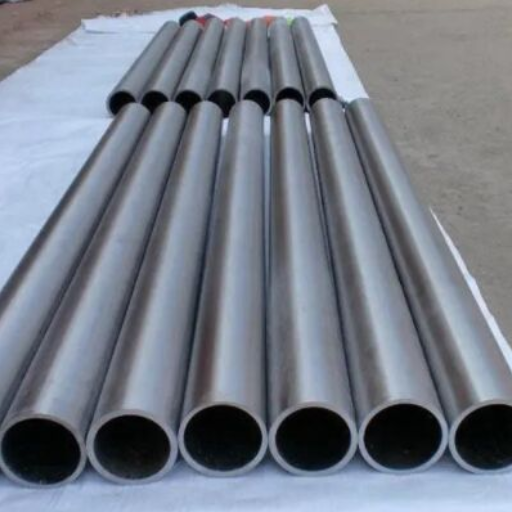
Nickel 200’s defining strength is hot caustic soda (NaOH) and other alkalis. In sodium hydroxide, Nickel 200 and 201 hold a corrosion rate below 0.025 mm/y (under 1 mpy) up to about 73% concentration. Below roughly 50% concentration, the rate is negligible, under 0.1 mpy, even in boiling solutions. Only above about 75% near the boiling point does the rate rise above 1 mpy. In molten caustic, nickel is second only to silver in resistance.
Potassium hydroxide (KOH) behaves similarly, and the same selection logic applies.
The industry-standard selection tool for caustic service is the Nickel Institute isocorrosion diagram for Nickel 200/201 in sodium hydroxide, which plots concentration against temperature with constant-corrosion-rate contours. We use it rather than a hand-drawn equivalent because it is the recognized reference. If you are specifying a caustic evaporator, concentrator, crystallizer, storage tank or transfer line, that diagram is where the specification should start.
The caustic SCC mechanism: why stainless fails here
If the corrosion rate on stainless is acceptable, why would you specify a far more expensive pure nickel? Because the failure mode is not general corrosion. It is stress corrosion cracking.
Austenitic stainless steels such as 304 and 316L are subject to caustic stress corrosion cracking above roughly 60 °C in concentrated NaOH. Cracks initiate and propagate in the caustic environment under stress, often with virtually no metal loss and no warning. Nickel 200 and 201 are essentially immune to caustic SCC to about 290 °C. That immunity, not the corrosion rate, is the engineering argument for the grade.
This is exactly the failure that the Southeast Asian plant above was chasing. The 316L corrosion rate looked fine on paper; the cracking did not. The same logic sits behind the general question of when to upgrade from stainless steel to nickel alloy: the upgrade is usually driven by a cracking mechanism, not by a number on an isocorrosion chart.
The honest limits: where Nickel 200 is the wrong answer
Nickel 200 is not a universal corrosion material, and any page that presents it as inert is misleading.
- Not for oxidizing media. Nickel does not form the protective passive film that chromium does. Nitric acid, concentrated sulfuric acid and oxidizing salt solutions attack it rapidly.
- Not above about 315 °C. That routes to Nickel 201.
- Lower strength than the superalloys. Nickel 200 is not a high-temperature structural material. Where strength at temperature is the driver, the answer is Inconel 625 or Incoloy 800H.
- Sulfur-bearing reducing environments at elevated temperature attack nickel, which is also why weld cleanliness matters.
- Price tracks LME nickel almost 1:1 because the alloy is about 99% nickel, so it carries the most nickel-price exposure of any grade in this family.
Thermal and Electrical Conductivity: The Heat-Transfer Grade
Nickel 200’s thermal conductivity of about 70 W/m·K is roughly four times that of 304 or 316L (about 16 W/m·K) and about seven times that of Inconel 625 (about 9.8 W/m·K). Duplex grades sit near 19 W/m·K. No other corrosion-resistant pipe grade in common use conducts heat this well.
That property is the reason Nickel 200 is specified for caustic evaporators, concentrators, and heat-exchanger tubes. In a caustic evaporator, the tube wall must both resist the caustic and move heat efficiently; stainless fails the first requirement above 60 °C, and the superalloys, while corrosion-resistant, conduct heat poorly. Nickel 200 satisfies both. This is a case where the material is chosen for a physical property, not only for corrosion resistance.
High electrical conductivity opens the electronics applications: battery electrodes, lead wires, sensors, and vacuum-tube and spark-plug components. The ferromagnetic nature of Nickel 200, unusual for a corrosion-resistant metal, matters both for electromagnetic applications and for field identification, since a magnet will tell you a Nickel 200 pipe from a stainless one on sight.
Welding Nickel 200 and Nickel 201 Pipe
Nickel 200 and 201 weld readily by conventional processes. GTAW (TIG) is the first choice; GMAW and SMAW are also used. Compared with the superalloys, nickel is more forgiving. It does not work-harden aggressively, and it does not demand the strict heat-input and interpass controls that Hastelloy C-276 requires.
The matching consumables are ERNi-1 for GTAW and GMAW, and ENi-1 for SMAW. Where the weld must match base-metal corrosion resistance, the matching filler is the correct choice.
The governing discipline is cleanliness. Nickel is sensitive to sulfur, lead and other low-melting-point contaminants, which embrittle the weld. Use dedicated stainless or nickel tooling, clean the work area, and keep nickel-grade consumables segregated. This is the same contamination discipline that applies across the nickel alloys.
Nickel 200 and 201 weld to each other freely, so a mixed fabrication with a Nickel 200 body and a Nickel 201 hot end is legitimate and common. Dissimilar joints between Nickel 200 and stainless or carbon steel are routine, but the galvanic couple and, critically, the stainless leg’s caustic-SCC susceptibility both need consideration. Keep parent-metal and filler certifications on the Mill Test Report.
Applications: Where Nickel 200 and 201 Pipe Is Specified
- Caustic soda and KOH evaporators, concentrators, crystallizers, storage and transfer lines
- Chlor-alkali plants, with Nickel 201 above about 315 °C
- Heat exchangers and condensers, on the thermal-conductivity argument
- Food and beverage process lines handling hot alkalis
- Electronics and batteries: electrodes, lead wires, sensors
- Synthetic fiber (viscose) production, marine and desalination equipment, aerospace and nuclear auxiliary piping
Our team recently worked through a 350 °C final caustic concentrator specification where the client had initially listed Nickel 200 throughout. At the front-end stages, at 210–260 °C, Nickel 200 was correct and marginally stronger. At the 350 °C concentrator outlet, Nickel 200 would have graphitized. The final line list used Nickel 200 for the low stages and Nickel 201 for the concentrator, one purchase order, one alloy family, correct at every temperature. Getting that split right is the whole value of understanding the carbon difference.
Nickel 200 vs Monel 400 vs 316L: Selection Table
| Factor | Nickel 200/201 | Monel 400 | 316L |
|---|---|---|---|
| Family | Commercially pure Ni | Ni-Cu alloy | Austenitic stainless |
| Key property | Caustic immunity, high conductivity | Seawater and HF resistance | General corrosion resistance |
| Caustic SCC | Immune to ~290 °C | Resistant | Fails above ~60 °C in concentrated NaOH |
| Thermal conductivity | ~70 W/m·K | ~21 W/m·K | ~16 W/m·K |
| Governing standard | B161 / B163 / B725 / B730 | B165 / B725 (welded pipe) | A312 / A213 |
| Choose when | Hot concentrated caustic; heat transfer | Seawater; hydrofluoric acid; chloride | General service below the caustic limit |
The verdict is straightforward. Stainless is out on caustic SCC above about 60 °C in concentrated NaOH regardless of corrosion rate. Monel 400 is the seawater and hydrofluoric-acid answer. Nickel 200/201 is the hot-concentrated-caustic and heat-transfer answer. If strength at temperature is the real driver rather than corrosion, step up to Inconel 625 pipe specifications.
Nickel 200 Pipe Price and Cost Drivers
Indicative 2026 pricing for Nickel 200 and 201 pipe sits in the 25–45 USD/kg band. Supplier listings have quoted 29.9–39.9 USD/kg FOB, and FAQ pages in the market cite 30–50 USD/kg. Treat all of these as indicative; nickel pricing moves and every quote should be validity-dated.
The honest cost story matters here, because the reflex is to assume the “least-alloyed” grade is the cheap one. It is not. Nickel 200 contains no expensive molybdenum or chromium additions, but it is about 99% nickel, and nickel is the costly element. Its price therefore tracks LME nickel almost one-to-one: roughly a 0.99 USD/kg shift for every 1,000 USD/t move in LME nickel.
Show the floor openly. At roughly 99% nickel and an indicative LME nickel of about 16–17 USD/kg, the raw-material floor is approximately 16–17 USD/kg. The 25–45 USD/kg band is therefore consistent with a 40–55% raw-material share, which is normal for a wrought nickel mill product.
There is also a distributor-versus-mill-direct spread. Buying a pure-nickel heat from a stocking distributor adds a margin layer and usually a size surcharge for non-standard OD, whereas a mill-direct order for a full length pattern is priced closer to the floor. The buying decision, though, is not financial. The case for Nickel 200 is technical: caustic immunity and thermal conductivity that no cheaper grade provides.
Quality, Documentation and Verification
Verification is where this grade pair is uniquely exposed. Nickel 200 and Nickel 201 differ only in carbon, and carbon is invisible to the most common field verification tool.
XRF cannot read carbon. A handheld X-ray fluorescence analyzer will read nickel, copper, iron and most other elements, but it cannot measure carbon. That means XRF cannot distinguish Nickel 200 from Nickel 201. The only practical method that resolves the carbon difference is optical emission spectrometry (OES). If a supplier cannot provide an OES carbon value, they cannot demonstrate which of the two grades they shipped.
For a caustic concentrator running at 350 °C, that is not a paperwork nicety; it is the difference between a sound pressure envelope and a latent embrittlement failure.
Every shipment should carry a Mill Test Report stating the heat number, the chemical analysis with a carbon value, the mechanical properties and the governing standard with its edition year. EN 10204 3.1 certification is standard; where a project requires third-party witness, 3.2 applies. Hydrostatic testing, eddy-current testing for tube, and ultrasonic testing for pipe all apply as specified. Heat-number traceability from raw material to the finished pipe, with the OES record on file, is what makes the 200-versus-201 distinction verifiable rather than asserted. For the broader supplier-qualification picture, see sourcing nickel alloy pipe from China.
Request a sample MTR and OES carbon reading for a Nickel 200 or 201 heat. We would rather you verify our material before you order than after.
Buying Nickel 200 or 201 Pipe: Specification Checklist
- Grade and UNS number, Nickel 200 (N02200) or Nickel 201 (N02201), stated explicitly
- Standard with edition year, B161 seamless, B163 heat-exchanger tube, B725 welded pipe, or B730 welded tube
- Form, seamless or welded, pipe or tube
- Dimensions, OD × Wall Thickness × Length, with schedule per ASME B36.19
- Quantity and length pattern, random lengths or fixed cut lengths
- Mechanical and physical requirements, confirm delivery condition (annealed, cold-worked, hot-finished)
- Test requirements, hydrostatic or electric test, flattening, flare, and the carbon analysis
- Documentation, MTR with carbon value, EN 10204 3.1 or 3.2, third-party witness if required
- Third-party inspection (TPI) arrangement, named agency and scope before the heat is cast
Frequently Asked Questions
What is Nickel 200 pipe used for?
Nickel 200 pipe is used mainly for hot caustic soda and alkali service, caustic evaporators and concentrators, heat exchangers and condensers, food and beverage process lines, and electrical and electronic components. It is chosen where austenitic stainless steels would crack on caustic stress corrosion cracking.
What is the difference between Nickel 200 and Nickel 201?
The only intentional difference is carbon: Nickel 200 permits 0.15% maximum and Nickel 201 permits 0.02% maximum. Every other ASTM B161 limit is identical. The lower carbon in Nickel 201 prevents graphitization and raises the usable service temperature from about 315 °C to roughly 600 °C.
What ASTM standard covers Nickel 200 pipe?
It depends on the form. Seamless pipe and tube is ASTM B161; seamless heat-exchanger tube is ASTM B163; welded pipe is ASTM B725; welded tube is ASTM B730. Large-diameter electric-fusion-welded pipe is ASTM B474.
What is the chemical composition of Nickel 200?
Per ASTM B161, Nickel 200 is 99.0% nickel minimum with carbon 0.15% max, copper 0.25% max, iron 0.40% max, manganese 0.35% max, silicon 0.35% max and sulfur 0.01% max. Nickel 201 is identical except carbon is limited to 0.02%.
What is the maximum service temperature for Nickel 200 pipe?
About 315 °C (600 °F). Above that temperature, carbon precipitates as graphite at the grain boundaries, the material embrittles and intergranular attack becomes likely. For service above 315 °C, specify Nickel 201.
Why is Nickel 201 used above 315 °C?
Because its carbon content of 0.02% maximum is too low to form grain-boundary graphite, so it does not embrittle. Nickel 201 remains stable to roughly 600 °C and higher, which is why chlor-alkali final concentrators running at 350–400 °C are Nickel 201 by default.
Is Nickel 200 pipe resistant to caustic soda?
Yes. Nickel 200 and 201 hold corrosion below 0.025 mm/y up to about 73% NaOH and are essentially immune to caustic stress corrosion cracking to about 290 °C. In molten caustic, nickel is second only to silver.
Is Nickel 200 magnetic?
Yes. Nickel 200 is ferromagnetic below a Curie temperature of about 360 °C, which is unusual for a corrosion-resistant material and makes a magnet a useful field check.
Is Nickel 200 suitable for seawater?
No. Seawater contains chlorides that cause pitting and crevice attack on pure nickel. Monel 400 or a super duplex grade is the correct choice for seawater service.
Is Nickel 200 pipe the same as Monel 400?
No. Nickel 200 is commercially pure nickel (UNS N02200). Monel 400 is a nickel-copper alloy (UNS N04400). They share the welded pipe standard B725 but are different alloys for different duties.
Conclusion and Next Step
Nickel 200 and 201 pipe are the caustic and heat-transfer specialists of the nickel-alloy family. Remember five things. The two grades differ only in carbon, 0.15% versus 0.02%. The 315 °C line is decisive because of graphitization, not general corrosion. The correct standard depends on the product form: B161, B163, B725 or B730. Caustic SCC immunity to about 290 °C is the real engineering argument. And XRF cannot read carbon, so only an OES reading proves which grade you received.
Nickel 200 is not the cheap nickel alloy. At 99% nickel, it tracks the LME nickel price, and its value is technical. Specified correctly, it ends the retube cycle on a caustic evaporator that stainless keeps failing.
Send us your line list, with caustic concentration, service temperature and required standard, and our technical team will confirm whether Nickel 200 or Nickel 201 is correct and quote the schedule, finish and documentation. We respond within 24 hours, and we welcome a request for a sample MTR with the OES carbon value before you commit.