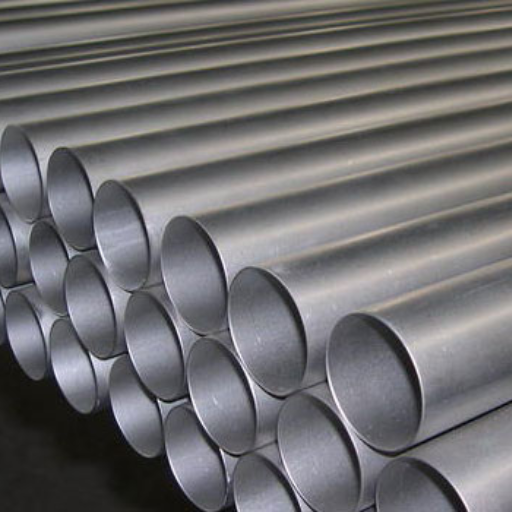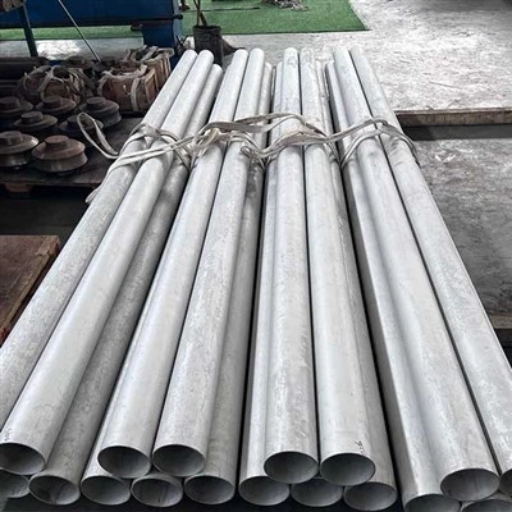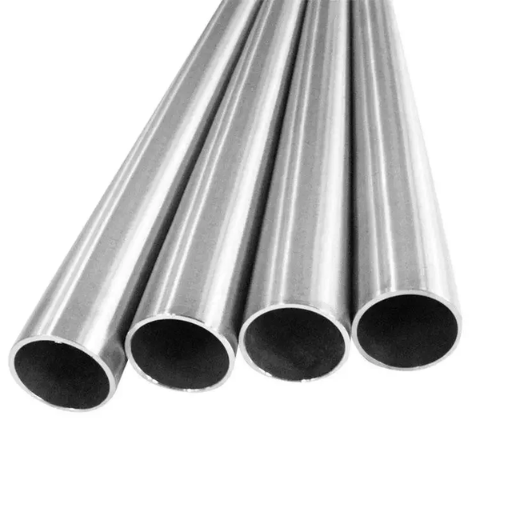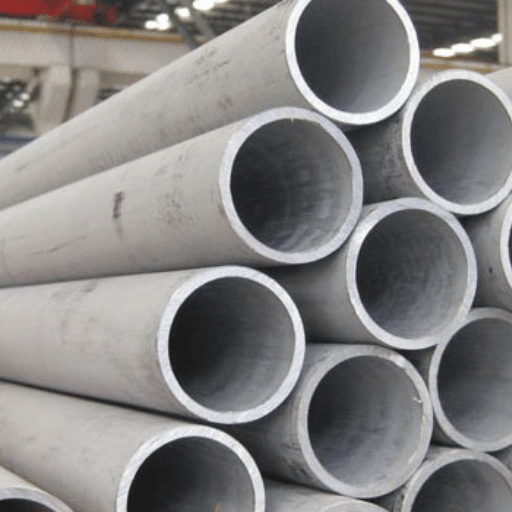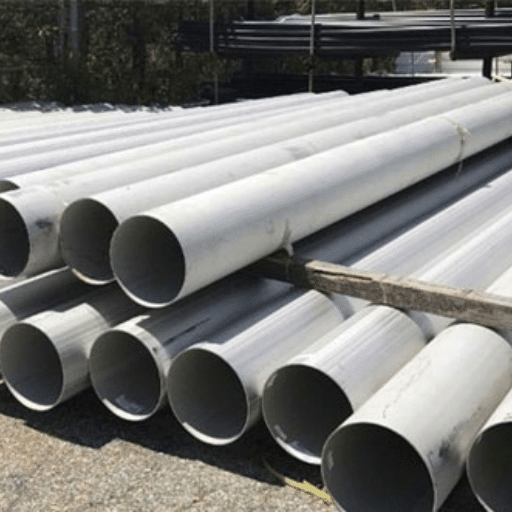
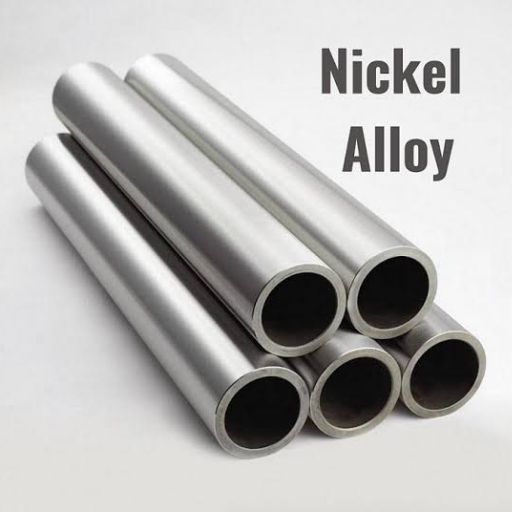
A nickel alloy pipe weighs more than the same-size stainless pipe, because the alloy is denser. Inconel 625 at NPS 6″ Sch 40S (OD 168.3 mm × wall 7.11 mm) weighs 30.4 kg/m; the identical size in 316L weighs 28.7 kg/m. This chart gives nickel alloy pipe weight in kg/m and lb/ft by grade, schedule and size, plus the weight factor that lets you calculate any alloy listed below.
If you looked up that 6-inch pipe on a standard ASME B36.19 weight table, the number probably came back light. Around 11% light for a Monel 400 line, because the table was computed at a steel density, not a nickel alloy one. That silent error compounds across freight, lifting and support loads.
You need a number you can defend. This reference gives you the alloy-specific weight factor for every common grade, the formula that turns it into a weight for any OD × wall thickness, and the charts in both unit systems. By the end you can weight a pipe that appears in no published table, and you’ll know why the table you already have is wrong.
This is a data reference inside our wider nickel alloy pipe guide. The schedule system is explained elsewhere; the grade decision and the standards index are linked, not repeated.
Key Takeaways
- Nickel alloy pipe weight is (OD − t) × t × C, where C is the alloy’s weight factor, C = π × ρ ÷ 1000.
- Density drives everything: Incoloy 825 is 8.14 g/cm³, Inconel 625 is 8.44, Monel 400 is 8.80, and Nickel 200 and Hastelloy C-276 are 8.89.
- Published B36.19 kg/m tables are steel-basis and understate nickel alloy weight by 3–13%, worst for Monel 400, Nickel 200/201 and C-276.
- The same pipe in a different alloy changes weight only by the density ratio; OD and wall thickness are fixed by the standard.
- One factor replaces the lookup table: multiply (OD − t) × t × C for the weight of any size in that grade.
How to Calculate Nickel Alloy Pipe Weight
The weight of a nickel alloy pipe per metre is W (kg/m) = (OD − t) × t × C, where OD is outside diameter in mm, t is wall thickness in mm, and C is the grade’s weight factor, equal to π × ρ ÷ 1000 (ρ = density in g/cm³). No approximation is involved: this is the exact area of the circular metal annulus, times density.
That line is the most useful thing on this page, because it works for any size in any listed grade. You don’t need a chart for a one-off size, you need one factor and a multiplication. It turns the chart into a nickel alloy pipe weight calculator you can run by hand.
It is also auditable. The cross-section of a round pipe is a circular annulus: outer circle minus inner circle. That area equals π × t × (OD − t).
Multiply by density and convert units, and π·ρ/1000 falls out as C. Every pipe-weight table ever printed is this formula with a particular C baked in.
Worked example, Inconel 625, NPS 6″ Sch 40S (OD 168.3 mm, wall 7.11 mm, C = 0.02652):
- W = (168.3 − 7.11) × 7.11 × 0.02652 = 30.4 kg/m
- Per 6 m length: 182 kg
- The same OD × wall in 304 stainless (C = 0.02491) is 28.5 kg/m, so Inconel 625 is about 6.6% heavier for an identical piece of pipe.
Worked example, Nickel 200, NPS 2″ Sch 40S (OD 60.3 mm, wall 3.91 mm, C = 0.02793): W = (60.3 − 3.91) × 3.91 × 0.02793 = 6.16 kg/m.
Worked example, Incoloy 825, NPS 4″ Sch 10S (OD 114.3 mm, wall 3.05 mm, C = 0.02557): W = (114.3 − 3.05) × 3.05 × 0.02557 = 8.68 kg/m.
For a US buyer working in imperial, the same structure holds: W (lb/ft) = (OD − t) × t × F, with OD and t in inches. The simpler route is to take the kg/m figure and multiply by 0.67197; the reverse is × 1.48816.
One caveat before the charts: these are theoretical weights, calculated from nominal OD and nominal wall. A delivered pipe is weighed, not calculated. The theoretical vs. actual discussion below explains when that gap matters.
Nickel Alloy Density and Weight Factor by Grade
Density is the only alloy-specific input to a pipe weight. The table below lists the density and resulting weight factor C for every common nickel alloy pipe grade, computed as C = π × ρ ÷ 1000. Because the factor comes from the density, you can reproduce every value yourself, which is exactly the point.
Basis: theoretical weight at room temperature (20 °C), on the densities listed, from published alloy datasheets.
| Alloy (trade) | UNS | Family | Density ρ (g/cm³) | Weight factor C (kg/m) |
|---|---|---|---|---|
| Nickel 200 | N02200 | Ni | 8.89 | 0.02793 |
| Nickel 201 | N02201 | Ni | 8.89 | 0.02793 |
| Monel 400 | N04400 | Ni-Cu | 8.80 | 0.02765 |
| Monel K500 | N05500 | Ni-Cu-Al | 8.44 | 0.02652 |
| Inconel 600 | N06600 | Ni-Cr | 8.47 | 0.02661 |
| Inconel 601 | N06601 | Ni-Cr | 8.06 | 0.02532 |
| Inconel 617 | N06617 | Ni-Cr-Co-Mo | 8.36 | 0.02626 |
| Inconel 625 | N06625 | Ni-Cr-Mo-Nb | 8.44 | 0.02652 |
| Inconel 690 | N06690 | Ni-Cr | 8.19 | 0.02573 |
| Inconel 718 | N07718 | Ni-Cr-Fe-Nb | 8.19 | 0.02573 |
| Incoloy 800 / 800H | N08800 / N08810 | Ni-Fe-Cr | 7.94 | 0.02494 |
| Incoloy 825 | N08825 | Ni-Fe-Cr | 8.14 | 0.02557 |
| Hastelloy C-276 | N10276 | Ni-Mo-Cr | 8.89 | 0.02793 |
| Hastelloy C-22 | N06022 | Ni-Cr-Mo | 8.69 | 0.02730 |
| Alloy 20 | N08020 | Ni-Fe-Cr | 8.08 | 0.02538 |
| Reference, 304/304L | S30400 / S30403 | Austenitic SS | 7.93 | 0.02491 |
| Reference, 316/316L | S31600 / S31603 | Austenitic SS | 7.98 | 0.02506 |
These factors cross-check against published industrial values to five significant figures. RathGibson and Alphasteel technical tables list 0.02792 for Nickel 200, 0.02765 for Monel 400, 0.02652 for Inconel 625 and 0.02557 for Incoloy 825, the same convention, C = π·ρ/1000. The densities above also match the Nickel Institute physical-property references. We present this as an industry cross-check, not as the source of our values.
Two things stand out. The spread inside “nickel alloy” is wide: Incoloy 800 is 7.94 g/cm³ and Nickel 200 / C-276 is 8.89, a swing of about 12%. That in-family spread is larger than the step from 316L to many nickel grades, so alloy choice is a weight decision as well as a corrosion decision.
The family choice is covered in Inconel vs Monel vs Hastelloy vs Incoloy. For a single grade’s corrosion story, see Inconel 625 pipe to ASTM B444 and Monel 400 pipe for seawater service.
Need the recomputed weight sheet for a specific heat, on the density we actually certify? Send us the grade and size, our technical team supplies the factor and the MTR basis. Request it here
Nickel Alloy Pipe Weight Chart (kg/m)
The chart below gives per-metre weight for Inconel 625 (C = 0.02652), the highest-demand nickel grade, at ASME B36.19 dimensions from NPS 1/8″ to NPS 12″. Every value is computed as (OD − t) × t × 0.02652. Only the wall thickness changes between schedules; the OD is fixed for a given NPS.
Basis: theoretical weight, kg/m, Inconel 625 (UNS N06625), ρ = 8.44 g/cm³, room temperature.
| NPS | OD (mm) | Sch 5S | Sch 10S | Sch 40S | Sch 80S |
|---|---|---|---|---|---|
| 1/8 | 10.30 | n/a | 0.30 | 0.39 | 0.50 |
| 1/4 | 13.70 | n/a | 0.53 | 0.68 | 0.86 |
| 3/8 | 17.10 | n/a | 0.68 | 0.91 | 1.18 |
| 1/2 | 21.30 | 0.86 | 1.07 | 1.36 | 1.74 |
| 3/4 | 26.70 | 1.10 | 1.38 | 1.81 | 2.36 |
| 1 | 33.40 | 1.39 | 2.25 | 2.69 | 3.48 |
| 1 1/4 | 42.20 | 1.77 | 2.90 | 3.65 | 4.80 |
| 1 1/2 | 48.30 | 2.04 | 3.34 | 4.35 | 5.82 |
| 2 | 60.30 | 2.57 | 4.23 | 5.85 | 8.04 |
| 2 1/2 | 73.00 | 3.97 | 5.66 | 9.28 | 12.27 |
| 3 | 88.90 | 4.86 | 6.94 | 12.14 | 16.42 |
| 4 | 114.30 | 6.28 | 9.00 | 17.28 | 24.00 |
| 5 | 141.30 | 10.17 | 12.43 | 23.40 | 33.30 |
| 6 | 168.30 | 12.16 | 14.87 | 30.39 | 45.76 |
| 8 | 219.10 | 15.89 | 21.47 | 45.75 | 69.50 |
| 10 | 273.10 | 24.31 | 29.88 | 64.85 | 87.69 |
| 12 | 323.90 | 33.59 | 38.69 | 79.44 | 104.79 |
The short table below puts Sch 40S weight side by side for four grades, so the density effect is visible at one size, no formula required.
Basis: theoretical weight, kg/m, Sch 40S, room temperature.
| NPS | 316L (7.98) | Inconel 625 (8.44) | Monel 400 (8.80) | Nickel 200 / C-276 (8.89) |
|---|---|---|---|---|
| 1/2 | 1.29 | 1.36 | 1.42 | 1.43 |
| 1 | 2.54 | 2.69 | 2.81 | 2.83 |
| 2 | 5.53 | 5.85 | 6.10 | 6.16 |
| 4 | 16.34 | 17.28 | 18.02 | 18.21 |
| 6 | 28.73 | 30.39 | 31.68 | 32.01 |
The pattern is the whole insight: weight scales linearly with density, and nothing else. Same OD, same wall, only the alloy changes the number.
Can’t find your size in the chart? Send us the grade, OD × wall thickness and length, or just the size you calculated, and our technical team confirms availability and a documented weight within 24 hours. Request a quote
Nickel Alloy Pipe Weight Chart (lb/ft)
For US and Gulf buyers working in imperial units, the chart below gives the same Inconel 625 weights in lb/ft. One conversion bridges the two: 1 kg/m = 0.67197 lb/ft, so the metric figure multiplied by 0.67197 gives the number below.
Basis: theoretical weight, lb/ft, Inconel 625 (UNS N06625), ρ = 8.44 g/cm³, room temperature.
| NPS | OD (in) | Sch 10S | Sch 40S | Sch 80S | kg per 6 m (Sch 40S) |
|---|---|---|---|---|---|
| 1/8 | 0.405 | 0.20 | 0.26 | 0.34 | 2.4 |
| 1/4 | 0.540 | 0.35 | 0.46 | 0.57 | 4.1 |
| 3/8 | 0.675 | 0.45 | 0.61 | 0.79 | 5.5 |
| 1/2 | 0.840 | 0.72 | 0.91 | 1.17 | 8.2 |
| 3/4 | 1.050 | 0.92 | 1.22 | 1.59 | 10.9 |
| 1 | 1.315 | 1.51 | 1.81 | 2.34 | 16.1 |
| 1 1/4 | 1.660 | 1.95 | 2.45 | 3.23 | 21.9 |
| 1 1/2 | 1.900 | 2.25 | 2.93 | 3.91 | 26.1 |
| 2 | 2.375 | 2.84 | 3.93 | 5.41 | 35.1 |
| 2 1/2 | 2.875 | 3.80 | 6.24 | 8.24 | 55.7 |
| 3 | 3.500 | 4.67 | 8.16 | 11.04 | 72.8 |
| 4 | 4.500 | 6.05 | 11.61 | 16.13 | 103.7 |
| 5 | 5.563 | 8.35 | 15.73 | 22.37 | 140.4 |
| 6 | 6.625 | 9.99 | 20.42 | 30.75 | 182.3 |
| 8 | 8.625 | 14.43 | 30.74 | 46.70 | 274.5 |
| 10 | 10.750 | 20.08 | 43.58 | 58.92 | 389.1 |
| 12 | 12.750 | 26.00 | 53.38 | 70.42 | 476.6 |
The last column gives the weight of a 6 m length at Sch 40S, the length most common in Asia. Note the assumption: a “6 m” length is a nominal cut, not a guaranteed 6.000 m. Many international buyers work in 20 ft (6.096 m) or 40 ft lengths instead, so the per-metre figure is the primary unit; adapt it to your own length.
Why Nickel Alloy Pipe Weighs More Than Stainless Steel
For a given NPS, the OD is fixed by the dimensional standard and the wall thickness is fixed by the schedule. Neither changes with the alloy, so density is the only variable, and nickel alloys are denser than stainless steel. A nickel alloy pipe of the same size and schedule is heavier than its stainless equivalent.
Against 316L at 7.98 g/cm³: Inconel 625 (8.44) is about 6% heavier, Monel 400 (8.80) about 10% heavier, and Nickel 200 and C-276 (8.89) about 11% heavier.
Now the trap, stated plainly. Most published ASME B36.19 kg/m tables were computed at a steel density, roughly 7.85–8.0 g/cm³, and almost none of them say so. Lift a number from one of those tables for a nickel alloy order and you systematically understate the weight. Here is the same pipe, NPS 1/2″ Sch 40S, OD 21.3 mm × wall 2.77 mm, against the 1.27 kg/m that a steel-basis table prints:
| Grade | ρ (g/cm³) | True weight (kg/m) | Steel-basis table | Understatement |
|---|---|---|---|---|
| Incoloy 825 | 8.14 | 1.31 | 1.27 | +3.1% |
| Inconel 625 | 8.44 | 1.36 | 1.27 | +7.1% |
| Monel 400 | 8.80 | 1.42 | 1.27 | +11.7% |
| Nickel 200 / C-276 | 8.89 | 1.43 | 1.27 | +12.9% |
That 1.27 kg/m is reproducible with the carbon-steel constant 0.02466; the industry table is a carbon-steel artifact reused for stainless, then reused again for nickel, without changing the constant.
The one-line rule: a “nickel alloy” weight built on a stainless density is simply wrong by 3–13%. State the basis on every table.
Daniel, an estimator at a Singapore EPC, sized a Monel 400 cooling-water line from a standard B36.19 table. The figure matched a competitor datasheet, so he used it. When the forwarder weighed the shipment, the actual total ran 13% above his estimate- the exact gap this page predicts for Monel 400- and the container was overweight for the route he had booked. The fix was not a better table; it was knowing the density basis.
The in-family spread matters as much. Choosing Incoloy 825 (8.14) over C-276 (8.89) changes the weight by about 9%, more than the step from 316L to many nickel grades. For a heavy order, that is freight and support-load money, not just a corrosion decision. Compare families in Inconel vs Monel vs Hastelloy vs Incoloy, and read Hastelloy C-276 pipe for the densest common grade.
Nickel Alloy Pipe Sizes and Schedules (ASME B36.19)
The governing dimensional standard for stainless and nickel alloy pipe is ASME B36.19 / B36.19M, which defines the S-series schedules (5S, 10S, 40S, 80S, and 160/XXS at larger sizes). ASME B36.10 covers carbon and alloy steel pipe and is a common specification error; it isn’t the nickel alloy dimensional standard.
For a given NPS the OD is fixed and the wall thickness changes with schedule. Nickel alloy pipe sizes are set by NPS and schedule together, and those two inputs, OD and wall, are all the weight formula needs.
Two practical notes on availability. Seamless and welded forms are supplied to different standards; for Inconel 625 that is ASTM B444 (seamless) and B705 (welded); for C-276 it is B622 (seamless) and B619 (welded). And not every grade is stocked through the full size and schedule range: nickel alloys are a specialist, inquiry-based line for us, so we confirm grade, form, size and schedule for your requirement rather than publish a stock list we may not be able to hold.
This page presents B36.19 dimensions only as the input to weight. The schedule system, what “10S” means, why the OD is fixed, and how 40S differs from 40, belongs to our ASME B36.19 pipe schedule chart. The standard-to-form mapping across all grades is explained in nickel alloy pipe standards.
What the Weight Number Is For: Freight, Price and Lifting
A weight figure is useful only if it resolves a decision. Here are the five a nickel alloy pipe weight drives.
Freight and container planning. Weight, not volume, limits a payload, and nickel alloy is both heavy and expensive, so a 3–13% understatement has money attached. The method: total the order weight in kg, compare it to the container payload limit for your route, then back-calculate how many lengths fit. We give the method, not a fixed “lengths per container” figure, because the limit depends on the route, container and packing.
Price per kg versus price per metre. Nickel alloy is quoted both ways, and the factor above is the converter between them. For why the per-kg price runs far above stainless, see when a nickel alloy is worth the upgrade.
Lifting and handling. Bundle and lift weight must stay inside crane and manual limits. A denser alloy reaches those limits sooner than stainless at the same OD.
Support spacing and piping loads. Weight per metre is the input to support and hanger design. Priya, a piping engineer on a caustic line, specified Incoloy 825 for corrosion resistance but sized her supports from a stainless weight table out of habit. The spacing was marginally under-designed at the heavier walls; catching it at review, not in the field, came down to using the alloy’s real density instead of the stainless default.
Bill of materials. Length → weight → cost is the standard estimating chain, and the weight factor is the link between the first two.
Theoretical versus actual weight. Theoretical weight assumes nominal OD and nominal wall. Six real-world effects move the delivered figure: the density basis (the biggest lever, a nickel alloy weight on a stainless density is wrong by 4–13%); wall-thickness tolerance, which ASTM product standards permit above or below nominal; OD tolerance, smaller but compounding at heavy walls and large diameters; length randomness (single random ≈5.8–6.1 m, double random ≈11.8 m); the weld bead, ignored in a theoretical chart; and cut/end preparation. The gap matters when you pay by weight, load a container or design a support. It doesn’t matter when you compare two alloys or make a first estimate, where the density difference dominates and tolerance is noise.
Sourcing Weight-Documented Nickel Alloy Pipe (RFQ)
The most useful thing you can send us is the size you calculated. Give the grade or UNS number, the condition, the ASTM standard with edition, the form (seamless or welded), the OD × wall thickness × length, the quantity, and any length preference, and we move straight to a documented quote.
Ask for the documentation with the material:
- MTR with measured chemistry and mechanicals, and the density basis stated
- PMI (XRF or OES), since nickel alloy families are visually indistinguishable on the rack
- EN 10204 Type 3.1 certification
- Third-party inspection (SGS, TUV, BV) where the project requires it
- Packing list with weighed bundle weights, so freight planning starts from real numbers
Nickel alloys are a specialist line for us, quoted on inquiry. We would rather say that plainly than publish a chart row we can’t supply. With your size and grade, our technical team confirms availability, documented weight, MOQ, and lead time within 24 hours. For the wider picture, see sourcing nickel alloy pipe from China.
Frequently Asked Questions
How do you calculate the weight of a nickel alloy pipe?
Use W (kg/m) = (OD − t) × t × C, where OD and wall thickness t are in millimetres, and C is the grade’s weight factor. C equals π × ρ ÷ 1000, with ρ the density in g/cm³. For Inconel 625, C = 0.02652. Multiply by length in metres for the piece weight.
What is the weight of Inconel 625 pipe per meter?
It depends on size and schedule. Inconel 625 (ρ = 8.44 g/cm³, C = 0.02652) at NPS 6″ Sch 40S (OD 168.3 mm × wall 7.11 mm) weighs 30.4 kg/m, and the same grade at NPS 2″ Sch 40S weighs 5.85 kg/m. Apply (OD − t) × t × 0.02652 for any other size.
What is the density of nickel alloys?
The common nickel alloy pipe grades run from about 7.94 g/cm³ (Incoloy 800/800H) to 8.89 g/cm³ (Nickel 200/201 and Hastelloy C-276). Inconel 625 is 8.44, Monel 400 is 8.80, Incoloy 825 is 8.14 and Hastelloy C-22 is 8.69. Density is the only alloy-specific input to pipe weight.
Why does nickel alloy pipe weigh more than stainless steel pipe?
For a given NPS, the OD is fixed by ASME B36.19 and the wall thickness by the schedule, so density alone sets the weight. Nickel alloys are denser than stainless steel: Inconel 625 at 8.44 g/cm³ is about 6% heavier than 316L at 7.98, and C-276 at 8.89 is about 11% heavier.
What is the weight factor for Monel, Inconel or Hastelloy pipe?
The factor C is grade-specific and equals π × ρ ÷ 1000. Monel 400 is 0.02765, Inconel 600 is 0.02661, Inconel 625 is 0.02652, Incoloy 825 is 0.02557, and Hastelloy C-276 is 0.02793. Multiply (OD − t) × t × C to get kg/m for any size in that grade.
Does Inconel 625 or Monel 400 weigh more?
Monel 400 weighs more. Its density is 8.80 g/cm³ against 8.44 g/cm³ for Inconel 625, so for an identical OD × wall thickness the Monel 400 pipe is about 4% heavier, and about 10% heavier than the same size in 316L stainless.
What is the difference between theoretical and actual pipe weight?
Theoretical weight is calculated from nominal OD and nominal wall. Actual weight is what the delivered pipe weighs, and it differs because of wall and OD tolerance, length randomness, the weld bead and end preparation. The density basis is the largest single factor when a table made for steel is applied to a nickel alloy.
What is a 6 m length of nickel alloy pipe in kg?
Multiply the kg/m weight by 6. Inconel 625 at NPS 6″ Sch 40S is 30.4 kg/m, so a 6 m length is about 182 kg. Note that a “6 m” cut is nominal; single random lengths run roughly 5.8–6.1 m, so confirm the actual length for exact freight planning.
How do I convert kg/m to lb/ft?
Multiply kg/m by 0.67197 to get lb/ft, or divide lb/ft by 0.67197 to return to kg/m. For example, 30.4 kg/m × 0.67197 = 20.4 lb/ft. The reverse factor is 1 lb/ft = 1.48816 kg/m.
Conclusion: The Chart, the Factor, and the Mill Behind It
Everything in this nickel alloy pipe weight chart comes down to three things. The formula is (OD − t) × t × C, with C = π × ρ ÷ 1000. The factor table turns it into one multiplication, so you can weight a size that is in the chart. And your existing B36.19 table was probably computed for steel, which understates Monel 400, Nickel 200/201, and C-276 by 11–13%.
The whole page compresses into one idea: same pipe, different alloy, and the weight changes only by the density ratio. OD and wall come from the standard; density comes from the alloy. Get the density right, and the weight follows.
That’s also the honest caveat. These are theoretical weights, and tolerance, length randomness and end preparation move the delivered figure, the density basis most of all. So we state the basis on every table and put it on the MTR.