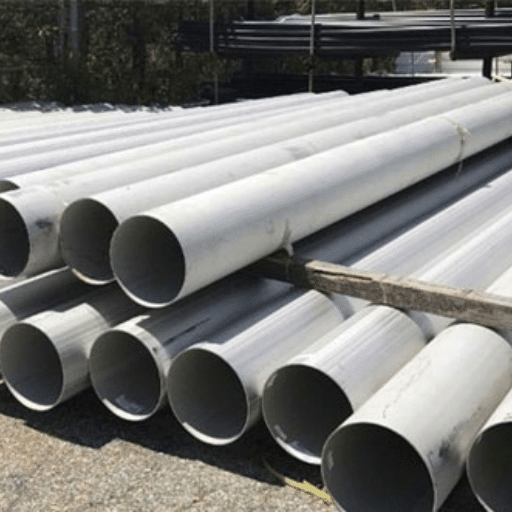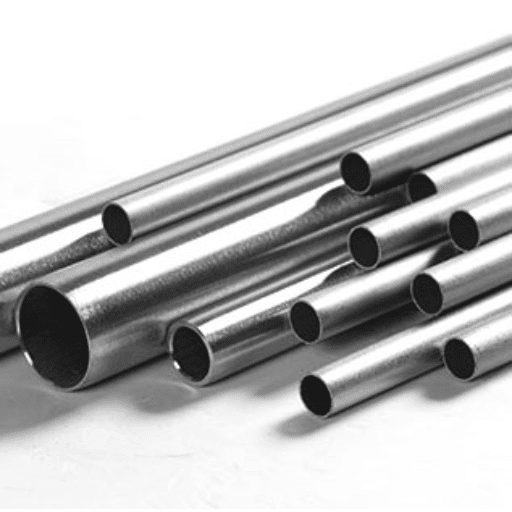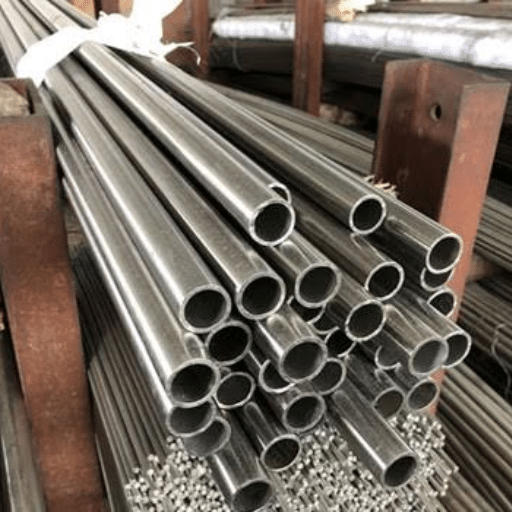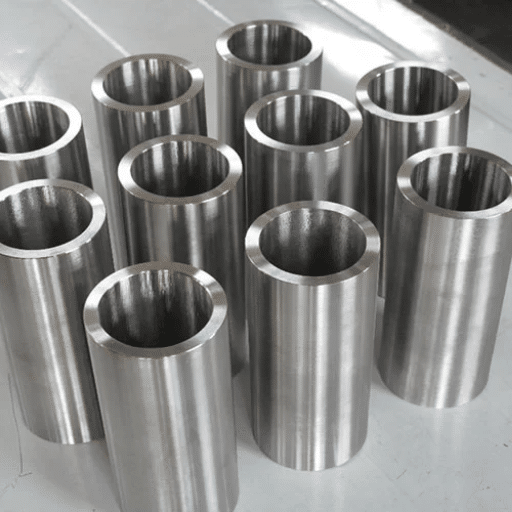
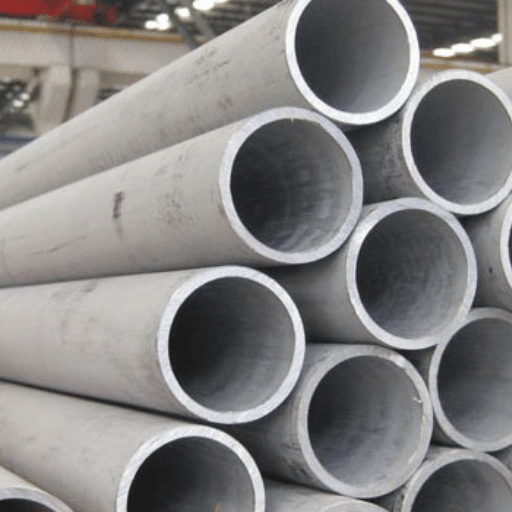
ASTM B622 is the specification for seamless nickel and nickel-cobalt alloy pipe and tube. It is a multi-alloy standard, covering roughly three dozen UNS grades in one document, and it applies to seamless product only. If your material is welded rather than seamless, B622 does not apply at all: welded pipe is ASTM B619 and welded tube is ASTM B626.
That last point is where most procurement mistakes begin, and it is not the only one. B622 is not a grade, and it is not a material. It is a document with a boundary. This article maps that boundary: which alloys B622 actually covers, which standard takes over when they fall outside it, what the standard tests for, and how to write all of it correctly onto a purchase order.
In early 2026, a project engineer at an EPC contractor in Rotterdam issued a purchase order for 600 metres of 1-inch Sch 40S seamless 625 tubing. The line list read “Nickel Alloy Seamless Tube, ASTM B622, Inconel 625.” The mill shipped sound material with a clean mill test report. Then the client’s third-party inspector rejected the documentation, because Inconel 625 is not covered by ASTM B622. The material was fine. The paperwork was not, and the paperwork is what holds up a project.
Key Takeaways
- ASTM B622 covers seamless nickel and nickel-cobalt alloy pipe and tube. Welded pipe is ASTM B619; welded tube is ASTM B626. The split is by product form, not by quality.
- Inconel 625 (UNS N06625) is not a B622 alloy. It is specified to ASTM B444 (seamless pipe and tube), B705 (welded pipe) and B704 (welded tube). A certificate issued to B622 for 625 material will fail receiving inspection.
- B622 is a multi-alloy document of roughly 35 UNS grades, and the list is edition-dependent. The 2023 edition added grades the 2017 edition did not carry, and a further revision has been reported since.
- The tolerances are not in B622 itself. They sit in the general-requirements standard, ASTM B829 for seamless product. A specification that cites B622 alone is incomplete.
- On ASME code work, the designation must read SB622, not ASTM B622. The texts are identical; the designation is not interchangeable.
This is the document layer that sits above every grade decision. For how the standards fit into material selection overall, see our complete nickel alloy pipe guide.
What Is ASTM B622?

ASTM B622, formerly the Standard Specification for Seamless Nickel and Nickel-Cobalt Alloy Pipe and Tube, is issued by ASTM Committee B02 on Nonferrous Metals and Alloys, Subcommittee B02.07. It is a product specification: it defines what a compliant length of seamless pipe or tube must be made of, what condition it must be delivered in, and what tests it must pass.
| Item | Value | What it means for the buyer |
|---|---|---|
| Full title | Standard Specification for Seamless Nickel and Nickel-Cobalt Alloy Pipe and Tube | The title answers the seamless/welded question before you read a clause |
| Product form | Seamless pipe and tube | Welded product is B619 (pipe) and B626 (tube) |
| Material class | Nickel and nickel-cobalt alloys | Multi-alloy: roughly 35 UNS grades, not a single-alloy spec |
| Delivery condition | Solution annealed and descaled | Descaling may be waived where atmosphere control is used |
| ASTM committee | B02, Subcommittee B02.07 | Same subcommittee that issues B829 |
| ASME equivalent | SB622 | Identical text, adopted into BPVC Section II Part B |
| General requirements | ASTM B829 | Carries tolerances, workmanship and inspection |
| Unit convention | Inch-pound units standard | SI values in parentheses are informational, not normative |
Two features of this table cause most of the confusion downstream. First, unlike most ASTM product specifications, B622 covers pipe and tube in one document. Pipe is ordered by nominal pipe size and schedule; tube is ordered by outside diameter and wall thickness. Most standards split the two. B622 does not, which is the root of nearly every question about its scope. Second, the standard says nothing about welded product, which routes welded buyers to B619 or B626.
The edition question is worth handling before you write a standard number on a PO. The edition most standards resellers list today is B622-23, approved in December 2023 to supersede B622-17b. At least two resellers also list a B622-26 dated September 2026, so a newer edition may be current. Confirm the live edition on the ASTM webstore before you commit a purchase order, and cite the edition year on the order rather than the bare number that first comes to mind.
Not sure which standard your line list should cite? Send our technical team the alloy, the UNS number and the product form. We will confirm the correct standard, and the correct edition, before you order. Send us your line list
Does ASTM B622 Cover Your Alloy? The Grade List
The alloys B622 covers
B622 is a multi-alloy specification, and its alloy list has grown with each revision. This matters commercially, because two suppliers can both be “correct” and still disagree: one is quoting the 2017 edition, the other the 2023 edition.
UNS grades reported as certifiable to the 2023 edition include:
N10001, N10242, N10665, N12160, N10675, N10276, N06455, N06007, N08320,
N06975, N06002, N06985, N06022, N06035, N06044, N08135, N06255, N06058,
N06059, N06200, N10362, N06030, N08031, N08034, R30556, N08535, N06250,
N06060, N06230, N06235, N06686, N10629, N06210, N10624, R20033
Treat that list as edition-dependent, not fixed. The 2017 edition carried 31 grades and did not include N06044, N08034 or N06235; the 2023 edition added them. Any edition-level list must be read out of the edition you are ordering against, not copied from a supplier page.
The grades a buyer encounters most often in B622 product are the nickel-molybdenum and Ni-Cr-Mo family: C-276 (N10276), C-22 (N06022), B-2 (N10665) and G-30 (N06030). C-276 is the market’s default B622 alloy, and its application picture is covered in detail in our Hastelloy C-276 pipe specifications article. Alloy 20 (N08020) sits outside B622 despite being a nickel alloy; it is specified to B729 for seamless pipe and tube, B464 for welded pipe and B468 for welded tube.
Inconel 625 is not a B622 alloy: the B444 correction
This is the single most useful correction this page can make, and it comes up on real purchase orders.
Inconel 625 (UNS N06625) does not appear in the ASTM B622 alloy list. The correct mapping for 625 is:
| Product form | Standard for UNS N06625 |
|---|---|
| Seamless pipe and tube | ASTM B444 / ASME SB444 |
| Welded pipe | ASTM B705 / ASME SB705 |
| Welded tube | ASTM B704 / ASME SB704 |
The error is widespread. Marketplace listings routinely read “ASTM B622 Inconel 625/600,” and combined-standard product titles list “B622 B619 B444 B165” as if the numbers were interchangeable. They are not interchangeable. They are different documents with different scopes.
The consequence is not metallurgical. A 625 heat made to exactly the right chemistry can still fail a project if the mill certificate cites B622 and the specification calls for B444. An inspector cross-checking the two at receiving inspection will raise a non-conformance, because the documentation does not match the requirement. The material may be perfectly good; the paperwork is wrong, and the paperwork is what releases the shipment.
The fix is simple: put the UNS number and the correct standard on the requisition and the PO, and require both to appear on the MTR. For the full 625 picture, including its Grade 1 and Grade 2 delivery conditions, see our Inconel 625 pipe to ASTM B444 guide.
Commonly mis-cited alloys, corrected
| Alloy | Standard often quoted | Standard that actually applies |
|---|---|---|
| Inconel 625 (N06625) | ASTM B622 | B444 seamless, B705 welded pipe, B704 welded tube |
| Incoloy 825 (N08825) | ASTM B622 | B423 seamless, B705 welded pipe, B704 welded tube |
| Monel 400 (N04400) | ASTM B622 | B165 seamless, B725 welded pipe, B730 welded tube |
| Nickel 200/201 (N02200/N02201) | ASTM B622 | B161 seamless pipe and tube, B163 seamless tube; B725 welded pipe, B730 welded tube |
Monel 400 is a common confusion point because it is a nickel alloy that buyers assume belongs in a nickel standard. It does not. Its specification is ASTM B165, covered in our Monel 400 pipe to ASTM B165 article. The broader question of when a nickel alloy is the right upgrade from stainless steel at all is addressed in when to upgrade from stainless steel to nickel alloy.
What ASTM B622 alloys are used for
The B622 alloys share one purpose: service where stainless steel has already failed. C-276 and C-22 handle wet chlorine, hypochlorite, and mixed acid streams; B-2 is chosen for hydrochloric acid where no chromium is wanted, and G-30 covers phosphoric acid and other highly oxidising duties. The common thread is a process chemistry aggressive enough to rule out 316L, duplex and super duplex. For independent corrosion data and application context across the family, the Nickel Institute is the reference most engineers start from.
Seamless or Welded? B622, B619 and B626
The most-searched question about ASTM B622 is its relationship to B619. The answer is a three-way split, and most supplier pages stop at two.
| Product form | Standard | End use |
|---|---|---|
| Seamless pipe and tube | B622 / SB622 | General corrosion and high-temperature service |
| Welded pipe | B619 / B619M / SB619 | Same alloy family, welded construction, ordered by NPS and schedule |
| Welded tube | B626 / SB626 | Heat-exchanger, condenser and evaporator service; ordered by OD and wall |
ASTM B622 is seamless. B619 is welded pipe. B626 is welded tube. The B619/B626 split is driven by product form and end use, not by quality. Both are fully specified, tested products. The distinction matters because a heat-exchanger buyer searching for “welded B622 tube” needs B626, and a page that only mentions B619 will send them to the wrong document.
One compliance point to verify against the applicable edition before you rely on it: welded B619 and B626 product is generally required to be solution annealed and water quenched after welding, which means as-welded product does not comply. Confirm the exact clause language in the edition you are ordering against.
Pipe versus tube: why B622 covers both
Pipe and tube are not the same product, and the difference is dimensional rather than metallurgical. Pipe is dimensioned by nominal pipe size and schedule, so a 2-inch Sch 40S pipe has a defined OD and a defined wall. Tube is dimensioned by outside diameter and wall thickness, so a 1-inch OD × 0.065-inch wall tube is specified directly. Nickel alloy pipe dimensions follow ASME B36.19M, the S-series schedules. Note that ASME B36.10M is the dimensional standard for carbon and alloy steel, and citing it for a nickel alloy pipe is a common and consequential error. For the schedule framework, see our ASME B36.19 pipe schedule chart.
The scope boundary: the tube size limit and large-diameter product
B622’s scope note has historically carried an outside-diameter limit for tube, reported at 3.5 inches (88.9 mm) in editions up to B622-17b. The 2023 and later editions are reported to have renumbered that clause. Read the current scope clause out of the edition you are ordering against rather than assuming the figure still stands.
The value here is the scope logic, not the exact number. B622’s boundary is what routes large-diameter and heavy-wall buyers to a different construction: beyond the point where seamless manufacture stops being practical, the product moves to welded pipe under B619 or welded tube under B626. If you are specifying a large-OD nickel alloy line, the question to ask early is not “which seamless mill” but “seamless or welded,” because that answer determines which standard, and therefore which supplier, applies.
ASTM B622 vs ASME SB622: Why the Designation Matters

ASME SB622 is the adoption of ASTM B622 into the ASME Boiler and Pressure Vessel Code, Section II Part B. The technical text is identical. The designation is not.
On code-stamped pressure equipment, vessels, heat exchangers and power plant piping, certification must be to the SB designation. A mill certificate that reads only “ASTM B622” may not satisfy an ASME code inspector, even though the material and the requirements are the same. The practical instruction is to state the governing code in the RFQ, not just the material standard, and to specify which designation must appear on the MTR. If the project is code-stamped, write SB622.
This is one of those details that costs nothing to get right up front and costs a documentation reissue, or a rejected shipment, to fix later. The same discipline applies across the grade articles: the document layer is upstream of everything.
The Nickel Alloy Pipe Standards Index: Alloy × Form
This is the table no competitor page assembles. It maps each alloy family to the standard that governs it in each product form. Read it by alloy family first, then by form. Where an alloy owner publishes its own specifications list, that list is the authority on which standard applies to its grades; Haynes International’s specifications index is the reference engineers most often cite for the Ni-Mo-Cr family.
| Alloy family | UNS grades | Seamless pipe & tube | Welded pipe | Welded tube |
|---|---|---|---|---|
| Ni-Mo and Ni-Mo-Cr (B-, C-, G-series) | N10276, N06022, N10665, N06030, N06035, N06059, others | B622 | B619 | B626 |
| Inconel 625 family | N06625, N06219, N06852 | B444 | B705 | B704 |
| Monel 400 | N04400 | B165 | B725 | B730 |
| Incoloy 825 | N08825 | B423 | B705 | B704 |
| Nickel 200 and 201 | N02200, N02201 | B161 (pipe and tube), B163 (tube) | B725 | B730 |
| Inconel 600 family | N06600, N06601, N06690 | B167 | B517 | B516 |
| Alloy 20 | N08020 | B729 | B464 | B468 |
| Incoloy 800/800H/800HT | N08800, N08810, N08811 | B407 | B514 | B515 |
The first row is where ASTM B622 lives. Every row below it is a standard that takes over once the alloy leaves the B622 list, which is precisely why a page about B622 has to discuss eleven other standards: B622’s scope boundary is the reason they exist as alternatives.
For the family-level comparison that sits above this index, see comparing the nickel alloy families.
The General-Requirements Layer: B829, B775 and B751
The most common incomplete specification in nickel alloy procurement is one that cites the product standard and stops there. The product standard tells you what the material must be. It does not carry all of the tolerances. Those live in a separate layer: the general-requirements standards.
| Layer | Standard | Applies to |
|---|---|---|
| General requirements, seamless pipe and tube | ASTM B829 | B161, B163, B165, B167, B407, B423, B444, B535, B622 and others |
| General requirements, welded pipe | ASTM B775 / B775M | B464, B517, B619, B673, B705, B725 and others |
| General requirements, welded tube | ASTM B751 | Welded tube product specs including B704 and B730 |
B829, B775 and B751 carry permissible variations (tolerances), workmanship, inspection, marking, and the optional-test clauses. When a product specification and a general-requirements specification conflict, the product specification takes precedence. That rule is stated in both B829 and B775.
In practice, a fabricator in Texas learnt this the expensive way. He wrote “ASTM B622, C-276, 3-inch Sch 40S” on a PO and considered the specification complete. The pipe arrived and met B622 on chemistry, mechanicals and hydrostatic test. It also sat slightly outside the wall and straightness bands his support design had assumed, because the tolerances he was relying on belonged to B829 and he had never invoked it. The material was compliant with the standard he wrote. It was not compliant with the standard he meant.
The lesson generalises: if your specification cites only the product standard, you have described the material and left the dimensions open.
What ASTM B622 Requires: Testing, Condition and Tolerances
Solution annealed and descaled
B622 product is delivered in the solution-annealed and descaled condition. Solution annealing puts the alloy back into a single-phase state and dissolves the precipitates that form during working; descaling removes the oxide left by that heat treatment. Descaling may be waived where the mill uses atmosphere control, so confirm the delivery condition on the order if surface condition matters to your fabrication.
Tension, hydrostatic and nondestructive electric testing
The standard’s test regime is built on three tests applied to the product: a tension test, a hydrostatic test, and a nondestructive electric test. The tension test verifies tensile strength, yield strength and elongation against the specified minimums. The nondestructive electric test is normally run as an eddy-current examination, with ultrasonic testing used where the purchaser specifies it or where the wall section demands it. Chemical composition is verified by analysis, and mass or weight is checked against the nominal.
The hydrostatic test is a pressure-integrity check. The test pressure is derived from the formula P = 2St/D, where S is the allowable fiber stress for the alloy, t is the specified wall thickness and D is the outside diameter. The allowable stress value varies by alloy, and any leak at test pressure is cause for rejection. The test pressure is internally capped, reported at 1,000 psi (6.89 MPa); verify the cap and the formula against the current edition before you rely on them in a design calculation. What hydrostatic testing proves is that the length does not leak or rupture at test pressure. What it does not prove is that the wall is uniform or the chemistry is correct. It is a pressure integrity check, not a full quality review.
Permissible variations
The permissible variations for outside diameter, wall thickness, length, straightness and ovality are carried by B829, and they vary by manufacturing route (cold-worked, hot-finished, hot-worked) and by size band. Because these values are edition- and route-dependent, cite the applicable band out of the current standard rather than from a supplier table. The pipe dimensions themselves follow ASME B36.19M. For the stainless counterpart to this whole framework, the same standards discipline applied to stainless pipe is a useful parallel.
One commercial note that follows from the material rather than the standard: nickel alloys run denser than stainless, roughly 8.19 to 8.89 g/cm³ against about 8.0 g/cm³ for 316L. A C-276 or C-22 pipe weighs more per metre at the same OD and wall, which shifts freight, support spacing and weight-based pricing.
Documenting ASTM B622 Compliance
MTR contents for a B622 heat
A mill test report for a B622 heat should show the heat number, the UNS grade, the product form, the standard and edition year, the chemical analysis, the mechanical test results, the hydrostatic test result, and the nondestructive electric test result. Cross-check the UNS number and the standard against your requisition before you accept the report, because a mismatch here is what triggers a receiving-inspection non-conformance.
EN 10204 3.1 versus 3.2
The European documentation framework is widely referenced even on ASTM orders. An EN 10204 3.1 certificate is issued by the manufacturer’s own inspection department. A 3.2 certificate involves an independent inspector, either a third party or the customer’s representative. Specify which is required, and specify whether third-party inspection is to be accommodated, before the material is ready to ship rather than after.
PMI and the heat-number trail
Positive material identification by XRF or OES confirms that the alloy actually delivered matches the alloy specified, independent of the paperwork. For nickel alloys, where C-276 and C-22 are visually indistinguishable in the field and where mixed stock is a real risk, PMI on receipt is standard good practice. Keep the heat-number trail from mill to installed location so a future corrosion problem can be traced back to a specific heat.
Is there a GB equivalent to ASTM B622?
There is no one-to-one GB equivalent to ASTM B622. The Chinese nickel alloy framework sits in standards such as GB/T 28883 and GB/T 24593, and Chinese grades such as NS3405 map to specific UNS alloys rather than to the ASTM standard itself. That is the honest structure: the equivalence is at the grade level, alloy by alloy, not at the standard level. If your project requires a GB designation, confirm the grade-level mapping for your specific alloy, and do not assume that a GB specification and an ASTM specification with similar names are interchangeable. This is a frequent source of confusion on cross-border projects, and it mirrors the alloy-level confusion that trips up even experienced buyers on the sourcing side, as covered in our supplier qualification for imported pipe guide.
How to Specify ASTM B622 Correctly: PO Checklist

A complete nickel alloy B622 specification captures everything in the following list. Every line below is a place where an incomplete order creates a receiving-inspection problem later.
- Alloy and UNS number: write both, e.g. “Hastelloy C-276, UNS N10276.”
- Product form: state pipe or tube explicitly. B622 covers both, and they are dimensioned differently.
- Standard and edition year: “ASTM B622-23,” not the bare number.
- Companion general-requirements standard: “per ASTM B829” for seamless product.
- Dimensions: NPS × schedule for pipe; OD × wall thickness for tube.
- Dimensional standard: ASME B36.19M for pipe.
- Quantity and length pattern: total length plus random or fixed lengths.
- Delivery condition: solution annealed and descaled, unless waived.
- Test requirements: tension, hydrostatic, and nondestructive electric; name any additional tests.
- Designation: ASTM B622 or ASME SB622, driven by whether the equipment is code-stamped.
- Documentation: MTR, EN 10204 3.1 (or 3.2 on request), PMI, and what must appear on the certificate.
- Inspection: whether third-party inspection is required and by whom.
If you can send those twelve lines, the order is complete. Send us your line list and our technical team will check the alloy against the standard and return the corrected specification with grade, form and lead time within 24 hours. Send us your line list
Frequently Asked Questions
Is ASTM B622 seamless or welded?
Seamless. The full title is Standard Specification for Seamless Nickel and Nickel-Cobalt Alloy Pipe and Tube. Welded pipe is ASTM B619 and welded tube is ASTM B626.
What is the difference between ASTM B622 and B619?
B622 covers seamless pipe and tube. B619 covers welded pipe of the same alloy family. The difference is product form: seamless versus welded. Both are fully specified, tested products.
What is the difference between ASTM B622 and B444?
They are different documents covering different alloys. B444 is the specification for Inconel 625 (N06625) seamless pipe and tube. B622 covers nickel and nickel-cobalt alloys but not 625. If your material is 625, cite B444, not B622.
Does ASTM B622 cover Inconel 625?
No. UNS N06625 is not in the B622 alloy list. Inconel 625 is specified to B444 (seamless pipe and tube), B705 (welded pipe) and B704 (welded tube).
Is ASME SB622 the same as ASTM B622?
The technical text is identical. ASME SB622 is the adoption of ASTM B622 into the ASME Boiler and Pressure Vessel Code, Section II Part B. On code-stamped equipment, the certificate must carry the SB622 designation.
What is the size limit of ASTM B622?
The scope note has historically carried a tube outside-diameter limit, reported at 3.5 inches (88.9 mm) in editions up to B622-17b, and reported renumbered in later editions. Read the current clause out of the edition you are ordering against. Large-diameter product generally moves to welded construction under B619 or B626.
What tests does ASTM B622 require?
A tension test, a hydrostatic test, and a nondestructive electric test, plus chemical analysis and mass verification. Additional tests are available as options and should be named on the purchase order if the service requires them.
Is there a GB equivalent to ASTM B622?
No one-to-one equivalent. Chinese grades such as NS3405 map to specific UNS alloys at the grade level, within the GB/T 28883 and GB/T 24593 framework, rather than mapping to the ASTM standard as a whole.
Conclusion: Cite the Right Document, Not the Familiar One
ASTM B622 is a narrow, precise document, and treating it as a general-purpose nickel alloy standard is where procurement problems start. Four decision points resolve almost every case:
- Seamless or welded? B622 is seamless. Welded product is B619 (pipe) or B626 (tube).
- Is your alloy actually in B622? Roughly 35 UNS grades are. Inconel 625, Incoloy 825 and Monel 400 are not, and each has its own standard.
- Have you cited the tolerances? B622 does not carry all of them. Add the general-requirements standard, B829 for seamless product.
- Code work or not? If it is code-stamped, the designation must read SB622 on the certificate.
That same discipline applies elsewhere in the family. When you move from nickel alloys to stainless, for example, the ASTM A312 standard carries its own set of scope boundaries and optional tests worth reading before you write a PO.
None of this is difficult once the map is in front of you. The difficulty is that most pages describing B622 repeat the same wrong table, and a buyer who follows it can specify the wrong document without ever knowing. Getting the document right is what makes every later grade, form and documentation decision hold together.
Send us your ASTM B622 line list with the alloy, the UNS number, the product form, and the governing standard, including the edition year and whether the project is code-stamped. If the alloy and the standard do not match, our technical team will tell you before you order and return the corrected specification with grade, form and lead time within 24 hours. Contact our technical team