Your refinery process line needs isolation valves that will operate reliably for 25 years. Your procurement team currently evaluates whether your specification requirement for Class 600 needs API 600 or if the ASME B16.34 general-purpose option will suffice. The maintenance engineer pushes for a specific API trim number based on previous corrosion failures, while the EPC contractor requires full MTR documentation to support their quality plan.
The process of specifying industrial gate valves involves a challenging process that requires understanding multiple standards, materials, and application requirements to determine which components will provide dependable performance for many years or which ones will result in major system breakdowns. This guide provides the technical framework for specifying API 600 gate valves with confidence, which includes all essential ASTM material grades and trim selection, pressure-temperature ratings, and testing requirements needed to enable your isolation valves to function according to their intended design throughout their entire operational lifespan.
What Is an Industrial Gate Valve?
Definition and Basic Function
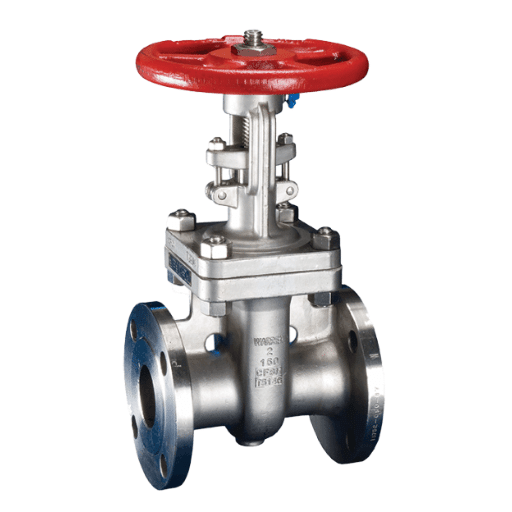
An industrial gate valve functions as a linear-motion isolation valve which provides two operational modes between complete opening and complete closing. The valve functions through the movement of a disc which has a flat shape or a wedge shape as it moves up and down to block or allow flow through the pipe. The gate opens fully to move back into the bonnet where it creates a straight-through flow path which enables minimal pressure loss.
This design characteristic makes gate valves ideal for applications where:
- Maximum flow capacity is required when open
- Minimal pressure drop is critical (pipeline pumping costs)
- Infrequent operation is expected (isolation, not control)
- Bi-directional flow capability is needed
The full-bore design of a gate valve provides a Kv coefficient (flow coefficient) nearly equal to an equivalent length of straight pipe — typically only 0.1–0.3 pressure loss coefficient compared to 3–10 for globe valves of equivalent size.
Key Design Components
Understanding gate valve anatomy is essential for proper specification:
Body and Bonnet: The pressure-containing envelope. API 600 requires minimum wall thicknesses 50% greater than ASME B16.34 general purpose valves, providing additional corrosion allowance and structural strength for refinery service.
Wedge/Disc: The sealing element. Three configurations exist:
- Solid wedge: Single-piece cast design, simplest and most common
- Flexible wedge: Split design with center hub allowing slight flexure — superior for thermal cycling and steam service
- Split wedge: Two-piece design self-adjusting to seat angles — used for non-condensing gases and services with solids
Stem: The operating mechanism. Outside Screw and Yoke (OS&Y) designs — also called rising stem gate valve designs — place the thread outside the pressure boundary, with the stem rising visibly as the valve opens — providing immediate visual indication of valve position.
Seats: The sealing surfaces. API 600 requires integral seats or pressed-in rings of specified material (determined by trim number). Metal-to-metal seating is standard; resilient seats are available for bubble-tight shutoff in water service.
Types of Industrial Gate Valves

Wedge Gate Valves
Wedge gate valves represent the majority of industrial gate valve installations. The wedge-shaped disc provides a mechanical sealing force against matching tapered seats.
Solid Wedge: The simplest design, used for general service where thermal cycling is minimal and the fluid is clean. Limited to temperatures below 400°F (204°C) for continuous service due to potential binding from thermal expansion differentials.
Flexible Wedge: Features a circumferential cut or slot in the disc center, creating two flexing halves. This design accommodates thermal expansion and seat face irregularities. Essential for steam service and applications with temperature variations exceeding 200°F (93°C).
Split Wedge (Double Disc): Two independent disc halves that self-align to seat angles. Used for dry gases and services where line solids might prevent proper seating of solid designs. Not recommended for liquid service where pressure binding can occur.
Parallel Slide Gate Valves
Parallel slide gate valves use two parallel discs with a spreading mechanism between them, rather than a wedging action. The discs slide parallel to the flow path, then spread against the seats for sealing.
Advantages over wedge designs:
- No wedging force during closure — reduced operating torque
- Self-compensating for seat wear — longer service life
- Superior for high-temperature steam (above 800°F / 427°C)
- Better tolerance of thermal transients
Parallel slide valves dominate power generation applications, particularly main steam and feedwater isolation where temperature cycling is severe.
Knife Gate Valves
Knife gate valves serve a specialized niche — on/off isolation of slurries, pulp stock, and solid-laden fluids. The knife-edged gate shears through solids and drops into a gap below the flow path.
Critical distinction: Knife gate valves are not API 600 compliant. They follow MSS SP-81 or manufacturer-specific standards. Pressure ratings are typically limited to Class 150–300 equivalent. Never specify knife gate valves for:
- High-pressure hydrocarbon service
- API refinery applications
- Services requiring tight shutoff against gas
API 600 and Industry Standards

API 600 Standard Overview
API 600, “Bolted Bonnet Steel Gate Valves for Petroleum and Natural Gas Industries,” establishes comprehensive requirements for steel gate valves used in refinery, chemical, and severe service applications. The standard is the U.S. national adoption of ISO 10434.
Key API 600 requirements exceeding general purpose valves:
- Wall thickness: Minimum 50% thicker than ASME B16.34
- Stem diameter: Larger minimum stem diameters for strength
- Bolted bonnet: Mandatory for Class 150–1500; pressure seal for Class 2500
- Backseat: Required for all OS&Y designs — permits stem packing replacement under pressure
- Low emission: Testing requirements for fugitive emissions compliance
When to specify API 600 versus ASME B16.34:
- API 600: Refineries, chemical plants, power generation, sour service (H₂S), high-cyclic operation
- ASME B16.34: General industrial, water, HVAC, non-critical commercial applications
Complementary Standards
An API 600 gate valve specification is incomplete without reference to these complementary standards:
| Standard | Coverage |
|---|---|
| ASME B16.34 | Pressure-temperature ratings, material groups, minimum dimensions |
| ASME B16.10 | Face-to-face and end-to-end dimensions (ensures replacement compatibility) |
| ASME B16.5 | Flange dimensions for valves 2″–24″ NPS |
| ASME B16.47 | Flange dimensions for valves 26″ NPS and larger |
| ASME B16.25 | Butt weld end preparation dimensions |
| API 598 | Inspection and testing requirements (shell test, seat test, backseat test) |
Pressure Classes and Temperature Ratings
API 600 covers pressure classes from 150 to 2500:
| Class | Nominal Rating | Typical Applications |
|---|---|---|
| 150 | 285 psi @ 100°F | Water, low-pressure steam, non-critical oil |
| 300 | 740 psi @ 100°F | General process, hydrocarbon service |
| 600 | 1,480 psi @ 100°F | Refinery process, high-pressure steam |
| 900 | 2,220 psi @ 100°F | Severe service, large high-pressure pipelines |
| 1500 | 3,705 psi @ 100°F | Power generation, critical isolation |
| 2500 | 6,170 psi @ 100°F | Ultra-high pressure, wellhead isolation |
Critical specification rule: Pressure ratings decrease as temperature increases. A Class 600 WCB carbon steel valve rated for 1,480 psi at 100°F is rated for only 1,095 psi at 800°F. Always specify based on maximum operating temperature, not ambient pressure.
Material Selection and API Trim Numbers

Body Materials (ASTM Specifications)
Gate valve body material selection determines pressure-temperature limits and corrosion resistance:
Carbon Steel:
- ASTM A216 WCB: Most common, -20°F to 800°F (-29°C to 427°C), general hydrocarbon service
- ASTM A352 LCB/LCC: Low-temperature carbon steel, -50°F to 650°F (-46°C to 343°C)
Stainless Steel:
- ASTM A351 CF8 (304): -450°F to 1,500°F (-268°C to 816°C), general corrosion resistance
- ASTM A351 CF8M (316): Superior chloride resistance, chemical service
- ASTM A351 CF3M (316L): Low carbon for welded construction, same range as CF8M
Alloy Steel (High Temperature):
- ASTM A217 WC6: 1.25% Cr-0.5% Mo, to 1,000°F (538°C)
- ASTM A217 WC9: 2.25% Cr-1% Mo, to 1,100°F (593°C)
- ASTM A217 C5: 5% Cr-0.5% Mo, to 1,200°F (649°C)
Duplex Stainless Steel:
- ASTM A890 4A (2205): High chloride resistance, sour service
- ASTM A995 5A (2507): Super duplex for severe offshore environments
API Trim Number Guide
API trim numbers specify the material composition of seat, disc, stem, and backseat components. Selecting the correct trim is critical for service life.
| Trim # | Seat | Disc | Stem | Backseat | Applications |
|---|---|---|---|---|---|
| 1 | 13% Cr SS | 13% Cr SS | 13% Cr SS | 13% Cr SS | General service, non-corrosive |
| 5 | Stellite | Stellite | 13% Cr SS | 13% Cr SS | Erosive service, moderate corrosion |
| 8 | Stellite | Stellite | 18-8 SS | 18-8 SS | Corrosion + erosion, high temp |
| 10 | 18-8 SS | 18-8 SS | 18-8 SS | 18-8 SS | Chemical, corrosive (no erosion) |
| 12 | 18-8 SS | Stellite | 18-8 SS | 18-8 SS | Severe service, best erosion resistance |
Specification example: A gate valve for refinery catalytic reforming with catalyst fines would require Trim 5 minimum — the Stellite hardfacing resists particle erosion that would rapidly degrade Trim 1.
NACE MR0175 Compliance: For sour service (H₂S environments), specify “NACE trim” — typically Trim 10 or 12 with controlled hardness (22 HRC maximum) to prevent sulfide stress cracking.
Gate Valve vs. Other Valve Types

Gate Valve vs. Globe Valve
The most common specification error is confusing isolation and throttling functions:
| Characteristic | Gate Valve | Globe Valve |
|---|---|---|
| Primary function | Isolation (on/off) | Flow regulation/throttling |
| Pressure drop (open) | Minimal | 3–10× higher |
| Throttling capability | Poor — causes damage | Excellent |
| Flow direction | Bi-directional | Uni-directional |
| Service life (throttling) | Rapid seat erosion | Designed for continuous throttling |
Critical rule: Never use a gate valve for throttling service. Partial opening causes:
- Gate vibration and chatter
- Seat erosion from high-velocity flow
- Potential catastrophic failure (gate drop)
When the procurement team asks, “Can we just buy gate valves and use them for flow control?” the answer must be an emphatic no — this specification shortcut has caused countless premature failures and unplanned shutdowns.
Gate Valve vs. Ball Valve
| Characteristic | Gate Valve | Ball Valve |
|---|---|---|
| Operation | Multi-turn (linear) | Quarter-turn (90° rotation) |
| Operation speed | Slow (30+ turns) | Fast (90° motion) |
| Sealing | Metal-to-metal standard | Soft-seat standard (bubble tight) |
| Size range | 2″ to 60″+ | Typically ≤24″ (larger very expensive) |
| Pressure rating | Up to Class 2500 | Typically ≤Class 600 |
| Cost (large sizes) | Lower | Higher |
Selection guidance:
- Ball valve: Frequent cycling, quick emergency shutoff, gas service requiring bubble-tight shutoff. Zhongzheng manufactures API 6D ball valves for pipeline applications and ASME B16.34 ball valves for general industrial service.
- Gate valve: Large diameters (24″+), high-pressure steam, infrequent operation, cost-sensitive specifications
For pipeline block valves in sizes above 24″, gate valves are typically the only economically viable option — trunnion ball valves at these sizes cost 3–5× more.
Industrial Applications
Oil and Gas Industry
Upstream production facilities specify API 600 gate valves for:
- Wellhead isolation: High-pressure, H₂S exposure requiring NACE compliance
- Manifold isolation: Frequent operation, full-bore for pigging operations
- Process unit isolation: Refinery catalytic, cracking, and reforming units
Offshore platforms add requirements for:
- Fire-safe design (API 607)
- Low emission packing (EPA compliance)
- Extended bonnet options for subsea applications
The Trim 5 gate valves were selected by Marcus Chen to meet the Class 600 specifications which he required for the Gulf of Mexico platform production manifold which he was building in 2023. However,thepreviousplatformhadexperiencedTrim1seatfailureswithin18monthsduetosanderosion the18,000. The 18,000 upgrade which was implemented actually protected the business from losing 450,000 because it stopped unplanned shutdowns from happening according to the business estimate.
Power Generation
Fossil fuel and nuclear power plants rely on gate valves for:
- Main steam isolation: Parallel slide designs for high-temperature steam (1,000°F+)
- Feedwater systems: Flexible wedge for thermal cycling
- Turbine bypass: High-pressure Class 1500–2500
- Blowdown and drain: Standard Class 600–900
The key specification factor in power generation is thermal cycling. A flexible wedge or parallel slide design is mandatory for steam service — solid wedge valves will bind and fail to seal after repeated thermal transients.
Water and Wastewater
Municipal water systems use gate valves (primarily resilient seated) for:
- Distribution system isolation (every 500–1,000 feet)
- Pump isolation
- Treatment plant process lines
- Reservoir inlet/outlet
While API 600 is often over-specified for water service, the standard is frequently used for large-diameter transmission mains (36″+) where long service life and reliability justify the cost premium.
Knife gate valves dominate wastewater sludge and pulp stock applications — but never for clean water pressure service where tight shutoff is required.
Procurement and Quality Assurance

Documentation Requirements
International EPC contractors require comprehensive documentation packages:
Mill Test Report (MTR) must include:
- Heat number and material grade verification
- Chemical composition (spectrographic analysis)
- Mechanical properties (tensile, yield, elongation)
- Heat treatment records
- Hydrostatic test results
Additional certifications:
- API 598 test certificates
- NACE MR0175 compliance (sour service)
- Fire-safe certification (API 607) when specified
- Positive material identification (PMI) reports
- Third-party inspection reports (when TPI is specified)
Testing Requirements (API 598)
Every API 600 gate valve undergoes mandatory testing:
Shell Test: 1.5× rated pressure applied to valve body for minimum duration (varies by size). No leakage permitted through pressure boundary.
Seat Test: 1.1× rated pressure applied to closed valve. For metal-seated valves, API 598 permits “visible” leakage rates (typically 0–10 drops/minute depending on size). Resilient seated valves must be bubble-tight.
Backseat Test: For OS&Y designs, pressure applied with valve fully open and packing removed. Verifies backseat seal allows packing replacement under pressure.
Supplier Qualification Checklist
When qualifying a gate valve manufacturer, verify:
- API 600 manufacturing license: Confirmed API QR code on nameplate
- In-house testing capability: Hydrostatic test equipment, not subcontracted
- Material traceability: Heat number tracking from raw material to finished valve
- NACE compliance program: Documented hardness control for sour service
- Third-party inspection access: SGS, Bureau Veritas, TÜV witness capability
- Documentation quality: Sample MTRs reviewed for completeness
At Zhongzheng, every gate valve undergoes the same multi-stage QC process as our pipe and fitting products — spectrographic material verification, dimensional inspection, pressure testing, and full documentation. Our technical team reviews every specification to confirm trim number, pressure class, and material compatibility before production.
Common Specification Mistakes
Mistake 1: Using Gate Valves for Throttling
The most destructive specification error. When a gate valve is partially open, flow concentrates at the bottom of the disc, creating:
- High-velocity erosion of the seat and disc
- Vibration that loosens wedge nuts
- Potential for gate drop and catastrophic failure
Solution: Specify globe valves for throttling. If the application requires both isolation and throttling, use two valves — gate for isolation, globe for control.
Mistake 2: Ignoring Temperature Derating
A Class 600 WCB valve rated for 1,480 psi at 100°F is only rated for 1,095 psi at 800°F. Specifying based on ambient pressure ratings causes over-stress at operating temperature.
Solution: Always specify based on maximum operating temperature, using ASME B16.34 pressure-temperature tables.
Mistake 3: Wrong Trim for Media
Specifying Trim 1 for mildly corrosive service leads to rapid seat deterioration. Specifying Trim 10 for erosive service wastes money while still suffering erosion.
Solution: Use the trim selection matrix. When in doubt, consult the valve manufacturer with complete media composition and operating conditions.
Mistake 4: Confusing API 600 and API 6D
API 600 is for refinery/valve station service. API 6D is for long-distance pipelines. API 6D has stricter documentation, fugitive emission, and valve automation requirements.
Solution: Specify API 6D only for pipeline transmission applications. API 600 is correct for process plants and terminal facilities.
FAQ
What is the difference between API 600 and ASME B16.34?
API 600 is a product standard specific to steel gate valves for refinery service. The standard uses ASME B16.34 for pressure-temperature rating purposes but requires additional testing and specification of wall thickness and stem diameter requirements which exceed B16.34 minimum standards. ASME B16.34 is a general valve standard covering multiple valve types for broad industrial applications. For refinery, chemical, and power applications, specify API 600. The ASME B16.34 standard meets requirements for industrial water systems and low-pressure applications.
How do I select the right API trim number?
Match the trim to your service conditions:
- Non-corrosive, clean fluids: Trim 1 (13% Cr stainless)
- Erosive service with solids: Trim 5 or 8 (Stellite hardfaced seats)
- Chemical, corrosive (no erosion): Trim 10 (316 SS)
- Severe service, both corrosion and erosion: Trim 12 (316 SS with Stellite seat)
- Sour service (H₂S): NACE-compliant Trim 10 or 12 with hardness ≤22 HRC
When uncertain, provide your complete media composition, temperature, and solids content to the valve manufacturer for trim recommendation.
What pressure class do I need for steam service at 400°C?
At 400°C (752°F), pressure ratings derate significantly. The minimum requirement for Class 300 should be established for saturated steam at 400°C which corresponds to 250 psi / 17 bar. Engineers recommend using Class 600 for main steam isolation at this temperature because steam service best practices require a safety margin which protects against pressure transients and extended operational use.
Can I use a gate valve for throttling?
The design of gate valves permits operation only when the valve is either fully open or fully closed. Throttling creates three dangerous effects which include seat erosion, vibration damage and catastrophic failure. For flow control applications, specify globe valves (for precise control) or butterfly valves (for economy). The system requires two control functions which need a gate valve to provide upstream isolation of a globe valve used for control purposes.
What is the difference between flexible wedge and solid wedge gate valves?
The solid wedge functions as a basic design that requires only one metal component for its complete creation, yet faces operational difficulties because of its thermal cycling process. The flexible wedge design includes a slot or cut which enables limited movement to handle both seat defects and thermal expansion needs while functioning in steam systems and environments with changing temperatures. The flexible wedge costs 15 to 25 percent more than the solid wedge yet establishes dependable seals that protect against thermal cycling failure.
When do I need a pressure seal bonnet vs. bolted bonnet?
Bolted bonnets are required in standard practice for Class 150 through Class 900. Pressure seal bonnets are required for Class 1500 and 2500 (high pressure) and optionally for Class 900. Pressure seal designs use line pressure to energize the bonnet seal which creates better high-pressure sealing through reduced bolt requirements. The specification of bolted bonnets above Class 900 should not occur because these bonnets fail to maintain pressure containment.
What testing is required per API 598?
Three mandatory tests:
- Shell test: 1.5× rated pressure, verifies pressure boundary integrity
- Seat test: 1.1× rated pressure, verifies closure member sealing
- Backseat test: 1.1× rated pressure with valve open, verifies stem seal integrity
Test duration varies by valve size (60 seconds for 2–4″, up to 300 seconds for 24″+). Metal-seated valves permit slight leakage; resilient seated valves must be bubble-tight.
Can Zhongzheng provide third-party inspection support?
Yes. Zhongzheng supports third-party inspection by SGS, Bureau Veritas, TÜV, Lloyds Register, and project-specified inspection agencies. The QC team of our company manages witness testing procedures which include hydrostatic testing, and seat testing, and backseat testing, along with material verification and dimensional inspection. Customers must schedule TPI requirements through their RFQ requests to receive proper production hold points.
Conclusion
The industrial gate valve specification requires compliance with standards and material requirements and application limitations which many procurement processes fail to recognize. The difference between API 600 and ASME B16.34 and the correct API trim number for your media and the pressure-temperature derating at operating conditions – these details determine whether your isolation valves provide 25 years of reliable service or fail prematurely at the worst possible moment.
Key takeaways:
- Specify API 600 for refinery, chemical, and power applications where reliability matters
- Never use gate valves for throttling — this is the most common and costly specification error
- Match API trim numbers to service conditions; when uncertain, consult the manufacturer
- Always specify pressure class based on maximum operating temperature, not ambient conditions
- Require full API 598 testing and MTR documentation for every valve
Ready to specify industrial gate valves for your project? Submit your line list with operating conditions (pressure, temperature, media composition) and Zhongzheng’s technical team will confirm the correct API 600 specification — including pressure class, material grade, and trim number — with a detailed quotation within 24 hours.
Reference Sources
- API Standard 600: Bolted Bonnet Steel Gate Valves for Petroleum and Natural Gas Industries
- ASME B16.34: Valves — Flanged, Threaded, and Welding End
- API Standard 598: Valve Inspection and Testing
- ASME B16.5: Pipe Flanges and Flanged Fittings
- Mordor Intelligence: Industrial Valves Market Size & Share Analysis Report 2025
- Market.us: Gate Valve Market Size, Share & Industry Analysis 2024-2034
- NACE MR0175/ISO 15156: Petroleum and Natural Gas Industries — Materials for Use in H₂S-Containing Environments
- ASTM A216/A216M: Standard Specification for Steel Castings, Carbon, Suitable for Fusion Welding
- ASTM A351/A351M: Standard Specification for Castings, Austenitic, for Pressure-Containing Parts
- Emerson Valve Industry Report: Smart Valve Technologies and Market Trends 2025