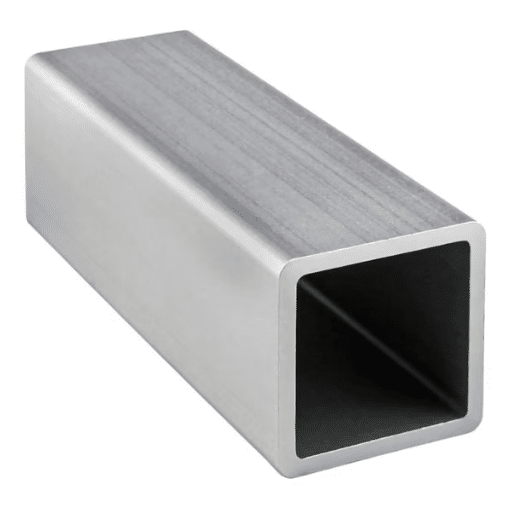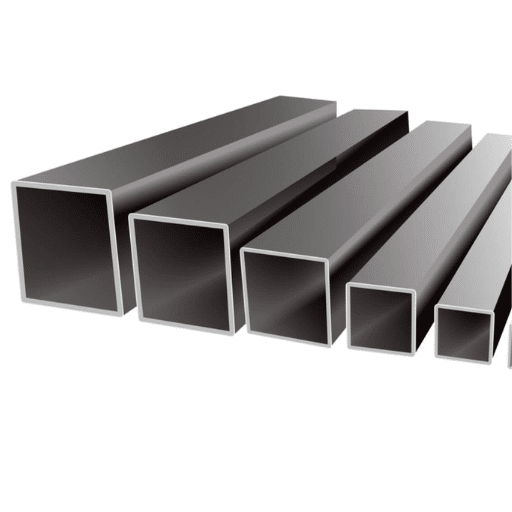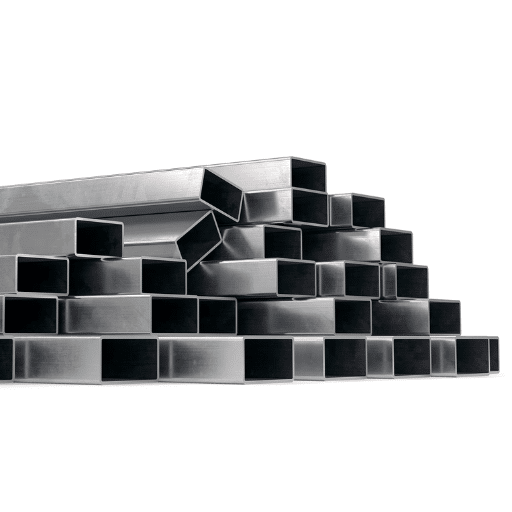
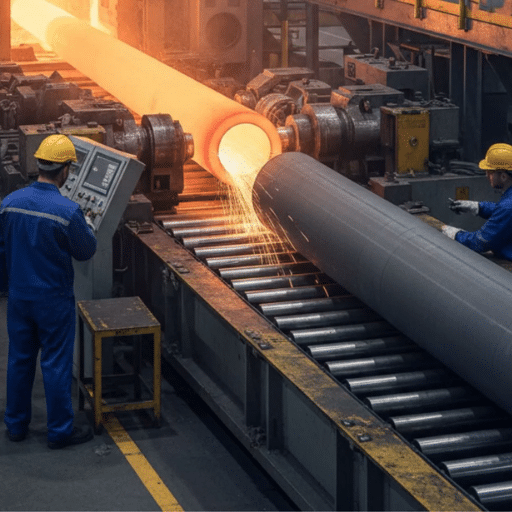
The process of producing a seamless pipe begins with the creation of a solid steel billet, which undergoes piercing or extrusion to form a hollow tube. The tube undergoes multiple processes, which include elongation, sizing, heat treatment, and testing until it reaches the required standards. The absence of welded seams in seamless pipes prevents any seam-related failures, which enables seamless pipes to achieve a quality factor of E equal to 1.0 according to ASME B31.3 standards. In contrast, electric resistance-welded pipes receive a quality factor of E equal to 0.85.
A procurement manager from a Singapore-based EPC company made her initial visit to a Wenzhou pipe mill in 2023. She observed a solid billet at 1,200°C transform into a hollow tube within twenty seconds. The moment created a new way for her to evaluate suppliers. Before the trip, she had treated seamless pipe as a commodity. Afterward, she realized that the manufacturing process determines whether the pipe will survive fifteen years of cyclic pressure service or fail during the first hydrotest.
You already know that seamless pipe costs more than welded pipe. The manufacturing steps that create seamless pipe costs, which you need to understand because they create the price difference, together with the manufacturing methods that some mills use to create lower pipe quality. The guide explains the entire process, which begins with receiving billets and ends with shipping completed pipes. The process of piercing will be explained together with the significance of heat treatment temperature for corrosion resistance, and methods to control wall thickness eccentricity and necessary verification steps for manufacturer qualification.
Key Takeaways
- The seamless pipe manufacturing process transforms a solid billet into a hollow tube through hot piercing or extrusion, followed by elongation, sizing, heat treatment, and finishing.
- Mannesmann piercing is the dominant method for high-volume austenitic pipe; hot extrusion is preferred for heavy walls, smaller diameters, and duplex or super duplex grades.
- Solution annealing at 1,040-1,100°C followed by rapid water quench is essential to restore corrosion resistance and dissolve chromium carbides that form during hot working.
- In-line ultrasonic testing and hydrostatic pressure testing are standard QC steps that verify structural integrity before pipe leaves the mill.
- Seamless pipe costs 20-40% more than welded because of billet material, slower production rates, and additional heat treatment and testing steps.
What “Seamless” Actually Means (and Why the Manufacturing Process Matters)

The Definition
A seamless pipe has no longitudinal welded seam. The pipe material displays complete uniformity in its grain structure because it was created through the process of forming a solid round instead of using a rolled flat strip, which requires edge joining to create the pipe. This matters for pressure containment. Under ASME B31.3, seamless construction receives a joint quality factor E = 1.0, while longitudinal ERW welds receive E = 0.85. The 15% difference between these two values impacts the maximum pressure rating, which both materials share according to their schedule and grade specifications.
Why the Manufacturing Process Is Different
Welded pipe starts as flat strip. The strip is formed into a cylinder and welded longitudinally. The process is fast, and it operates efficiently while maintaining low operational costs. The production of seamless pipe begins with the creation of a solid round billet. The billet requires heating and piercing to create a hollow shell, which needs to be elongated into a specific length and then reduced to the required diameter before undergoing heat treatment and testing. The manufacturing of seamless pipes incurs additional costs with every step that is added to the process. The manufacturer gains extra strength through all of the additional steps that he includes in his production process.
Seamless pipe becomes essential for your application when your requirements include high pressure and elevated temperature, cyclic loading, and sour service. The weld seam is not present which creates an essential stress point that leads to both corrosion and fatigue cracks. If you’re comparing seamless vs welded stainless steel pipe for a critical service, the manufacturing method is the single most important variable in that decision.
Want to see how seamless construction pressure capacity affects? Review our stainless steel pipe pressure rating tables to compare E = 1.0 seamless against E = 0.85 welded ratings by schedule and temperature.
Step 1: Raw Material Preparation
Billet Selection and Inspection
The production of seamless pipes starts with round billets, which have standard dimensions of 100 to 250 millimeters in diameter and 2 to 4 meters in length. Continuous casting and ingot rolling serve as the methods through which billets achieve their desired form. The chemical composition of a billet must undergo verification through optical emission spectrometry testing before it can enter the production process. At Zhongzheng, every heat undergoes spectrographic testing to verify its compliance with the ordered grade specification before the material reaches the piercing mill. This single step prevents an entire production lot from being manufactured from the wrong material.
The process begins with surface conditioning. Grinding functions to eliminate scale, laps, and all surface imperfections that might extend into the final pipe wall. The production schedule requires specific parameters that determine the selection of billet diameter according to the target pipe outer diameter, wall thickness and required elongation ratio.
Heating for Hot Working
Billets are heated in rotary hearth furnaces or walking beam furnaces to temperatures between 1,150°C and 1,250°C for austenitic stainless steel. Temperature control extends beyond achieving plastic deformation. Alloys 304 and 316L experience chromium carbide precipitation at grain boundaries when it undergoes heating or cooling between 450°C and 850°C for an extended period. The process known as sensitization results in chromium depletion from the surrounding matrix, which leads to complete loss of corrosion protection. The furnace must heat the billet quickly through the sensitization range and hold it uniformly at piercing temperature to minimize thermal gradients that cause eccentricity.
Step 2: Hot Piercing or Hot Extrusion
The Mannesmann Piercing Process
The Mannesmann piercing mill functions as the primary equipment for all seamless pipe production processes. The two barrel-shaped rolls move forward because they turn in matching directions while their axes maintain an angle that points away from the billet path. The rolls use their grip to move the billet ahead while a pointed mandrel enters from the opposite end. The combined action of roll compression and mandrel penetration creates a central cavity that opens into a hollow shell.
The mechanics display a graceful design. The skewed rolls create alternating tensile and compressive stress patterns, which affect the billet centerline. The center of the material first experiences tension failure under hot conditions, which creates the initial cavity. The mandrel stabilizes the existing cavity while extending it as the shell expands. A typical 150 mm diameter billet can become a hollow shell 2-4 times its original length in 10-20 seconds.
Hot Extrusion (Alternative for Specialty Alloys)
The seamless pipe manufacturing process includes hot extrusion as a different method of production. The process begins with pre-drilling or piercing the billet, which is then inserted into a container that holds a mandrel for hydraulic ram-powered die extrusion. Extrusion produces a better material yield, which ranges from 85 to 95 percent, while piercing produces a lower material yield, which ranges from 70 to 85 percent, because the die-mandrel gap stays fixed through mechanical means. The process of extrusion operates at reduced speed which makes it ideal for producing small amounts of materials that require thick walls and specific alloy compositions.
Duplex and super duplex stainless steel applications show a preference for extrusion instead of piercing. The grades possess hot-working limits that define their deformation resistance. The controlled deformation of extrusion produces more uniform wall thickness and better phase balance in the final product.
Piercing vs. Extrusion: When Each Is Used
| Factor | Mannesmann Piercing | Hot Extrusion |
|---|---|---|
| Volume | High volume, standard grades | Low to medium volume |
| Wall thickness | Medium to standard schedules | Heavy walls, tight tolerances |
| Grade range | Austenitic standard grades | Duplex, super duplex, nickel alloys |
| Eccentricity | Moderate (controlled by setup) | Lower (die-mandrel fixed gap) |
| Material yield | 70-85% | 85-95% |
| Production rate | Faster (10-20 sec per billet) | Slower |
Step 3: Elongation and Wall Thickness Reduction

Mandrel Mill (Plug Mill) Process
The shell undergoes reheating after its initial piercing process, which then proceeds through a sequence of roll stands to reach the mandrel. The mandrel mill operates under its alternate name, plug mill. The rolls function to decrease wall thickness while simultaneously increasing pipe length. The mandrel bar supports the inner diameter to prevent collapse. The primary control parameter for wall thickness requires roll gap setting as its main control method. The mandrel mill produces pipe when properly calibrated to achieve wall thickness tolerance of approximately ±10%, which exceeds the ASME B36.19M baseline requirement of ±12.5%.
Pilger Rolling (Cold or Warm)
For smaller OD and thinner walls, particularly in precision tubing applications, pilger rolling provides additional reduction. The pilger mill uses a reciprocating action with a tapered mandrel and grooved rolls. Each forward and return stroke reduces diameter and wall in small increments. Pilger rolling achieves tighter tolerances than the mandrel mill alone and is common for ASTM A213 and ASTM A269 tubing used in heat exchangers and instrumentation.
Wall Thickness and Eccentricity Control
Seamless pipe manufacturing faces its most serious quality problem because the wall thickness around the pipe circumference experiences excessive variations. The problem occurs because billets get placed off-center and because furnace temperatures create different heat levels, and because mandrels move from their original positions during pipe lengthening.
An EPC contractor from the Middle East ordered NPS 8″ Sch 40S 304 seamless pipe in 2021 for a high-pressure steam line project. The receiving inspection found 18% eccentricity through ultrasonic wall thickness scanning. The wall thickness measurement showed a range of 7.8 mm to 9.4 mm around the pipe’s circumference. The pressure rating dropped below design requirements because the thin section caused a decrease in pressure rating, although both measurements stayed within the ±12.5% tolerance range. The root cause of the problem occurred because the piercing mill failed to center billets properly while working without an inline wall thickness measurement. The entire lot was rejected. The contractor’s revised specification now requires mills to demonstrate inline ultrasonic wall measurement and statistical process control data.
Leading mills control eccentricity through centered billet placement, uniform furnace heating, precision mandrel positioning, and inline ultrasonic measurement after elongation.
Step 4: Sizing and Finishing
Sizing Mill
The seamless pipe manufacturing process reaches its last stage through the process of sizing. The sizing mill serves as the last point for outer diameter testing, while stretch-reducing mills use multiple stands to continuously decrease diameter until they reach their required dimensions. Sizing requires a small amount of cold working, which helps achieve better dimensional accuracy and improved surface finish.
Cutting to Length
Pipes are cut to their requested length through either hot saw or abrasive cut-off methods. End facing ensures squareness. The length tolerance for fixed-length orders according to ASTM A312 establishes a limit of +6 mm / -0 mm. The initial visual inspection of pipes begins after cutting to check for surface cracks laps, and other defects.
Surface Conditioning
Some applications require grinding to remove minor surface imperfections. For standard industrial pipe, this step is selective. For critical service or when the pipe will be used as a tube shell for further cold drawing, surface conditioning is more thorough. At this stage, the stainless steel pipe schedule dimensions are verified against the ordered specification.
Step 5: Heat Treatment in Seamless Pipe Manufacturing
Why Heat Treatment Is Critical for Stainless Steel Pipe
Hot working disrupts the microstructure. Carbides form precipitates at the boundaries of grains that exist in the material. The process of work hardening strengthens the material but creates a loss of ductility. The heat treatment process eliminates these particular effects. The solution annealing process for austenitic stainless steel achieves three outcomes, which include carbide dissolution and restoration of corrosion protection, and the production of mechanical properties that meet ASTM A312 standards through grain structure recrystallization.
Solution Annealing for Austenitic Grades
The process requires heating 304 and 316L seamless pipes to 1,040°C for enough time to dissolve carbides before performing water quenching. The process needs a quick quenching method. Chromium carbides start to reprecipitate during the slow cooling process, which moves through temperatures between 450 and 850 degrees Celsius. The solution-annealed pipe exhibits a uniform austenitic grain structure, which provides maximum protection against corrosion while displaying the yield strength and elongation values that the Mill Test Report contains.
In 2019, a chemical plant in India received a shipment of 316L seamless pipe for nitric acid service. The pipe met all dimensional requirements and passed the hydrotest. Eighteen months after installation, intergranular corrosion appeared at locations that had never been welded. The investigation traced the failure to insufficient solution annealing at the mill. The pipe had been heated to only 980°C, leaving chromium carbides intact at grain boundaries. The carbide-depleted zones corroded preferentially. The mill had shortened heat treatment to save furnace time. For stainless steel, heat treatment is not optional. It is what makes the steel stainless.
Duplex and Super Duplex Heat Treatment Nuances
Duplex grades need further precise control because they require additional control. The heat treatment window moves between 1 050 and 1 100 degrees Celsius. Sigma phase forms below this range, which results in material embrittlement. The material becomes less tough and less resistant to corrosion when ferrite content exceeds the specified range. The target requires an equal distribution of ferrite and austenite according to ASTM A790. Ferrite measurement establishes the requirement for every heat, which must be verified through metallographic examination according to ASTM E562 or through ferritoscope reading.
At Zhongzheng, super duplex S32750 pipe and other duplex grades are heat-treated with full phase balance documentation included in every MTR. If your project requires ferrite content verification, specify it at inquiry stage.
Bright Annealing vs. Annealing and Pickling
A controlled atmosphere furnace operates bright annealing through its hydrogen-nitrogen gas mixture. The absence of oxygen prevents oxide scale formation, producing a bright, mirror-like surface without subsequent acid pickling. Standard annealing requires air because air creates an oxide scale, which needs removal through acid pickling.
Bright annealing is specified for pharmaceutical tubing, semiconductor applications, and instrumentation tubes where surface cleanliness and roughness matter. The industrial process pipe usually receives its final finish through annealing and pickling. The two processes aren’t interchangeable. Bright annealed tube achieves Ra ≤ 0.4 μm internal surface. The Ra measurements for the pickled tube range between 1.6 and 3.2 μm.
Step 6: Cold Drawing (When Required)
Why Cold Draw?
Not all seamless pipe is cold-drawn. Hot-finished pipe is sufficient for most process piping applications per ASTM A312 stainless steel pipe requirements. Cold drawing is added in the seamless pipe manufacturing process when the application demands tighter dimensional tolerances, improved surface finish, or higher strength through work hardening.
The production of precision tubing needed for heat exchangers, instrumentation equipment, and hydraulic systems requires cold drawing to meet the ASTM A213 and ASTM A269 standards. The drawing process through a die with an internal mandrel or plug system decreases both outer diameter and wall thickness during each pass. The process requires multiple passes together with intermediate annealing to achieve a wall tolerance of ±7.5% and a surface roughness of Ra 0.8 μm or better.
Drawn vs. Hot-Finished Trade-offs
Cold-drawn pipe provides better control of its dimensions and surface quality; however, it requires higher expenses because of its extra manufacturing procedures. Hot-finished pipe, which comes in larger sizes and lower prices, serves as the preferred option for applications where welded pipes require less critical final surface finish than their pressure capacity.
Step 7: Quality Control and Testing in Seamless Pipe Manufacturing
In-Line Testing Sequence
Quality control in the seamless pipe manufacturing process follows a defined sequence:
- Dimensional inspection: OD, wall thickness, length, straightness, and ovality are measured against specification tolerances.
- Surface inspection: Visual examination plus eddy current testing to detect surface cracks, seams, or laps.
- Ultrasonic flaw detection: 100% volumetric testing for internal defects such as inclusions, porosity, or cracks. Inline UT can detect defects as small as 0.5 mm in wall thickness.
- Hydrostatic pressure test: Every pipe is pressurized to verify structural integrity. Per ASTM A312, test pressure is the greater of 1.5 times design pressure or a calculated pressure producing 60% of specified minimum yield strength.
Destructive Testing (Sample Basis)
The testing process requires tensile testing of sample pipes from every heat or production lot to establish yield strength, tensile strength, and elongation. The NACE MR0175 requirement for sour service is verified through hardness testing, which performs tests according to specified standards. The metallographic examination process confirms the assessment of grain size, duplex grades ferrite content and inclusion cleanliness.
Documentation and Traceability
The Mill Test Report (MTR) ties all elements together through its reporting system. The document contains chemical composition data from the original spectrographic verification, together with mechanical test results and heat treatment parameters and hydrostatic test pressure and dimensional inspection data. The MTR contains a heat number that serves as a direct connection to the billet receipt record. The documentation you need to provide to your receiving inspector serves to verify that the pipe complies with its design specifications.
Need to understand what belongs on an MTR? Our guide to stainless steel seamless pipe documentation explains the full certification package Zhongzheng provides with every shipment.
How Manufacturing Method Affects Procurement Decisions

What to Verify About a Manufacturer’s Process
When you qualify a seamless pipe supplier, the manufacturing process capability matters as much as the quoted price. Verify these five points:
- Billet sourcing and inspection: Does the manufacturer control incoming material verification, or do they accept mill certificates without retest?
- Piercing vs. extrusion capability: Extrusion is preferred for heavy walls and duplex grades. If you’re ordering super duplex or thick-wall pipe, confirm extrusion is available.
- Heat treatment control: Ask for furnace temperature records and quench method. Water quench is essential for austenitic grades. Atmosphere control records are required for bright annealing.
- In-line NDT: Does the mill perform 100% ultrasonic testing, or sample-based testing only? Inline UT on every pipe is the standard for ASTM A312 seamless pipe.
- Traceability: Can the manufacturer provide heat-number traceability from billet to finished pipe with full MTR documentation?
Common Manufacturing Shortcuts That Compromise Quality
Some mills reduce cost by shortening critical steps. Watch for these shortcuts:
- Insufficient solution annealing: Heating below 1,040°C or inadequate hold time leaves carbides undissolved, reducing corrosion resistance.
- Air cooling instead of water quench: Slow cooling causes sensitization, particularly in the heat-affected zones of welded fittings attached to the pipe.
- Skipping intermediate anneal between cold drawing passes: Excessive work hardening can lead to cracking during service.
- No in-line UT inspection: Internal defects reach the customer undetected.
- Substituting bright annealing with pickling: These produce fundamentally different surface finishes and cannot be interchanged for hygienic or precision applications.
The Cost Structure of Seamless Pipe
Seamless pipe typically costs 20-40% more than welded pipe of the same grade and nominal dimensions. The premium charge represents actual manufacturing costs, which require additional steps beyond standard production. The process requires solid billet material, which costs more than strip steel because it needs to go through piercing or extrusion, which takes more time than roll forming. The process requires solution annealing, which uses energy for furnace operations and 100% of non-destructive testing procedures. You pay for seamless pipe because it lacks a seam and requires extra testing to prove that it lacks a seam.
Ready to verify your supplier’s process capability? You need to send your specification document to our technical team. We will confirm grade suitability, available dimensions, heat treatment method, and testing documentation within 24 hours.
Conclusion
The seamless pipe manufacturing process consists of multiple technical stages, which determine the quality of the finished product. The chemical composition of a material is determined by its billet selection process. The method of piercing or extrusion determines the consistency of wall thickness throughout the product. The heat treatment process delivers restoration of all corrosion resistance properties. Cold drawing process provides accurate dimensioning results. Testing proves the structural soundness of the material.
A procurement team evaluating seamless pipe suppliers should look beyond price and delivery date. The personnel should request information about the procedures used to verify billet materials and the records kept for heat treatment temperatures, the extent of NDT testing done during production, and the methods used to trace MTR documents. The answers to those questions reveal whether a manufacturer treats quality as a production parameter or merely a marketing claim.
Zhongzheng produces every seamless pipe production batch through complete spectrographic testing, together with inline ultrasonic examination and documented heat treatment processes. Our technical team reviews every inquiry against the application requirements before confirming feasibility. Please provide us with your line list together with your operating conditions and the relevant standard. We provide a complete quotation that includes grade confirmation, all available dimensions, lead times, and documentation package details within a 24-hour period.
Frequently Asked Questions
How is seamless pipe different from welded pipe in manufacturing?
The seamless pipe manufacturing process begins with a solid round billet, which workers heat to create a hollow shell that they proceed to pierce, stretch, and shape through heat treatment. The production process for welded pipe begins with flat strip material, which workers form into a cylindrical shape through rolling before they join the edges together through welding. The seamless manufacturing method creates a circular shape that shows consistent grain structure throughout its entire circumference and achieves an E = 1.0 quality factor according to ASME B31.3 standards, while ERW-welded pipe only reaches an E = 0.85 standard.
What is the Mannesmann piercing process?
The Mannesmann piercing process uses two barrel-shaped rolls rotating in the same direction to grip and advance a heated billet toward a piercing mandrel. The skewed rolls create alternating tensile and compressive stress at the billet centerline, opening a cavity that the mandrel enlarges into a hollow shell. A solid billet can transform into a hollow tube through this process within 10 to 20 seconds.
Why does seamless pipe cost more than welded pipe?
Seamless pipe costs 20-40% more because it requires solid billet material (more expensive than strip steel), hot piercing or extrusion (slower than roll forming), solution annealing (energy-intensive), and 100% in-line non-destructive testing. The additional steps produce a pipe that contains no seam-related failure modes and achieves full E = 1.0 quality factor.
What is the difference between hot extrusion and piercing?
The methods of hot extrusion and piercing process materials in different ways. Piercing uses cross-rolling mills to open a cavity in a solid billet. The method produces standard austenitic grades at high speed, which enables factories to produce large quantities. The extrusion process uses a hydraulic ram to push a pre-drilled billet through a die-mandrel gap. The method produces results with lower eccentricity and higher material yield, yet operates at reduced production speed. The manufacturing process uses extrusion for duplex grades and heavy wall components which require tight dimensional control.
How is wall thickness controlled in seamless pipe manufacturing?
The piercing mill uses mandrel positioning to control wall thickness, while the mandrel mill uses roll gap setting and inline ultrasonic measurement systems that operate after elongation. The process uses three methods to achieve minimal eccentricity, which include uniform heating of billets, centered placement, and precise mandrel alignment. Premium mills achieve wall tolerance of ±10%, tighter than the ±12.5% baseline in ASME B36.19M.
What heat treatment is required for 316L seamless pipe?
The 316L seamless pipe requires solution annealing at a temperature of 1,040°C or higher, followed by immediate water quenching. The process dissolves chromium carbides, which formed during hot working, thus restoring full corrosion resistance. The 450-850°C temperature range allows slow cooling, which leads to carbide reprecipitation and sensitization that destroys 316L’s corrosion resistance suitable for chemical service.
How do manufacturers test seamless pipe for defects?
Manufacturers use specific methods to examine seamless pipe for any potential defects. The testing process requires complete ultrasonic flaw detection to identify all internal defects, while using eddy current testing to detect surface cracks and hydrostatic pressure testing to examine structural integrity, with tensile and hardness testing conducted on selected samples. The dimensional inspection process assesses the outer diameter and wall thickness, length measurement, and straightness evaluation. The Mill Test Report documents all testing outcomes.
What is bright annealing, and when is it used?
Bright annealing is a heat treatment process that takes place in a controlled environment where hydrogen and nitrogen gases create an atmosphere that prevents oxide scale from forming. The process creates a mirror-like surface finish that does not need acid pickling as a finishing step. Bright annealing is specified for pharmaceutical tubing, semiconductor applications, and instrument tubing where Ra ≤ 0.4 μm surface roughness is required. The standard industrial pipe goes through an air annealing process, which manufacturers follow before they start the pickling procedure.
Reference Sources
-
- ASME B36.19M – Stainless Steel Pipe (wall thickness tolerances and dimensions)
- Engineering Toolbox – Seamless Pipe Manufacturing Process Overview