The Gulf Coast refinery experienced its main failure because debris contaminated its pumps which resulted in an operational shutdown. The engineering team had installed standard 40 mesh Y-strainers upstream of critical process pumps but the cooling water system carried algae and fine silt which passed through the 400 micron openings. The pump impellers reached a point of total destruction after six months of continuous erosion which resulted in $380,000 expenses for emergency replacement and production losses.
The industrial world experiences this situation at its facilities which exist throughout the globe. Engineers experience actual difficulty when they need to choose between Y-strainers and basket strainers and bag filters. Each technology serves different contamination types, flow rates, pressure requirements, and maintenance philosophies. The wrong technology selection will either result in equipment failure protection loss or create extra maintenance tasks which will require workforce resources from the budget.
This guide provides a technical framework which helps users select the best filtration equipment by assessing particle size distribution, flow capacity, pressure requirements, operational limitations. The user must select the appropriate technology for their application which requires protection of high-pressure steam turbines and chemical process stream filtration and reverse osmosis water preparation.
Understanding Industrial Filtration Categories

Industrial filtration isn’t a single solution—it’s a spectrum of technologies each designed for specific contaminant sizes, flow rates, and operating pressures. Understanding where each technology fits on this spectrum is the first step toward correct specification.
Coarse Filtration: Y-Strainers & Basket Strainers
Y-strainers and basket strainers represent the coarse filtration category, designed to capture particulate matter larger than 40 mesh (approximately 400 microns). Both technologies use metal screens and perforated baskets as reusable components which can undergo cleaning processes before they are put back into operational use.
Metal strainer technology provides its primary benefit through its ability to withstand high pressure systems. The filtration element material which includes stainless steel and carbon steel mesh enables these devices to operate under system pressures that range from 150 PSI in standard ANSI Class 150 designs up to 6,000 PSI in high-pressure specialty configurations. Strainers serve as vital components for steam systems and high-pressure hydrocarbon service and pump protection applications because disposable media materials would lose their structural integrity.
Y-strainers in particular offer a compact footprint. The Y-shaped body design provides a unique configuration which enables installation into narrow piping systems that have limited available space. Basket strainers provide greater debris-holding capacity through their larger cylindrical baskets, making them suitable for applications with higher particulate loading.
Fine Filtration: Bag Filter Systems
The fine filtration range of the spectrum consists of bag filters which can eliminate particles between 1 and 200 microns depending on the chosen filter media. Bag filters operate with disposable fabric bags which are made from polypropylene and nylon and polyester and PTFE felt unlike strainers.
Metal screens cannot achieve the same level of filtration which fabric media enables. A 100 mesh strainer screen captures particles down to approximately 150 microns whereas a bag filter can achieve 5-micron or even 1-micron nominal ratings. The use of bag filters becomes essential in operations which need to safeguard delicate machinery including spray nozzles and membrane systems and analytical instruments.
The trade-off results in pressure restriction. Bag filter housings operate between 100 and 300 PSI maximum working pressure which works for most liquid processing needs but fails to meet the demands of high-pressure steam and hydrocarbon operations. The fabric media has specific temperature limits which must be matched with the environmental conditions of the operational area.
Selection Matrix Overview
The selection process for these technologies starts with three basic criteria, which must be assessed first.
Particle Size Distribution: Analyze your contaminant. The Y-strainer or basket strainer should be used when particles reach 400 microns, which become visible to the eye as fine sand. Bag filtration becomes necessary when your application needs to remove particles that exist below the 100-micron size threshold.
Flow Rate vs. Filtration Precision: The process of creating finer filtration systems results in increased resistance to flow. The system requires larger housing capacity when it demands 1,000 GPM flow and provides 5-micron protection in comparison to its 100-micron protection capacity at the same flow rate. You need to allocate funds for the pressure drop and all related sizing consequences.
Maintenance Philosophy: The process of cleaning reusable metal strainers involves three steps, which include screen or basket removal, debris cleaning through washing or brushing, and component reinstallation. Bag filters require full media replacement when users detect that differential pressure has reached its maximum capacity. You should assess your maintenance workers’ abilities while comparing disposable media costs to expenses incurred during cleaning operations.
Y-Strainer Specifications & Applications

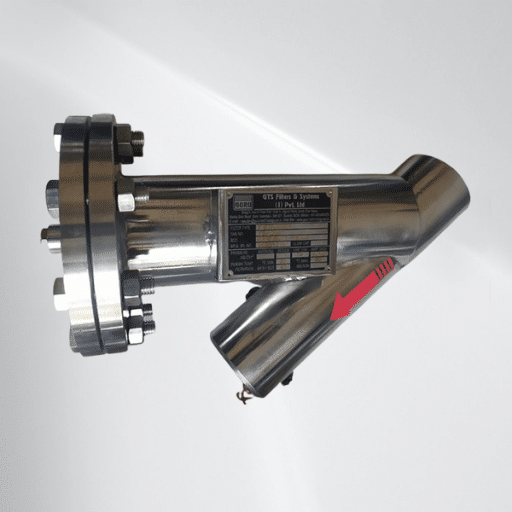
Y-strainers represent the workhorse of industrial pipeline protection. Their compact design, high-pressure capability, and straightforward maintenance make them the default choice for pump protection, steam service, and general process filtration.
ASME Pressure Class Ratings
The pressure ratings of Y-strainers adhere to the valve standard classification system established by ASME B16.34. The proper specification process requires knowledge of these rating systems.
The Class 150 Y-strainers operate at a pressure rating of 285 PSIG which corresponds to 100°F and 19.7 bar at 38°C. The maximum permitted pressure at higher temperatures follows the derating curves which ASME B16.34 specifies. The Class 150 carbon steel strainer operates at 500°F and its pressure limit reaches approximately 175 PSIG. The strainers operate in various industrial applications which include water distribution systems and low-pressure steam systems and process cooling systems.
The Class 300 Y-strainers provide users with higher pressure capabilities which reach a maximum of 740 PSIG at 100°F. The pressure-temperature derating curve permits higher stress levels throughout the entire temperature range, thus Class 300 becomes suitable for medium-pressure steam systems and chemical process piping and high-pressure hydrocarbon applications.
The Class 600 Y-strainers operate at their highest capacity because they hold a pressure rating of 1,480 PSIG which applies at 100°F. The Class 600 standard maintains high-pressure capability because it allows carbon steel elements to operate at 600 PSIG pressure up to 838°F. The strainers function in power generation for high-pressure steam and petroleum refining and essential process protection applications.
ASTM Material Specifications
The selection of Y-strainer body materials requires assessment of corrosion resistance needs and temperature limits and applicable code requirements.
The standard material for carbon steel Y-strainers is ASTM A216 WCB (Wrought Carbon Steel, Grade B). This casting grade provides excellent mechanical properties at moderate cost, suitable for water, steam, oil, and gas service where corrosion is not a primary concern. WCB metal maintains its properties within the temperature range of -29°C to +425°C.
The cast stainless steel equivalents of 304 and 316 stainless steel exist as ASTM A351 CF8 and CF8M. CF8M (316 equivalent) is the most common choice for corrosive service, providing resistance to a wide range of chemicals and atmospheric corrosion. The molybdenum addition in CF8M improves resistance to pitting and crevice corrosion in chloride-containing environments.
The low-temperature carbon steel grades ASTM A352 LCB and LCC are designed for cryogenic applications. Standard carbon steels lose their ductility when operating systems reach temperatures below -29 °C. LCC (Low-Temperature Carbon Steel, Grade C) maintains impact resistance down to -46°C and lower, essential for cold climate installations and cryogenic process systems.
The screen materials use SS 304 or SS 316 mesh as standard options, while Monel or Hastelloy serve as special materials for extremely corrosive environments. The screen must match the corrosion resistance of the body material—using a carbon steel screen in a stainless steel strainer defeats the purpose of the corrosion-resistant construction.
Mesh Size & Filtration Range
The number of openings per linear inch defines mesh designation, while higher mesh numbers provide better filtration capabilities.
The 20 mesh filter at 850 microns captures all large debris, which includes big particles, welding slag, and gasket pieces. The system protects rotating equipment from catastrophic damage, which pumps need to handle in their cleanest operational state.
The industrial standard for general Y-strainer applications requires a 40 mesh 400 micron mesh size. The system protects against sand and grit, and pipe scale while maintaining low pressure drop and avoiding frequent cleaning needs.
The 60 mesh 250 microns filter provides advanced protection for delicate equipment, which includes control valves, small-bore instrumentation, and mechanical seals. The system requires additional cleaning because it causes higher pressure loss through its operation.
The 100 mesh 150 micron filter establishes the maximum operational capacity of standard Y-strainer screens. The system becomes more effective through basket strainers and bag filters because open area restrictions lead to increased pressure loss and clogging frequency.
Y-Strainer Applications
Y-strainers demonstrate their superior performance capabilities through their ability to deliver pressure ratings together with their compact design in specific application instances.
Pump Protection: Y-strainers must be installed before centrifugal and positive displacement pumps because they stop debris from entering the pumps which would cause operational failures. The compact design fits into the limited space typically available at pump suction connections. Specify 20-40 mesh for general pump protection; finer screens may cause excessive suction pressure drop which will lead to cavitation.
Steam Systems: High-pressure steam lines need filters to protect turbine blades and steam traps and control valves from pipe scale and debris. Users prefer Y-strainers because they can manage steam pressures and temperatures that would destroy bag filters. The installation requires a horizontal screen element and a downward-facing blow-off valve to enable proper condensate drainage.
Natural Gas Pipelines: Y-strainers installed in pipelines protect all downstream equipment which includes regulators and meters and compression equipment. The materials used in sour gas service containing hydrogen sulfide (H₂S) must meet NACE MR0175 requirements through material selection which includes ASTM A352 LCC or stainless steel grades with verified hardness limits.
High-Pressure Hydrocarbon Service: Refinery and petrochemical process piping systems operate at pressures which exceed 1,000 PSI. The only strainer technology which can safely operate under these pressures while maintaining debris protection requires metal materials.
Bag Filter Housing Specifications

Bag filter systems provide fine filtration capability that metal strainers cannot achieve. When your application requires removing particles smaller than 100 microns, bag filters become the appropriate technology choice.
Housing Materials & Pressure Ratings
Bag filter housings are produced using different material choices which meet specific application needs.
The 304 and 316 Stainless Steel housings offer the widest range of chemical compatibility while maintaining their structural strength. 316L low-carbon construction serves as the standard material for environments which require aggressive chemical service and food and pharmaceutical applications and sites which face chloride stress corrosion cracking risks. The standard operating capacity of these housings reaches 150 PSI while their advanced models can operate at 300 PSI maximum pressure.
Carbon Steel housings provide economical advantages for applications which do not require corrosion protection such as water treatment and oil filtration. Process facilities can choose to use internal coatings or linings which provide basic chemical resistance.
Polypropylene PP housings offer affordable chemical protection against acids and alkalis and various corrosive substances. The temperature restrictions of PP housings which have a maximum of 140°F limit their use to conditions that match ambient temperatures.
Bag Sizes & Flow Capacities
The filtration industry has standardized bag dimensions, enabling interchangeability between manufacturers.
Size #1 Bags measure 7 inches in diameter by 17 inches long, providing approximately 0.19 m² of filter area. Standard flow capacity ranges to 100 GPM depending on fluid viscosity and filtration rating. Size #1 housings fit applications with space constraints or lower flow requirements.
Size #2 Bags measure 7 inches in diameter by 32 inches long, providing approximately 0.41 m² of filter area. These are the industry standard for industrial applications, handling flows to 200 GPM with 100-micron bags. Size #2 offers the best balance of flow capacity, debris-holding volume, and housing size.
Multi-Bag Housings accommodate 2 to 18 bags in parallel, enabling flow capacities exceeding 2,000 GPM. These systems use individual bag sealing mechanisms allowing bag replacement without system shutdown. Multi-bag configurations are common in water treatment, chemical processing, and large cooling water systems.
Micron Ratings & Media Types
The ability of a bag filter to capture particles depends on its micron ratings which define its filtration effectiveness. The correct specification requires understanding how nominal ratings and absolute ratings differ from each other.
The filter will capture most particles at the rated size according to Nominal Ratings which show 60-90% efficiency but some smaller percentage will pass through. Nominal-rated bags suit general pre-filtration and equipment protection applications where complete removal isn’t critical.
Absolute Ratings (99%+ efficiency) ensure essentially complete removal of particles at or above the rated size. Absolute-rated bags are essential for critical applications protecting membranes, spray nozzles, and analytical instruments where any particulate contamination causes operational problems.
The chemical compatibility of Polypropylene Media extends to water and organic acids and alkalis and various solvents. Standard polypropylene bags handle temperatures to 200°F, with high-temperature formulations extending to 225°F.
The Nylon Media material provides enhanced compatibility with organic solvents and oils and hydrocarbons. The typical temperature limit for nylon bags reaches 325°F which makes them appropriate for hot oil filtration and elevated-temperature chemical processes.
Polyester Media exhibits excellent chemical resistance while maintaining stable dimensional properties. Polyester is often specified for petroleum products, paints, and coating applications.
Bag Filter Applications
Bag filters serve applications which need to filter materials at high levels of precision while operating under medium pressure conditions.
Water Treatment Pre-Filtration: Bag filters protect reverse osmosis membranes and ion exchange resins and UV disinfection systems from drum particulate contamination. A staged approach using 50-100 micron bags upstream of 5-10 micron final filtration extends the life of expensive membrane elements.
Chemical Processing: Fine chemical production often requires removing catalyst fines and precipitates and crystalline solids from process streams. Bag filters provide the necessary filtration without the pressure limitations of cartridge systems.
Food & Beverage: Edible oil filtration and syrup clarification and beverage production use food-grade polypropylene bags which meet FDA requirements. The single-use nature of bag media prevents cross-contamination between production batches.
Paint & Coatings: Paint manufacturing needs to eliminate oversized pigment particles and all impurities before the final product enters packaging. Bag filters provide the necessary clarity without the pressure drop of finer membrane filtration.
Basket Strainers: The Middle Ground

Basket strainers occupy the space between compact Y-strainers and disposable bag filters, offering higher debris capacity than Y-strainers with reusable metal media that bag filters cannot provide.
Simplex vs. Duplex Configurations
The main choice when specifying a basket strainer depends on whether the application can withstand maintenance requirements for cleaning purposes.
Simplex Basket Strainers contain a single basket element. The system needs a complete shutdown process when debris fills the basket. Simplex designs cost less and work well for batch processes which require minimal shutdown time and handle low debris loading conditions.
Duplex Basket Strainers use two separate strainer chambers which include a diverting valve that connects both chambers. The first basket is cleaned while the flow redirects to the second chamber. This system enables continuous operation which chemical processing and power generation and all production systems that require non-stop operation to prevent safety problems or production interruptions need.
Duplex strainer switching valves require proper specification. Three-way plug valves or butterfly valve assemblies must handle full system pressure and provide positive sealing to prevent bypass of unfiltered fluid. The specified valve materials must be suitable for both process fluid and current operating temperature conditions.
Basket Strainer Specifications
Basket strainers provide better specifications than Y-strainers in situations that require their specific use.
The cylindrical basket design offers more screen area than Y-strainer screens which match the size of the pipe. The system achieves extended cleaning intervals because of its ability to operate with partially blocked pipes.
Basket strainers enable cost-effective fine mesh filtration at 60 to 100 mesh through their increased screen area while maintaining lower pressure loss rates compared to Y-strainers which operate at the same line size. Some designs offer 200-mesh capability for specialized applications.
Basket strainer designs enable fast maintenance access through their quick-opening cover systems. The system uses swing bolts and hinged covers along with yoke-style closures to enable basket removal without the need to disassemble the entire cover system. The system enables faster maintenance processes while decreasing labor expenses for high-demand work environments.
ASME B16.34 Compliance: Y-strainers and basket strainers both follow ASME B16.34 pressure-temperature standards which include Class 150 300 and 600 rating options. The material specifications use ASTM standards to define A216 WCB for carbon steel and A351 CF8M for stainless steel.
When to Specify Basket Strainers
Basket strainers become the correct choice when specific application conditions align with their capabilities.
Higher Debris Loads: The cooling water systems and river water intakes together with process streams that carry heavy particulate loads gain advantages from the basket strainer which offers extended capacity to retain particles. The larger basket volume means less frequent cleaning and more consistent flow between service intervals.
Reusable Media Requirement: Applications where disposable media costs would be prohibitive—such as high-flow systems with continuous contamination—favor the cleanable metal basket over ongoing bag replacement expenses.
Large Particle Removal with Lower Pressure Drop: The basket’s greater filtration area reduces pressure drop compared to equivalent Y-strainers. In large-diameter piping (8 inches and above), basket strainers become increasingly advantageous over Y-strainers from both pressure drop and maintenance access perspectives.
Continuous Operation Needs: When system shutdown is unacceptable, duplex basket strainers provide the only practical solution among reusable strainer technologies.
Side-by-Side Technical Comparison

Selecting the optimal filtration technology requires comparing specifications across the parameters that matter for your application.
Filtration Capability Comparison
| Parameter | Y-Strainer | Basket Strainer | Bag Filter |
|---|---|---|---|
| Filtration Range | 40 mesh – 500 μm | 5 – 200 μm | 1 – 200 μm |
| Pressure Rating | Up to 6,000 PSI | Up to 1,500 PSI | 100 – 300 PSI |
| Temperature Range | -196°C to 650°C | -196°C to 650°C | Up to 325°F (media dependent) |
| Debris Capacity | Low | High | Very High |
| Media Type | Reusable metal | Reusable metal | Disposable fabric |
| Initial Pressure Drop | Moderate | Low-Moderate | Low (when clean) |
Y-strainers handle the highest pressures but offer the smallest debris capacity and coarsest filtration. Bag filters provide the finest filtration and highest debris-holding capacity but at significantly reduced pressure ratings. Basket strainers offer a middle position with reusable metal media and substantial debris capacity.
Material Specifications Comparison
| Component | Y-Strainer | Basket Strainer | Bag Filter Housing |
|---|---|---|---|
| Carbon Steel | ASTM A216 WCB | ASTM A216 WCB | 304/316 SS or CS |
| Stainless Steel | ASTM A351 CF8M | ASTM A351 CF8M | 316L standard |
| Low-Temp Service | ASTM A352 LCC | ASTM A352 LCC | Limited options |
| Screen/Basket | SS 304/316 mesh | SS 304/316 mesh | N/A |
| Gaskets | Spiral wound/graphite | Spiral wound/graphite | EPDM/Viton |
Material selection follows the same corrosion resistance principles across all three technologies. The critical difference is that bag filter housings are typically stainless steel regardless of application, because the disposable bag provides the process contact surface.
Flow & Maintenance Comparison
| Factor | Y-Strainer | Basket Strainer | Bag Filter |
|---|---|---|---|
| Pressure Drop (clean) | Moderate-High | Low-Moderate | Low |
| Pressure Drop (dirty) | High | Moderate | High |
| Cleaning Method | Blow-off or disassembly | Basket removal | Bag replacement |
| Downtime Required | Minimal (with blow-off) | Moderate (Simplex) / None (Duplex) | Moderate |
| Labor Intensity | Low | Moderate | Moderate |
| Ongoing Media Cost | None | None | Ongoing bag cost |
| Maintenance Frequency | Higher | Lower | Lowest |
Y-strainers with blow-off valves can be partially cleaned without shutdown—a unique advantage for high-pressure systems. Basket strainers require more involved maintenance but less frequently. Bag filters offer the lowest maintenance frequency but require ongoing consumable expenditure.
Application-Specific Selection Guide

The correct filtration technology depends on industry-specific requirements, operating conditions, and regulatory constraints.
Oil & Gas Industry
Upstream production facilities face unique challenges because they deal with three main problems which include sand production and sour gas and high-pressure operation.
Upstream Production: Sand and debris accompany hydrocarbon production from many reservoirs. The installation of ASTM A216 WCB Y-strainers with 20-40 mesh screens must take place upstream of wellhead chokes and separators and production pumps. The operation of high sand-cut wells requires duplex basket strainers because this equipment allows additional operation through the process of cleaning.
Pipeline Transport: High-pressure transmission pipelines need Class 600 (or higher) Y-strainers at compressor station suction and custody transfer points. The material for sour gas service containing H₂S must meet NACE MR0175 standards which require the use of ASTM A352 LCC or duplex stainless steels that have hardness values under 22 HRC.
Produced Water Treatment: Water which separates from hydrocarbon production contains oil droplets together with suspended solids and scale. Multi-bag filter systems with 10-50 micron polypropylene bags provide the fine filtration needed for reinjection or discharge compliance.
Chemical Processing
Chemical plants need filtration systems which can handle both their harsh chemical processes and their requirement for nonstop function.
Aggressive Chemicals: Specify 316L stainless steel or Hastelloy construction for acids, chlorides, and oxidizing chemicals. Verify gasket and seal materials for chemical compatibility—Viton for hydrocarbons, PTFE for aggressive acids, EPDM for alkalis.
Continuous Processes: Chemical manufacturing operations require ongoing production without any breaks. The Duplex basket strainers system allows operators to clean strainer baskets while keeping the system operational at full capacity. The strainer should be designed to handle the expected maximum debris capacity plus an additional 25 percent safety margin.
Fine Chemicals: Pharmaceutical intermediates and specialty chemicals need to eliminate both catalyst fines and crystalline solids from their products. The bag filters with 1-25 micron ratings deliver the required level of clarification. The use of absolute-rated bags is essential when complete particle removal is required.
Power Generation
Steam power plants function under extremely high temperature and pressure conditions which create the need for unique filtration solutions.
Steam Systems: Power plants need Y-strainers which can handle high-pressure steam conditions for both their boiler feedwater and their steam lines. For high-temperature applications use ASTM A216 WCB or A217 WC9 as your material specification. The installation of strainers requires horizontal screen positioning to stop condensate from building up.
Cooling Water: The circulating cooling water systems operate under heavy debris conditions which emerge from both cooling tower operations and environmental contamination. The Duplex basket strainers deliver all the operational capacity needed for these systems to run successfully. The system needs 3/16″ to 1/4″ perforations to achieve effective removal of coarse debris.
Boiler Feed: The process of producing boiler feedwater requires multiple stages of filtration to achieve high purity standards. The system begins with Y-strainers or basket strainers for coarse protection, followed by cartridge or bag filtration for fine polishing before the boiler.
Water Treatment
Water treatment plants need to use filters which can handle all types of materials from very large particles to very small particles which need to be eliminated.
Raw Water Intake: River and lake and well water intakes need to use coarse filtration systems which safeguard their pumps and treatment systems. The system uses basket strainers which have 1/8″ to 1/4″ perforations to manage high debris loads while maintaining the usual water treatment facility flow rates.
RO Pre-Filtration: Reverse osmosis membranes show extreme sensitivity toward any particulate matter which damages them. The optimal protection method involves using Y-strainers and basket strainers to provide coarse protection which leads into 5-10 micron bag filters that maintain protection for RO membranes.
Process Water: The industrial process water requirements need to be determined according to each specific application. Pharmaceutical and food processing require sanitary-grade bag filter housings with 316L construction and FDA-compliant gaskets. General industrial applications can use standard carbon steel or stainless housings.
Pressure Drop & Sizing Calculations
Correct sizing ensures adequate flow capacity without excessive pressure loss. Undersized filtration creates energy costs and potential capacity limitations; oversized filtration wastes capital expenditure.
Y-Strainer Pressure Drop Factors
Pressure drop across Y-strainers depends on size, flow rate, mesh selection, and debris loading.
Flow Coefficient (Cv) values characterize clean-screen pressure drop. A typical 2-inch Y-strainer might have a Cv of 98, meaning 98 GPM flow creates 1 PSI pressure drop with clean screen. Pressure drop increases with the square of flow rate—doubling the flow quadruples the pressure drop.
Mesh Correction Factors adjust Cv for finer screens:
| Mesh Size | Pressure Drop Multiplier |
|---|---|
| 20 mesh | 1.0 (baseline) |
| 40 mesh | 1.2 |
| 60 mesh | 1.4 |
| 80 mesh | 1.6 |
| 100 mesh | 1.7 |
A strainer with 5 PSI clean pressure drop using 20 mesh would show approximately 8.5 PSI drop with 100 mesh at the same flow rate.
Clogging Impact: As debris accumulates, pressure drop increases progressively. A fully loaded screen can create 15 PSI additional pressure drop. Size strainers conservatively and monitor differential pressure to establish cleaning schedules before excessive pressure drop occurs.
Bag Filter Sizing
Bag filter sizing must account for micron rating, viscosity, and dirt-holding requirements.
Flow Rate vs. Micron Trade-offs: Finer filtration reduces maximum flow capacity. A Size #2 bag housing might handle 200 GPM with 100-micron bags, but only 100 GPM with 5-micron bags in the same fluid. Consult manufacturer flow curves for specific ratings.
Viscosity Corrections: Standard ratings assume water-like viscosity (1 cP). For thicker fluids—oils, syrups, chemical solutions—flow capacity decreases proportionally. A fluid with 10 cP viscosity achieves roughly one-tenth the flow rate of water through the same filter.
Dirt-Loading Calculations: Estimate debris loading rate from upstream process knowledge. Size housings so that bag replacement intervals align with maintenance schedules—typically weekly to monthly for most applications. Frequent bag changes indicate undersizing; bags lasting months with minimal pressure rise may indicate oversizing.
Sizing Best Practices
Following established engineering practices prevents common sizing errors.
Size for Maximum Flow Plus Margin: Size filtration equipment for the maximum anticipated flow rate plus 20% margin. This accommodates future capacity expansion and prevents excessive pressure drop during peak demand periods.
Monitor Differential Pressure: Install differential pressure indicators across all filtration equipment. For Y-strainers and basket strainers, clean when pressure drop reaches 5-10 PSI above baseline. For bag filters, change bags when differential pressure reaches 10-15 PSI or per manufacturer recommendation.
Consider Start-Up Debris Loads: New piping systems generate substantial debris during initial commissioning—welding slag, thread sealant fragments, mill scale. Size initial filtration conservatively or plan for more frequent service during the first weeks of operation.
Installation & Maintenance Best Practices

Correct installation and proactive maintenance maximize filtration effectiveness and equipment lifespan.
Installation Orientation
Filtration equipment installation orientation affects both performance and maintenance accessibility.
Y-Strainer Orientation: For liquid service, install Y-strainers with the screen element oriented downward into the Y-leg. This positioning allows debris to settle into the collection chamber and enables effective blow-off cleaning. For steam or gas service, horizontal installation prevents condensate accumulation that could cause water hammer or corrosion.
Bag Filter Housing Orientation: Bag filters must be installed vertically with the bag hanging downward. This orientation uses gravity to maintain the bag’s shape and ensures even flow distribution across the media. Horizontal installation causes uneven loading and premature bag failure.
Clearance Requirements: Provide adequate clearance below Y-strainers and basket strainers for screen/basket removal. A general rule is clearance equal to the strainer body length plus 6 inches. For bag filters, ensure adequate headroom for bag changeout—typically 18-24 inches above the housing.
Blow-Off Valve Utilization
Y-strainers equipped with blow-off valves enable partial cleaning without disassembly.
Blow-Off Procedure: With the system operating, slowly open the blow-off valve to flush accumulated debris from the screen chamber. Collect discharge in a suitable container or drain. Close the valve when discharge runs clear.
Limitations: Blow-off cleaning removes only loose debris from the collection chamber. Material firmly adhered to the screen requires complete removal and manual cleaning. Schedule periodic full disassembly for thorough screen cleaning even with regular blow-off operation.
Safety Considerations: Blow-off discharges pressurized fluid. Ensure discharge piping is rated for system pressure and directed to a safe location. Use caution when opening blow-off valves on high-pressure or high-temperature systems.
Differential Pressure Monitoring
Differential pressure across filtration equipment indicates service status and cleaning requirements.
Gauge Installation: Install differential pressure gauges or switches across all permanent filtration installations. Simple liquid-filled gauges provide visual indication; differential pressure switches can provide remote alarm signals or automatic cleaning activation.
Baseline Establishment: Record clean-element pressure drop during initial startup. This baseline establishes the reference for determining when cleaning or replacement is required.
Alarm Setpoints: Establish differential pressure alarm points based on manufacturer recommendations and system capacity. Typical values are 10 PSI above baseline for cleaning indication and 15 PSI for urgent alarm.
Maintenance Scheduling
Proactive maintenance prevents the emergency repairs that result from neglected filtration.
Y-Strainer Maintenance: In clean systems, annual inspection may suffice. In systems with significant debris, monthly or quarterly cleaning is typical. Establish inspection frequency based on differential pressure trends—clean when pressure drop reaches setpoint regardless of calendar schedule.
Bag Filter Maintenance: Replace bags based on differential pressure or time-in-service, whichever comes first. Even lightly loaded bags can degrade over time, potentially releasing fibers into the process stream.
Spare Parts Inventory: Maintain spare screens or baskets for critical strainers, and a supply of replacement bags for bag filter systems. Stocking these consumables prevents extended downtime when maintenance is required.
Frequently Asked Questions
What distinguishes a Y-strainer from a bag filter?
Y-strainers use reusable metal screens for coarse filtration, which captures particles that exceed 400 microns (40 mesh). They operate under high pressure conditions that reach 6,000 PSI and high temperature conditions that reach 650°C. Bag filters use disposable fabric media for fine filtration from 1 to 200 microns, which operates at moderate pressures of 100-300 PSI. Y-strainers meet the requirements for high-pressure steam systems and pump protection and general industrial applications. Bag filters perform particle removal operations that need to capture fine particles from water treatment and chemical processing and paint production.
What pressure rating is a Class 150 Y-strainer?
According to ASME B16.34 Class 150 Y-strainers have a pressure rating of 285 PSIG at 100°F (19.7 bar at 38°C). The rating decreases as the temperature rises according to standard pressure-temperature derating curves. At 500°F a Class 150 carbon steel strainer usually derates to about 175 PSIG. The specific pressure-temperature charts from manufacturers should be consulted to obtain precise ratings because material heat treatment and design variations will influence the equipment’s capabilities.
What is 40 mesh in microns?
The measurement of 40 mesh corresponds to a value of approximately 400 microns (0.4 mm) in size. The mesh designation indicates the number of openings that exist within each linear inch of the filtration material because higher mesh numbers results in more precise filtration. The following Y-strainer mesh conversions show common values: 20 mesh equals 850 microns, 40 mesh equals 400 microns, 60 mesh equals 250 microns, 80 mesh equals 177 microns, 100 mesh equals 149 microns. For reference, human hair presents a diameter range between 50 to 70 microns.
When should I use a duplex basket strainer?
Duplex basket strainers become necessary when industrial operations need to continue without any system shutdowns. The system includes two chambers that operate together through a diverting valve which enables flow movement between two baskets for cleaning purposes while one basket continues to filter. The use of duplex strainers becomes vital for chemical processing power generation and essential cooling water systems which need to maintain constant operation to prevent production disruptions and safety risks. The additional expense amounts to
What material is best for sour gas Y-strainers?
For H₂S-containing sour gas service, specify materials meeting NACE MR0175 requirements. The standard selection consists of ASTM A352 LCC (low-temperature carbon steel) and duplex stainless steels (UNS S31803, S32205) which have hardness values that stay below 22 HRC. The combination of hydrogen sulfide with moisture and stress makes standard carbon steels unsuitable for sour service because this leads to sulfide stress cracking. The NACE requirements must be confirmed for all wetted components which include screens and gaskets and bolting elements not just the body material.
Can bag filters handle high temperatures?
Standard polypropylene bag filters operate effectively up to a maximum temperature of 200°F (93°C). The high-temperature nylon bags provide an extended operational range which reaches 325°F (163°C). The use of metal strainer technology becomes necessary for temperatures which exceed this range. The temperature compatibility between bag media and housing seal materials must be verified because the housing gasket typically serves as the primary limiting element. Steam service and high-temperature hydrocarbon applications require Y-strainers or basket strainers with metal-to-metal seals.
How do I calculate strainer pressure drop?
Start with the manufacturer’s Cv (flow coefficient) for the strainer size. The equation for pressure drop calculates as Pressure drop (PSI) equals (Flow Rate divided by Cv) squared. The pressure drop for a strainer with a Cv of 100 which passes 200 GPM equals 4 PSI of clean pressure drop. Apply mesh correction factors for fine screens—multiply baseline pressure drop by 1.2 for 40 mesh, 1.4 for 60 mesh, 1.7 for 100 mesh. The sizing calculations need a 10-15 PSI extra allowance which accounts for debris loading.
What situations require basket strainers instead of Y-strainers?
Choose basket strainers when: (1) debris loading is high—basket strainers hold substantially more debris than Y-strainers; (2) continuous operation is required—duplex basket strainers enable cleaning without shutdown; (3) piping is 8 inches or larger—basket strainers become more economical and practical than large Y-strainers; (4) finer filtration is needed—basket strainers better accommodate 60-100 mesh screens witho
Conclusion
The choice of Y-strainers or basket strainers or bag filters as your filtration technology needs you to investigate both your contaminant profile and your operational conditions and your maintenance ability. Y-strainers enable industrial operations to achieve high-pressure protection through their space-efficient design. The design of basket strainers allows operators to handle high-volume tasks while running their systems without interruption in demanding situations. Through their ability to deliver fine filtration, bag filters surpass the capabilities of metal screens, which prohibit their use in sensitive industrial processes.
The decision framework operates in a direct manner because Y-strainers must be specified for high-pressure service applications that exceed 300 PSI or need compact installation solutions. The selection of basket strainers should be made when there are high debris loads that need to be handled for stations which require continuous operation through their large-diameter piping systems. Bag filters function as the solution which enables filtration but requires operation at pressures that match the needs of the system.
Material selection requires equal importance because standard service uses ASTM A216 WCB carbon steel while ASTM A351 CF8M stainless steel provides corrosion protection and NACE-compliant materials serve sour gas applications. The protection requirements should determine the screen or bag micron rating which must not exceed the necessary size because that would result in excessive pressure loss and maintenance requirements.
The technical team at Zhongzheng provides filtration specification support for various industries, which include oil and gas and chemical processing and power generation and water treatment systems. Our company produces Y-strainers and basket strainers and bag filter housings using both carbon steel and 316L stainless steel, and we possess complete ASME compliance documentation. Your line list needs submission with all flow rates and operating pressure and temperature and filtration requirements, and our engineers will determine the proper technology and size and material choice within 24 hours.