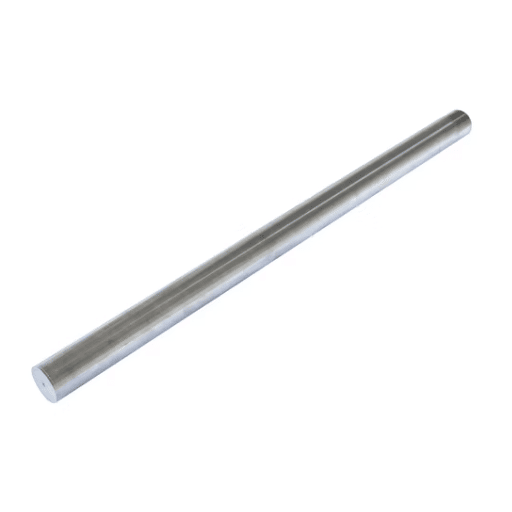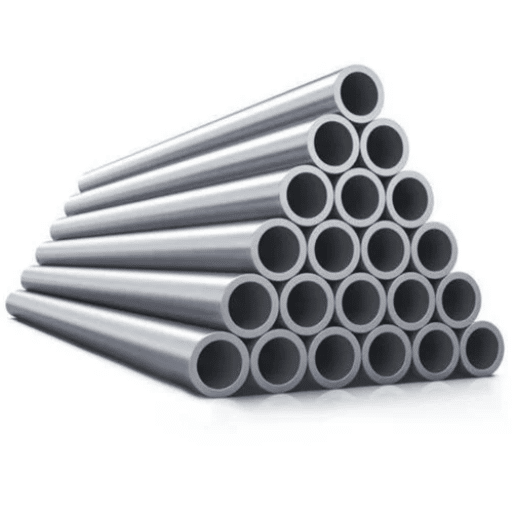
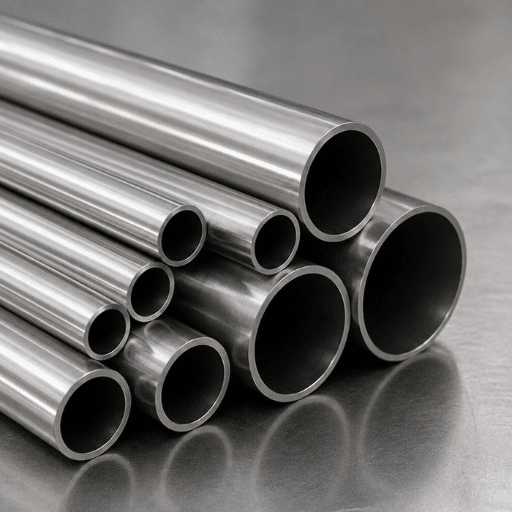
There is no single duplex 2205 pipe pressure rating. The pressure capacity of a duplex 2205 pipe depends on schedule, pipe outside diameter, grade basis (UNS S32205 or S31803), design temperature, and whether the pipe is seamless or welded. Change any one of those variables and the rating changes.
A Schedule 40S NPS 2 duplex 2205 pipe calculates to roughly 4,100 psi at ambient temperature with a seamless joint factor. The same pipe in Schedule 80S is closer to 5,900 psi. Step the schedule up to NPS 6 and the same Schedule 40S wall supports about 2,600 psi, because the wall thickness holds roughly constant while the diameter grows. And every one of those figures is only valid at the allowable stress you read from the current ASME B31.3 Table A-1 for your design temperature.
This duplex 2205 pipe pressure rating guide gives you the schedule tables engineers ask for, the B31.3 calculation method so you can reproduce any number, the temperature limits that generic stainless charts hide, and the receiving-inspection checks that confirm the delivered pipe matches the design basis.
Key Takeaways
- There is no universal duplex 2205 pipe pressure rating; it is conditional on schedule, grade basis, temperature, joint factor, and governing code.
- At the same schedule, duplex 2205 carries roughly 1.5 times the pressure of 316L, because its ambient allowable stress is near 30,000 psi versus about 20,000 psi for 316L.
- Duplex 2205 service is normally limited to about 600°F (316°C) maximum sustained temperature; above that, sigma-phase precipitation embrittles the material irreversibly.
- A welded duplex pipe carries a quality factor near 0.85 under B31.3, which is roughly 15% lower pressure capacity than seamless at the same dimensions.
- Design pressure and hydrostatic test pressure are different numbers; a pipe that passed a mill hydrotest is not automatically rated for that pressure in service.
Need a rating for a specific line? Send your design pressure, design temperature, NPS, and governing code; the technical team confirms the correct grade and schedule within 24 hours.
What Determines the Duplex 2205 Pipe Pressure Rating?

Every published table, including the ones in this guide, is a calculation applied to a stated set of assumptions. If you change the assumption, you change the number. That is why “the rating of 2205 pipe” is not a single value that a supplier can quote without knowing your design conditions.
The four variables engineers actually control
Four inputs dominate the internal-pressure calculation for duplex 2205 pipe:
- Wall thickness (schedule). Thicker wall, higher rating. The schedule designation selects a nominal wall for a given NPS.
- Outside diameter. For a fixed wall thickness, a larger diameter pipe supports less internal pressure because hoop stress rises with diameter.
- Allowable stress (S). This comes from the material specification and the governing code, and it changes with temperature.
- Quality factor (E). Seamless pipe carries a full factor; welded duplex pipe carries a lower factor that reflects the longitudinal seam.
Corrosion allowance and any thread or groove depth are subtracted from the wall before the calculation. The pressure formula is a starting point for design, not the complete design rule. Codes also impose minimum wall thickness, buckling and stiffness checks, fatigue review for cyclic service, and system-level limits that no single table can capture.
B36.19M schedules available for duplex 2205
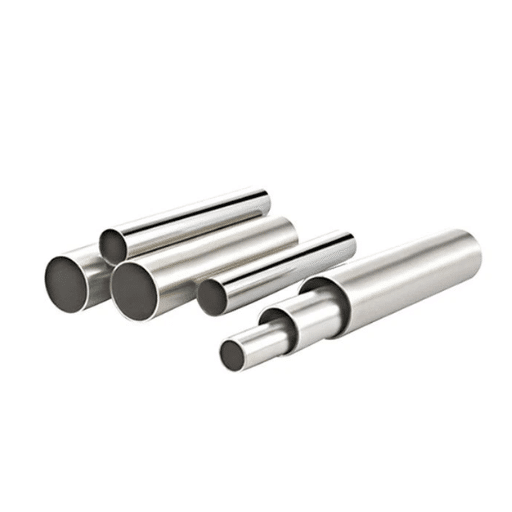
Duplex 2205 pipe is manufactured to the dimensions and schedules of ASME B36.19M, the standard for stainless steel pipe. The common stainless schedules are 5S, 10S, 40S, and 80S, with XS and XXS also available. Typical size ranges cover NPS 1/8 to 24, though project-specific requirements can extend that.
Schedule is a wall-thickness designation, not a pressure rating. A Schedule 40S NPS 1 pipe and a Schedule 40S NPS 12 pipe are both “Schedule 40S,” but their pressure capacities are very different. For a broader explanation of how schedules work across the stainless steel family, see our duplex stainless steel pipe grades and standards guide and the complete duplex stainless steel guide.
Duplex 2205 Allowable Stress and the ASME B31.3 Method
ASME B31.3, Process Piping, is the code most often applied to duplex 2205 process pipe. It defines how allowable stress is derived, how the design pressure formula is applied, and which temperature limits apply to duplex grades. No supplier table can substitute for the code, but the method is straightforward enough to apply yourself.
The B31.3 pressure formula
For thin-wall internal pressure, the B31.3 design pressure equation reduces to:
P = 2 × S × E × (t − c) / (D − 2 × Y × (t − c))Where:
- P = internal design gage pressure
- S = allowable stress from B31.3 Table A-1 at the design temperature
- E = longitudinal weld joint factor (seamless = 1.0; welded duplex is typically lower)
- t = nominal wall thickness
- c = corrosion allowance plus any thread or groove depth
- D = outside diameter
- Y = coefficient of 0.4 for ferritic and austenitic steels below about 900°F
For a worked example, a Schedule 40S NPS 2 pipe has an outside diameter of 2.375 in and a wall of 0.154 in. With S = 30,000 psi, E = 1.0, c = 0, and Y = 0.4:
P = 2 × 30,000 × 1.0 × 0.154 / (2.375 − 2 × 0.4 × 0.154)
P = 9,240 / 2.252 = 4,103 psi
That is the method behind the tables below. Anyone who gives you a rating for 2205 pipe should be able to show you the same math.
Allowable stress for S32205 and S31803
Duplex 2205 is normally specified as UNS S32205, with S31803 as the legacy grade basis still permitted under ASTM A790. Under common pipe specifications, S32205 has a minimum yield strength of about 450 MPa (65 ksi) and a minimum tensile strength of about 620 MPa (90 ksi). The B31.3 tensile-basis rule, S = minimum of UTS divided by 3 and two-thirds of yield, gives an ambient allowable near 30,000 psi (207 MPa) for general service.
Do not treat 30,000 psi as a fixed number. It is an approximation of the general-service basis, and the exact value varies by code edition, value basis, and the minimum certified tensile for the ordered product form. The correct procedure is to read S for S32205 from the current B31.3 Table A-1 at your design temperature. All example tables in this guide state the S value used so the numbers can be reproduced and re-checked. The S32205 pipe pressure rating is only as defensible as the allowable-stress basis behind it.
Seamless versus welded: the quality factor
The joint factor E accounts for the longitudinal seam in welded pipe. Under B31.3:
- Seamless duplex pipe: E = 1.0.
- Welded duplex pipe (ERW/EFW per A790): typically E = 0.85, subject to confirmation for the specific manufacturing method in the current Table A-1B.
A factor of 0.85 means roughly 15% lower pressure capacity at the same dimensions. That is a practical reason seamless duplex pipe is specified for high-pressure service. At elevated temperature, the weld-strength-reduction factor W can reduce welded-pipe capacity further.
For a direct comparison of seamless and welded options for your specification, see our seamless stainless steel pipe and welded stainless steel pipe product information.
Light-wall Schedule 10S duplex is commonly supplied as welded pipe, while high-pressure service usually specifies seamless construction. That split drives both the joint factor and the documentation your RFQ should name.
[YouTube embed placeholder: insert an authoritative technical video on duplex 2205 pipe fabrication or ASME B31.3 pressure design before publication.]
Duplex 2205 Pipe Pressure Rating Tables by Schedule

The tables below show approximate ambient pressure ratings for seamless duplex 2205 pipe. Assumptions: S = 30,000 psi, E = 1.0, Y = 0.4, c = 0, B36.19M dimensions. Values are illustrative at these assumptions. Read S from the current B31.3 Table A-1 and confirm with the mill for a project-specific rating.
Table 1: Schedule 40S
| NPS | OD (in) | Wall (in) | Rating (psi) | Rating (bar) |
|---|---|---|---|---|
| 1/2 | 0.840 | 0.109 | 8,700 | 600 |
| 3/4 | 1.050 | 0.113 | 7,100 | 490 |
| 1 | 1.315 | 0.133 | 6,600 | 455 |
| 1.5 | 1.900 | 0.145 | 4,900 | 340 |
| 2 | 2.375 | 0.154 | 4,100 | 283 |
| 3 | 3.500 | 0.216 | 3,900 | 270 |
| 4 | 4.500 | 0.237 | 3,300 | 228 |
| 6 | 6.625 | 0.280 | 2,600 | 180 |
| 8 | 8.625 | 0.322 | 2,300 | 160 |
| 10 | 10.750 | 0.365 | 2,100 | 145 |
| 12 | 12.750 | 0.375 | 1,800 | 125 |
Table 2: Schedule 80S
The duplex 2205 pipe schedule 80 pressure ratings are the most commonly requested in high-pressure process service, because the thicker wall carries a meaningfully higher rating:
| NPS | OD (in) | Wall (in) | Rating (psi) | Rating (bar) |
|---|---|---|---|---|
| 1/2 | 0.840 | 0.147 | 12,200 | 840 |
| 3/4 | 1.050 | 0.154 | 10,000 | 690 |
| 1 | 1.315 | 0.179 | 9,200 | 635 |
| 1.5 | 1.900 | 0.200 | 6,900 | 475 |
| 2 | 2.375 | 0.218 | 5,900 | 405 |
| 3 | 3.500 | 0.300 | 5,500 | 380 |
| 4 | 4.500 | 0.337 | 4,800 | 330 |
| 6 | 6.625 | 0.432 | 4,100 | 285 |
| 8 | 8.625 | 0.500 | 3,600 | 250 |
| 10 | 10.750 | 0.500 | 2,900 | 200 |
| 12 | 12.750 | 0.500 | 2,400 | 165 |
Table 3: Schedule 10S
For lower-pressure, weight-critical systems, Schedule 10S offers a light wall at a lower rating. It is common in utility, brackish-water, and moderate-chloride circuits where the pressure requirement is modest:
| NPS | OD (in) | Wall (in) | Rating (psi) | Rating (bar) |
|---|---|---|---|---|
| 1/2 | 0.840 | 0.083 | 6,400 | 440 |
| 3/4 | 1.050 | 0.083 | 5,100 | 350 |
| 1 | 1.315 | 0.109 | 5,300 | 365 |
| 1.5 | 1.900 | 0.109 | 3,600 | 250 |
| 2 | 2.375 | 0.109 | 2,900 | 200 |
| 3 | 3.500 | 0.120 | 2,100 | 145 |
| 4 | 4.500 | 0.120 | 1,600 | 110 |
| 6 | 6.625 | 0.134 | 1,200 | 83 |
Important: These tables assume seamless pipe at ambient temperature with no corrosion allowance. A 0.050 in corrosion allowance, a welded joint factor, or an elevated design temperature each changes the result. Use the tables to screen schedules, then run the calculation for the actual service.
Need a schedule check for a specific line? Send the design pressure, design temperature, NPS, and governing code with your S32205 duplex pipe enquiry. The technical team confirms grade, schedule, and documentation requirements within 24 hours.
Temperature Limits: Where Generic Tables Mislead
Generic stainless steel pressure charts are built around austenitic grades such as 304 and 316L. Duplex 2205 is a different metallurgy with a different service envelope, and that difference matters more than any pressure table value. For the 304/316L equivalent of these tables, see our stainless steel pipe pressure rating guide.
Maximum sustained service temperature
Duplex 2205 is normally limited to about 600°F (316°C) maximum sustained service temperature. Above that range, sigma-phase and chi-phase precipitation begin to embrittle the material, and the damage is irreversible. Some mill guidance is more conservative, capping sustained service near 482°F (250°C) because alpha-prime (475°C embrittlement) can initiate below the sigma threshold.
The practical consequence: the 2205 pressure advantage over 316L narrows as temperature approaches this ceiling. Near the ceiling, the allowable stress is derated, and the material is operating closer to a metallurgical limit that austenitic grades do not face at the same temperature. The duplex 2205 pipe max temperature therefore governs how much of that advantage is usable in service.
Minimum design temperature
At the low end, duplex 2205 is normally qualified to about -50°C (-58°F) by impact testing. B31.3 lists a -20°F minimum design temperature for duplex in general-service tables. Below that range, an austenitic grade such as 316L is the correct choice, because duplex loses the Charpy toughness that cryogenic and very low temperature service requires.
The derating curve
To see the shape of the derating curve without mixing rating systems, consider ASME B16.5 flange ratings for SAF 2205 Class 600. The rating falls from about 1,500 psig at ambient to roughly 1,440 psig at 200°F, 1,330 at 300°F, 1,230 at 400°F, 1,150 at 500°F, and about 1,115 psig at 600°F, a reduction of roughly 26%. Flange ratings are a separate pressure-rating system from pipe wall calculations, but they illustrate the same principle: duplex capacity erodes steadily as temperature rises, and the rate is worth accounting for at the design stage.
For more on how the duplex microstructure behaves in chloride service and at elevated temperature, see our duplex stainless steel corrosion resistance guide.
Duplex 2205 vs 316L: Pressure Rating Comparison
The single most useful commercial fact about duplex 2205 is its allowable-stress advantage. At ambient temperature, S32205 carries an allowable stress near 30,000 psi, while 316L is about 20,000 psi. All else equal, that is roughly 1.5 times the pressure capacity at the same schedule.
Comparison at the same schedule
| NPS | Schedule | 2205 rating (psi) | 316L rating (psi) |
|---|---|---|---|
| 2 | 40S | 4,100 | 2,700 |
| 2 | 80S | 5,900 | 4,000 |
| 4 | 40S | 3,300 | 2,200 |
| 4 | 80S | 4,800 | 3,200 |
The 316L figures use the same B31.3 method at S = 20,000 psi. Present them as “2205 carries roughly 1.5 times the pressure at the same schedule,” not as universal ratings.
Wall-thickness optimization
The reverse view is just as important. For a fixed design pressure, duplex 2205 supports a thinner wall than 316L. As an illustrative calculation, an NPS 4 line rated at about 2,200 psi needs the 0.237 in Schedule 40S wall in 316L but only about 0.16 in in 2205, roughly one-third less wall material.
Illustrative scenario: When Ana’s offshore contractor compared 316L and 2205 for a replacement seawater header, the 2,200 psi NPS 4 line required Schedule 40S in 316L but a calculated wall near 0.16 in in 2205. The project specified a custom-wall 2205 line and cut the pipe-wall weight by roughly a third, reducing support loads and weld counts. The decision stayed honest because the service remained below 482°F, so the duplex temperature ceiling never became the limiting factor. Note that 0.16 in falls between standard S-schedules, which is why custom wall thicknesses are common in duplex pressure procurement.
The trade-off: 316L wins for elevated-temperature and cryogenic service, and for projects where the fabrication shop is not qualified for duplex welding. For the full grade-selection discussion, see our duplex 2205 vs 316L comparison.
Design Pressure vs Hydrostatic Test Pressure

Design pressure and hydrostatic test pressure are routinely confused in duplex pipe procurement. They are different numbers with different purposes.
Per ASTM A790, each pipe must withstand a hydrostatic test calculated so that the resulting hoop stress does not exceed a stated fraction of the specified yield strength. The mill records this as evidence that the pipe is sound. Per ASME B31.3, the system hydrostatic test is typically 1.5 times the design pressure, temperature-corrected. Neither of these is the pipe’s service rating.
A pipe that “held the test” is not automatically rated for that pressure in service. The design pressure is the number that drives schedule selection, wall-thickness calculation, and code compliance. The hydrotest is a verification that the fabricated system holds together at a defined overpressure. Confusing the two is one of the more expensive procurement errors in pressure piping, because a pipe can pass a test and still be under-specified for the operating envelope.
In rare cases the test pressure itself drives schedule selection, when the specified test pressure, temperature-corrected, exceeds the rating of the chosen schedule. That is a design decision for the responsible authority, not a mill-supplier choice.
How to Verify Your Duplex 2205 Pipe Meets the Rating
A pressure rating on paper is only useful if the delivered pipe matches the assumptions behind it. Receiving inspection is where that gets confirmed.
Check the MTR
The Mill Test Report should confirm, at minimum:
- Grade basis: UNS S32205 or S31803, exactly as specified on the purchase order.
- Mechanical properties: yield and tensile values against the design basis, not just against the minimum.
- Wall thickness: actual measured wall, because the rating depends on it linearly.
- Heat number and solution-annealing condition: traceability and the required duplex solution-annealing heat treatment.
- Hydrotest record and test pressure: evidence of the mill hydrostatic test per the applicable standard.
Supplementary requirements for pressure service
For duplex pressure service, projects commonly specify additional controls: positive material identification (PMI) on receipt, ferrite-content verification to confirm the austenite-ferrite phase balance, Charpy impact testing, and third-party inspection when the project quality plan requires it. ASTM A923 is the test methods standard for detecting detrimental intermetallic phases in duplex stainless steel and is frequently specified for pressure-service duplex pipe.
Illustrative scenario: At receiving inspection for a chemical plant project, the inspector flagged a batch of NPS 2 Schedule 80S duplex pipe because the MTR listed S31803 while the purchase order specified S32205, and the recorded wall sat near the lower tolerance limit. The batch was set aside, the supplier confirmed the heat actually met the S32205 mechanical minimums, and an amended certificate was issued before installation. An hour spent checking the MTR prevented a line whose documented design basis never matched the pipe in the rack.
At Zhongzheng, every heat entering the production line is spectrographically verified before manufacturing, finished duplex pipe is ultrasonically tested and hydraulically proven before shipment, and the MTR reflects what was physically measured from the material rather than what was merely ordered. If you are preparing an RFQ for duplex 2205 pipe, our ASTM A790 duplex seamless pipe requirements page covers the specification details in full.
Conclusion: Apply the Method, Not Just the Number
The duplex 2205 pipe pressure rating is not a lookup value. It is the output of a calculation that depends on schedule, grade basis, temperature, joint factor, and code. Use the tables in this guide as a screening tool, run the B31.3 calculation for your actual design conditions, and verify the delivered pipe against the MTR on receipt.
Three checks keep a duplex 2205 specification defensible: confirm the grade basis and allowable stress for the design temperature, confirm seamless versus welded construction and its joint factor, and confirm the service stays inside the duplex temperature envelope. Those controls matter as much as any schedule table.
Send Zhongzheng your design pressure, design temperature, NPS, and applicable standard. The technical team confirms grade, schedule, and delivery options within 24 hours, with full MTR and test documentation aligned to your project requirements.
Frequently Asked Questions
What is the pressure rating of duplex 2205 pipe?
There is no single rating. It depends on schedule, pipe size, grade basis, temperature, and whether the pipe is seamless or welded. As an example, seamless Schedule 40S NPS 2 duplex 2205 pipe rates near 4,100 psi at ambient, while the same pipe in Schedule 80S rates near 5,900 psi at the stated assumptions. There is no single duplex 2205 pipe working pressure either; the value is a function of the line’s design conditions.
Is duplex 2205 pipe stronger than 316L pipe?
At the same schedule, yes, by roughly 1.5 times. Duplex 2205 has an ambient allowable stress near 30,000 psi versus about 20,000 psi for 316L under common B31.3 practice. The advantage narrows as temperature approaches the duplex ceiling of about 600°F.
What is the maximum working temperature for duplex 2205 pipe?
About 600°F (316°C) maximum sustained service temperature. Above that, sigma-phase and chi-phase precipitation embrittle the material irreversibly. Some mill guidance is more conservative, capping sustained service near 482°F (250°C) due to 475°C embrittlement concerns.
Can duplex 2205 pipe be used for high-pressure service?
Yes. The combination of high allowable stress and a seamless joint factor makes 2205 a common choice for high-pressure chloride service, such as produced-water and offshore systems. Confirm the design pressure, temperature, schedule, and joint factor with the calculation before specifying.
What is the difference between 2205 and 2507 pressure ratings?
2205 (UNS S32205/S31803) and super duplex 2507 (UNS S32750) are different grades. 2507 has a higher allowable stress and is the choice for higher-pressure and more severe chloride service. Full super duplex pressure data belongs on its own page; for a grade-level comparison, see our duplex vs super duplex guide.
How is duplex 2205 pipe pressure rating calculated?
Use the ASME B31.3 formula P = 2SE(t – c) / (D – 2Y(t – c)), with S read from Table A-1 at the design temperature, E = 1.0 for seamless, Y = 0.4, and the corrosion allowance subtracted from the wall.