The right stainless steel rectangular tube surface finish is the one you can write on a purchase order and verify when it arrives: a finish code (No.4, hairline, mirror, electropolished), a maximum surface roughness in Ra micrometers, and a grain direction. This guide explains how a welded rectangular tube’s finish actually works, which finish codes apply to tube rather than sheet, and how to protect that finish through fabrication so it survives the job site.
Two lengths of rectangular tube can look identical in a supplier photograph and behave very differently in service. One is mill finish at roughly 1.0 to 2.5 Ra. The other is a No.4 brushed finish at 0.4 to 0.8 Ra. In a coastal handrail, that difference is measured in how many seasons pass before tea staining appears. And because rectangular tube is a closed, welded section, there is a third surface nobody photographs: the interior, which is locked in at the forming line and can never be mechanically polished once the box is closed.
The finish is usually the last specification a buyer writes. It is also the first one a client sees fail. This guide is written by the mill that forms, welds, anneals, polishes, and electropolishes the section, so we can tell you exactly what happens to every surface, including the one you cannot see. Start with our complete stainless steel rectangular tube guide for the grade and geometry decisions, browse the stainless steel rectangular tube range, or read on for the finish specification you can paste straight onto an RFQ.
Key Takeaways
- A welded rectangular tube has three surfaces: the exterior faces (mechanically polishable), the corners and edges, and the interior of the closed section, which is fixed by the parent strip finish at forming and cannot be polished after welding.
- Flat-rolled finish numbers like 2B and No.4 from ASTM A480 describe the strip. After forming, the rectangular tube exterior is specified by grit per SSINA convention: No.4 equals roughly 150 to 180 grit, hairline 240 to 320 grit, buffed mirror to a No.8 look.
- A smoother finish gives chlorides fewer anchor points and is easier to clean, but finish never substitutes for grade. Coastal service still needs 316L, and finish is the second decision you make alongside it.
- Brushed and hairline finishes carry a directional grain that will not match across a mitered joint if sections are rotated; specify grain direction and keep cut orientation consistent.
- When you weld pre-finished tube, the finish is not done until heat tint is removed, iron contamination is cleaned off with dedicated stainless tooling, the joint is blended through the same grit progression, and the part is passivated.
What a Surface Finish Actually Is on a Rectangular Tube

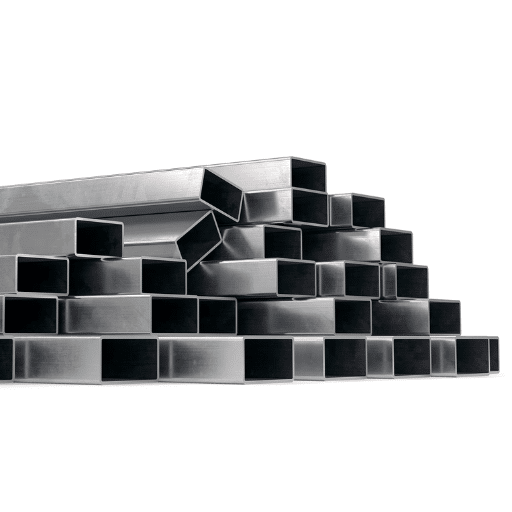
Start with the product form, because it decides everything else. Rectangular tube is welded mechanical tubing, manufactured to ASTM A554. A flat strip is roll-formed into a rectangular profile and closed with an ERW or TIG weld. That manufacturing route, not a sheet mill and not a seamless pipe process, defines what “finish” can mean. For the forming and welding detail behind that route, see how welded rectangular tube is manufactured.
Once the strip is closed into a box, you are specifying three surfaces at once:
- The exterior faces. These are mechanically polishable to nearly any grit after forming. This is the surface in every product photograph and the one most finish guides talk about.
- The corners and edges. They carry the tightest geometry and are the hardest to polish uniformly. On brushed sections, the grain wraps the corner, and a poor corner polish is the first thing an inspector notices.
- The interior of the closed section. This surface is fixed when the strip is formed and welded. You cannot reach inside a finished box to grind or polish it. If the interior must be smooth for a hygienic frame or a clean-room support, the decision is made at the strip, by starting from 2B or bright annealed strip, or by whole-tube bright annealing in a controlled atmosphere. It is not made later at a polishing station.
This is why rectangular tube finish guidance written for flat sheet or round pipe misleads. Sheet has one polished face and an open back you can process. Round sanitary pipe can be internally polished or electropolished along its bore. A rectangular box section cannot. Anyone selling you “internal polishing” on a closed rectangular tube is describing something that does not physically happen on a structural section.
Stainless Steel Rectangular Tube Surface Finish Codes: Which System Applies
The fastest way to write an ambiguous specification is to mix up three different finish-code systems. Here is the mapping that keeps them straight.
Flat-rolled finish numbers describe the strip (ASTM A480)
Rectangular tube starts as stainless strip, and strip finishes carry the flat-rolled numbers from ASTM A480/A480M: No.1 (hot-rolled, annealed, and pickled), 2D (dull, cold-rolled and pickled), 2B (cold-rolled, annealed, pickled, and skin-passed for a smooth matte), and BA (bright annealed in a controlled atmosphere). When you order “2B tube,” you are really ordering tube formed from 2B strip. The A480 numbers describe the starting material, not the finished tube exterior.
After forming, the exterior is specified by grit (SSINA convention)
Once the strip is formed, the exterior upgrade is a mechanical polishing operation described by abrasive grit. The architectural-tube convention follows SSINA’s surface finish designations: No.4 is a brushed finish at roughly 150 to 180 grit with a short-directional satin grain; hairline (HL) is finer, around 240 to 320 grit, with long, continuous lines; a buffed mirror takes the surface through fine abrasives up to a highly reflective, No.8-class finish.
A complete exterior specification reads as a chain: “2B strip, formed and welded, then exterior polished to No.4 (150 to 180 grit), Ra 0.8 max.” Say both the starting strip and the finished exterior and there is no ambiguity.
Hygienic references use ASME BPE SF ratings
For the reader building clean-room supports or pharmaceutical equipment frames, the third system is ASME BPE. Its SF ratings sort product-contact surfaces from mechanically polished grades near Ra 0.5 max up to electropolished grades around Ra 0.38 max. BPE governs round hygienic process components, not rectangular structural framing. Use it here as a reference point for how smooth an electropolished surface can be held, then cross over to our electropolished stainless steel tubing and bright annealed stainless steel tubing pages for the round-tubing process detail.
| Strip code (ASTM A480) | What it means | After forming to rectangular tube |
|---|---|---|
| No.1 | Hot-rolled, annealed and pickled | Mill-type surface; structural base |
| 2D | Cold-rolled, pickled, dull | Base for heavier polishing |
| 2B | Cold-rolled, annealed, pickled, skin-passed | Smooth matte; standard base for tube |
| BA | Bright annealed in reducing atmosphere | Bright surface; smooth-interior option |
The Rectangular Tube Finish Menu (with Ra Values)
Here is the finish menu we work with on welded rectangular tube, with the surface roughness each level typically produces. Ra is arithmetic average roughness in micrometers, and the values below are indicative industry ranges. Actual readings vary with strip route, grit, belt condition, and measurement method, which is why you specify a maximum Ra, not a target band. Re-verify any band against your supplier’s measured values and the current standard edition before you treat it as a guarantee.
| Finish | How it is made | Typical Ra (μm) | Appearance | Typical rectangular-tube use |
|---|---|---|---|---|
| Mill / annealed & pickled | Formed, welded, annealed and pickled; no mechanical polish | ~1.0-2.5 | Dull matte, scale-free | Structural, hidden or painted frames, machine guards |
| 2B base strip (unpolished tube) | Cold-rolled strip, annealed, pickled, skin-passed | ~0.2-0.5 | Smooth, uniform matte grey | General framing; base for further polishing |
| No.4 brushed (150-180 grit) | Mechanical abrasive-belt polishing | ~0.4-0.8 | Short-directional satin grain | Architectural handrails, balustrades, most-specified decorative finish |
| Hairline HL (240-320 grit) | Finer mechanical polishing, continuous long lines | ~0.2-0.4 | Fine, elegant linear grain | Premium architectural trim, visible frames |
| Mirror No.8 | Multi-stage fine abrasives plus buffing | <0.1-0.2 | Highly reflective, scratch-sensitive | Feature and decorative elements, luxury interior rail |
| Bright annealed (BA) | Controlled-atmosphere anneal, no pickling | ~0.05-0.2 | Bright, oxide-free | Smooth-interior requirement, precision work |
| Electropolished | Electrochemical anodic dissolution | <=0.4 | Bright, leveled, non-directional | Food, beverage and pharma frames, clean-room supports |
| Bead blasted | Fine glass or ceramic bead impact | Not Ra-defined | Uniform non-reflective matte | Architectural use where glare and fingerprints must be minimized |
Read the cost ladder the same way. Mill and 2B base are cheapest, then No.4, then hairline, then mirror, with electropolished at the top of the range for the sections it suits. Bright annealed sits between mill and mirror depending on the order. Polishing cost rises non-linearly: moving a mechanical finish from Ra 0.8 to 0.4 can roughly double the polish cost, and mirror and electropolished finishes demand careful handling, protective film, and premium packing. Anyone quoting a fixed surcharge percentage without a size, grade, and date is guessing. Ask for the number on your specific section instead.
Not sure which finish your application needs? Send the environment and a photo of the intended use to our technical team, and we will recommend a finish and a maximum Ra within 24 hours rather than guess from a catalog.
Finish, Corrosion, and Grade: Decisions You Make Together

A smoother finish holds less salt and soil, gives chlorides fewer microscopic anchor points, and cleans down faster. Within one grade, then, a higher-grit or electropolished surface is more corrosion-tolerant and lower-maintenance than the same grade at mill finish.
Finish never substitutes for grade. A 304 tube with a mirror finish can still tea-stain in aggressive coastal air, because the passive film is only as good as the alloy under it. Grade is the first corrosion decision and finish is the second, and you make them together. For the full grade comparison, our 304 vs 316L grade selection guide walks through where each grade holds up.
Coastal and marine: 316L plus a smooth finish and vertical grain
Tea staining is the rust-colored film you see on stainless railings near the sea. It is cosmetic surface corrosion, not structural rust, and it is driven by chlorides depositing on the surface. For coastal exposure, specify 316L, a smooth finish such as hairline or mirror so there is less for salt to grip, and orient the grain vertically so rain rinses contaminants downward. A monthly fresh-water rinse in salt-air zones removes deposits before they become stains. The Nickel Institute publishes the authoritative guidance on chloride corrosion of stainless grades.
Interior and urban exterior: when 304 plus No.4 is correct
Inside a building, or in a sheltered urban exterior with no chloride load, the mirror-and-electropolish spend buys nothing. A dry interior frame or a covered walkway in 304 with a No.4 brushed finish will outlive the building and cost a fraction of the coastal specification. This is the honest part of finish selection: the expensive finishes earn their keep only where the environment or the cleanliness requirement demands them.
Food, beverage, and pharmaceutical frames: 316L electropolished
Equipment frames and clean-room supports in process industries are specified in 316L and frequently electropolished, because the surface must stand up to clean-in-place chemicals and inspection. Electropolishing removes a thin surface layer electrochemically, drawing out embedded iron and leveling micro-roughness, and it is the default finish for hygienic framing. Note the terminology: electropolishing is an electrochemical process, not a synonym for mirror polishing. It leaves a bright, non-directional surface, and where hygienic service is the driver we call it what it is.
Brushed Grain Direction: The Fitment Nobody Warns About
A brushed or hairline finish is not uniform. It has a grain, and that grain is directional. Cut a length of pre-finished tube, rotate one section 90 degrees at a mitered return, and the grain on the two faces will run in different directions. On a long balustrade run, the mismatch reads instantly as a visible flaw.
Dan, a balustrade contractor in Leeds, learned this the hard way in 2024. He ordered 60 x 40 mm hairline-finished 316L and cut every section from the same stock lengths, but his team flipped alternate infill sections to make the mitered corners fit. When the architect walked the run, half the panels reflected light one way and half the other. The fix was re-polishing every joint on site with a flap disc, at a cost that erased the margin on the whole job.
Three rules prevent it. Specify the grain direction, normally longitudinal, on the purchase order. Keep every cut in the same orientation through fabrication. And where a joint cannot avoid a direction change, plan to blend it with a flap disc through the same grit progression as the parent finish.
Fabricating Welded Rectangular Tube: Protecting and Restoring the Finish
Most rectangular tube is not installed straight from the crate. It is cut, drilled, and welded into a handrail, a frame, or a balustrade. Every one of those operations attacks the finish. A finish specification is incomplete until it includes the fabrication protocol.
Heat tint: why welds discolor and how to remove it
Welding heats the metal around the joint to annealing temperatures, and the heat-affected zone oxidizes into the straw-blue colors of heat tint. Heat tint is not just cosmetic. It is a chromium-depleted oxide layer that can locally reduce corrosion resistance, and on visible work it looks wrong. Remove it mechanically by grinding and blending, or by pickling, before you passivate. On a visible No.4 or hairline section, that means re-polishing the joint back through the same grit sequence as the parent finish.
Iron contamination: dedicated stainless tooling and why passivation matters
Carbon-steel brushes, worn grinding discs, and shop dust embed free iron into the stainless surface. The iron rusts, and the rust stains the stainless around it, even on 316L. Use dedicated stainless-steel brushes and tooling on stainless, and clean the surface thoroughly before passivation.
Passivation is the final chemical step. A citric or nitric acid treatment removes embedded iron and lets the chromium-oxide passive layer reform. It does not change roughness or appearance, and it is not a polish. It is the step that makes a cleaned and blended weld as corrosion-resistant as the parent tube, and the British Stainless Steel Association publishes solid practical guidance on both pickling and passivation practice.
The weld-restoration sequence
Follow this order when a visible joint must match the parent finish:
- Grind the weld cap flush, stopping short of thinning the parent wall.
- Remove heat tint fully in the affected zone.
- Re-polish the joint through the parent finish’s grit progression, starting coarse and stepping finer.
- Blend the polished zone into the surrounding grain so the boundary disappears.
- Clean the whole section and passivate it as the final step.
One warning applies to electropolished sections specifically. Electropolishing reveals defects rather than hiding them, so any weld that is not ground flush before electropolishing shows up sharply afterward. That is why electropolishing is best done at the mill on clean, pre-ground sections, and why field welds on an electropolished frame need careful local blending before any final electrochemical pass.
Specifying a coastal or field-welded structure? We can advise on grain direction, weld restoration, and whether to ship pre-finished tube or mill-finish tube for on-site finishing, because the right answer depends on who is doing the welding.
Mirror and Electropolished Rectangular Tube: When to Pay for Them
Mirror No.8 and electropolished finishes are the most expensive on the menu, and both are frequently over-specified. They are worth the money in specific places.
Mirror No.8 is a decorative finish: highly reflective, specified for feature elements, luxury interiors, and marine rail where the look is the point. It shows fingerprints, scratches, and every dust mote, so it demands careful handling, protective film during transport, and high-touch maintenance in service. If the section is hidden or brushed is fine for the design, mirror is a cost with no benefit.
Electropolished rectangular tube earns its premium where the surface is a performance requirement: hygienic food, beverage, and pharmaceutical frames, clean-room supports, and washdown environments where surface cleanliness and easy cleaning matter. It produces a Ra of about 0.4 or better, removes embedded iron, and leaves a passive surface that resists bacterial adhesion. When an OEM machine builder asked us to mirror-polish the 304 guards on a dry interior line, we recommended a No.4 brushed finish instead, kept the protective film on for shipment, and cut their finishing cost substantially. The guards perform identically in a dry environment, and the client’s buyer now asks the same question on every order. That is the kind of guidance a mill should give you, even when it means a smaller order value.
Bead blasted rectangular tube is the specialty option for architectural work where glare and fingerprints are the enemy: a uniform, non-reflective matte that hides handling marks. It trades the directional grain of brushed finishes for a consistent texture and is worth specifying on inquiry for exposed interior architecture.
Common Finish Specification Mistakes

Most finish failures are specification failures, and they are avoidable. The ones we see repeatedly:
- Writing “polished” with no code. Polished could mean anything from a light scuff to a mirror. Name the finish and the grit.
- No maximum Ra. A finish name without a number is not measurable, so it cannot be verified or rejected at receiving inspection.
- No grain direction on a brushed or hairline section ordered for a visible installation.
- Ignoring the interior. If a closed section needs a smooth interior, the choice is made at the strip or by bright annealing, not by later polishing.
- Over-specifying Ra and paying double. Moving a mechanical finish from Ra 0.8 to 0.4 can roughly double polish cost for a benefit nobody can see at arm’s length.
- Expecting a mirror finish to hide scratches. A mirror shows every defect. Brushed and bead-blasted finishes hide handling marks far better.
- Ordering mirror or electropolished tube without protective film and premium packing, then receiving a scratched surface.
- Skipping sample approval on a visible architectural order, then discovering the grain or color is wrong only after a container arrives.
Each of these is closed by putting a measurable finish on the order and approving a physical sample before production.
How to Specify a Stainless Steel Rectangular Tube Surface Finish
A finish specification that survives receiving inspection states the code, the number, and the handling. Copy this block into your RFQ and adapt the details:
Finish specification: No.4 brushed (150 to 180 grit) per SSINA architectural convention, exterior faces only. Maximum Ra 0.8 μm, measured perpendicular to grain. Grain longitudinal. Sample of the finish to be approved before production. Protect finished surfaces with PVC sleeving or protective film for shipment.
Choose the entry that matches your need. For coastal or hygienic service, name the grade alongside the finish, 316L for both, and raise the bar: hairline or mirror for coastal rail, electropolished at Ra 0.4 max for hygienic frames. For a hidden or painted structural section, mill finish is correct and cheaper.
A complete order pairs the finish line with the rest of the specification string: standard and grade (ASTM A554, MT-316L), dimensions as outside width x outside height x wall, and fixed or random lengths. The rectangular tube size and dimension charts list the standard A x B x wall combinations and tolerances to build the order around.
At the mill, the finish you specify is only as trustworthy as the verification behind it. We check chemistry on every heat before forming, gauge finished sections in-line, and where a finish tolerance is specified, we confirm surface roughness with a profilometer and retain an approved sample against production. A measurable specification is one we can prove we met.
Frequently Asked Questions
What finishes are available for stainless steel rectangular tube?
Mill or annealed and pickled, 2B base strip, No.4 brushed (150 to 180 grit), hairline (240 to 320 grit), mirror No.8, bright annealed, electropolished, and bead blasted. Mill and 2B are the economical structural options; No.4 and hairline dominate architectural handrails; mirror, electropolished, and bead blasted serve specific decorative and hygienic needs.
What is the difference between a 2B and a No.4 finish?
2B is a flat-rolled strip finish: cold-rolled, annealed, pickled, and skin-passed to a smooth, matte grey. It describes the strip a tube is formed from. No.4 is a mechanically polished exterior finish at about 150 to 180 grit with a short-directional satin grain, applied to the tube after forming.
Can a rectangular tube be electropolished?
Yes. A rectangular tube can be electropolished where a smooth, non-directional, easy-to-clean surface is required, typically 316L frames for food, beverage, and pharmaceutical equipment. Electropolishing is an electrochemical process that removes a thin surface layer and embedded iron, commonly to Ra 0.4 or better.
Does a mirror finish prevent rust?
No. A mirror finish gives chlorides fewer anchor points and holds less salt and soil, which reduces tea staining, but it does not change the grade. A 304 mirror-finish tube can still tea-stain near the coast; 316L is the grade decision, and finish is a separate second decision.
How do I stop stainless steel tea staining near the coast?
Specify 316L for coastal service, choose a smooth finish such as hairline or mirror so salt has less to grip, orient the grain vertically so rain rinses deposits off, design out water traps, and rinse the surface with fresh water periodically in salt-air zones.
What Ra value do I need for a food or pharma equipment frame?
For hygienic rectangular-tube framing, a common requirement is 316L electropolished at Ra 0.4 max, matching the surface-smoothness level hygienic standards expect of product-contact and clean-room surfaces. Confirm the exact Ra against your own hygienic design standard and inspection method.
Is the inside of the rectangular tube finished too?
The interior is fixed at forming. You cannot mechanically polish the inside of a closed welded box after it is made, so the interior surface is whatever the parent strip carried. If a smooth interior is required, start from 2B or bright annealed strip or specify whole-tube bright annealing.
Conclusion: Specify the Finish You Can Actually Verify
A rectangular tube finish is not a single surface or a single number. It is three surfaces, one of which you cannot see or reach, governed by a code system that changes depending on whether you are describing the strip, the polished exterior, or a hygienic reference. Decide the grade and the finish together, keep the environment honest about whether you need mirror or electropolish at all, specify grain direction on visible brushed sections, and protect the finish through fabrication with heat-tint removal, stainless tooling, blending, and passivation.
Then make it measurable. Put a stainless steel rectangular tube surface finish you can verify on the purchase order: a finish name, a maximum Ra, and a grain direction. Approve a physical sample before production and ask for profilometer verification on the run. A finish you can measure is a finish you can hold a supplier to.
Send us your application, environment, and A x B x wall x length. Our technical team will confirm the correct finish and Ra within 24 hours, and we can ship an approved finish sample before you commit. Browse the stainless steel rectangular tube product range or speak with our technical team to start the conversation.