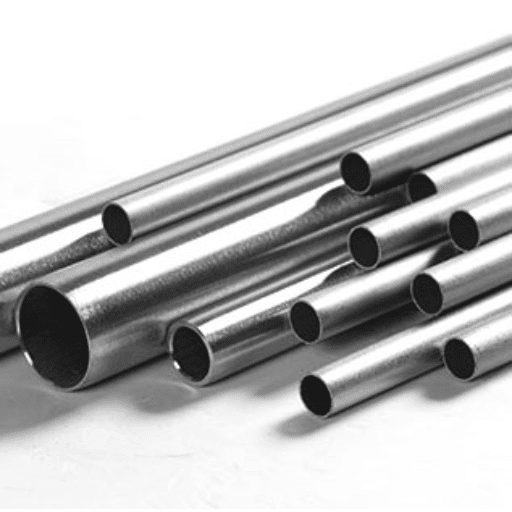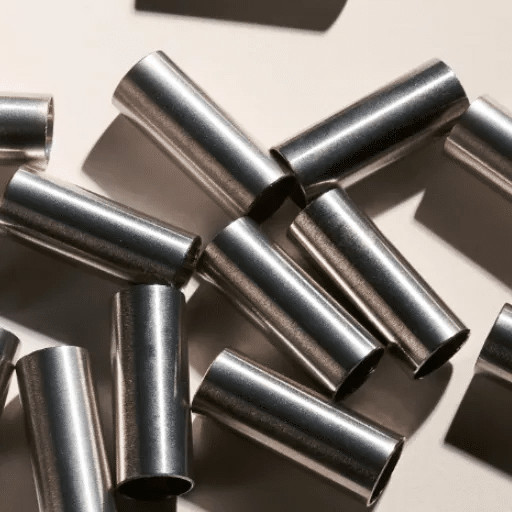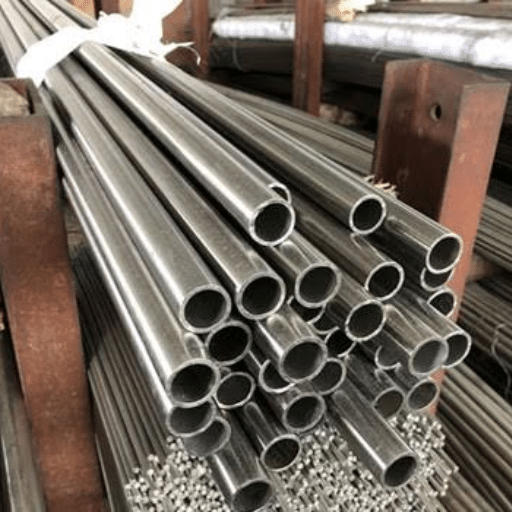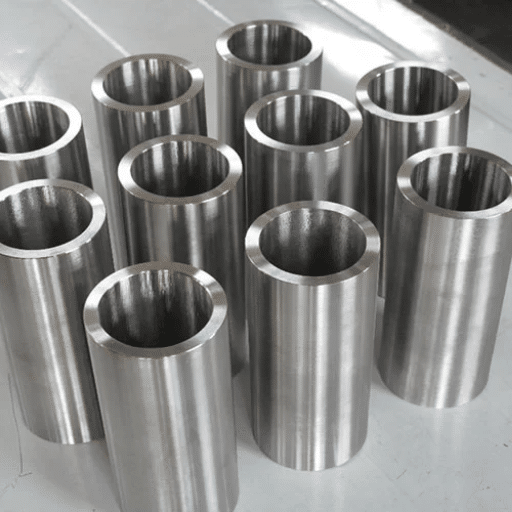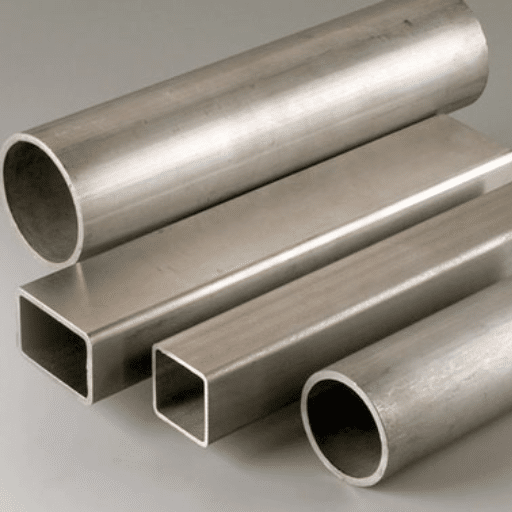
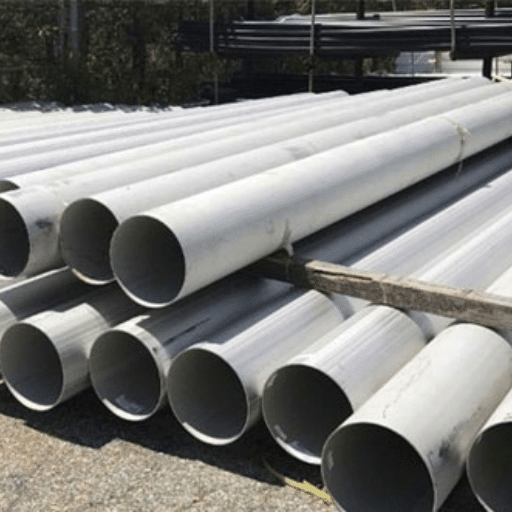
Monel 400 pipe is seamless or welded pipe made from the nickel-copper alloy UNS N04400, supplied as seamless to ASTM B165 and as welded pipe to ASTM B725. It contains at least 63% nickel and 28 to 34% copper, and no chromium. It resists hydrofluoric acid, caustic, and low-velocity seawater because it is noble in a reducing environment, not because it forms a chromium passive film. That same missing chromium is why it fails the moment the chemistry turns oxidising.
That one fact settles most Monel 400 selection arguments, and it is the fact most supplier pages leave out. In 2022, an alkylation unit on the US Gulf Coast replaced a carbon steel spool in an HF service line with Monel 400 after two corrosion-related shutdowns. The Monel spool performed exactly as specified for four years. A second spool, added later in a line where the acid had been contaminated with dissolved chlorine from a leaking cooler, failed within eleven months. Same grade, same nominal service, two different outcomes. The difference was the oxidiser, not the alloy.
This article gives you the composition, the standards map, the real corrosion envelope with its numbers and limits, the temperature rules, and the documentation package to put on the RFQ. It will also tell you where Monel 400 stops working, and which grade takes over when it does.
Key Takeaways
- Monel 400 (UNS N04400) is a nickel-copper alloy with no chromium and no molybdenum. Seamless pipe and tube are ASTM B165, welded pipe is ASTM B725, welded tube is ASTM B730, and heat-exchanger tube is ASTM B163. The split is by product form, not quality.
- Its performance comes from nobility in reducing environments, not from a passive film. That is why PREN is not applicable to this grade, and why the circulating figure of 22 to 25 is not a valid PREN.
- Monel 400 is immune to chloride stress corrosion cracking and corrodes at below 0.025 mm/y in flowing seawater, but it is susceptible to crevice and pitting attack in stagnant or low-velocity seawater, and hot stagnant high-chloride brine above roughly 60 °C is a do-not-specify condition.
- Monel K500 (N05500) is a different grade, not a stronger version of 400. It is age-hardened, costs 15 to 30% more, and its weld metal is not age-hardenable, so a K500 weld is weaker than the K500 base metal. Do not substitute one for the other.
- Expect roughly 7 to 8 times the price of an equivalent 316L pipe, with the 480 °C service limit being a scaling limit in air, not a strength limit. The load-bearing ceiling is lower, near 400 °C.
What Is Monel 400 Pipe?

Monel 400 is a single-phase, face-centred cubic nickel-copper alloy. It is strengthened only by cold work, cannot be hardened by heat treatment, and is supplied annealed or stress-relieved. Monel is a registered trade name of Special Metals Corporation, not a grade. The procurement identifier is the UNS number, N04400, and the European equivalent is W.Nr. 2.4360 / NiCu30Fe. Specify UNS N04400 pipe on the RFQ, the purchase order and the mill test report, and the trade-name ambiguity disappears.
Where Monel 400 sits in the material hierarchy matters more than what it contains. It is one rung on the upgrade ladder that starts at 304, steps to 316L, then to 2205 duplex, then to 2507 super duplex, and then reaches the nickel alloys. It is the lowest-cost rung of that nickel family, and it is the one most often specified for the wrong reason. Our complete nickel alloy pipe guide maps that ladder family by family, and the Monel versus Inconel comparison sets out how the families divide.
Monel 400 is not the “seawater alloy”. It is the reducing-environment alloy: the right answer for hydrofluoric acid and for low-velocity, oxygen-poor seawater, and the wrong answer the moment the water stops moving or the chemistry becomes oxidising.
Not sure which side of that line your duty falls on? Send our technical team the medium, the concentration, the operating temperature and the flow velocity, and say whether the stream is aerated or carries oxidising contaminants. We will confirm whether Monel 400 is the correct specification or whether duplex 2507, Inconel 625 or C-276 is the right answer. Send us your line list
Monel 400 Pipe Specifications, Composition and Standards
Chemical composition and why copper is the active element
Monel 400’s composition is unusual among corrosion alloys because copper, not chromium, does the work. Copper at 28 to 34% gives the alloy its resistance to hydrofluoric acid and to reducing acids, and its nobility in seawater. Nickel at 63% minimum forms the austenitic matrix and is the dominant cost input. Iron, manganese, carbon, silicon and sulphur are residuals held to maxima.
| Element | Range (wt%) | Function |
|---|---|---|
| Nickel | 63.0 min | Austenitic matrix; base element and primary cost driver |
| Copper | 28.0–34.0 | Resistance to HF, caustic and reducing media; seawater nobility |
| Iron | 2.5 max | Residual |
| Manganese | 2.0 max | Deoxidation residual |
| Carbon | 0.30 max | Residual |
| Silicon | 0.50 max | Residual |
| Sulphur | 0.024 max | Residual |
| Chromium | None | The fact that drives the entire selection rule below |
| Molybdenum | None | As above |
Confirm these limits against the current ASTM B165 Table 1 and a mill MTR before releasing a purchase order. Some published composition tables for this grade differ at the margins, and that difference is exactly what the MTR exists to settle.
Mechanical and physical properties
Monel 400 is a corrosion alloy, not a strength alloy. The standard minimums are modest, and they are size-banded, which is a detail suppliers routinely flatten into a single number.
| Property | Value (ASTM B165 minimum, annealed) |
|---|---|
| Tensile strength | 480 MPa (70 ksi) |
| Yield strength, 0.2% offset | 195 MPa (28 ksi) for OD ≤ 5 in.; 170 MPa (25 ksi) for OD > 5 in. |
| Elongation | 35% min |
| Stress-relieved, cold-drawn condition | 585 MPa tensile / 380 MPa yield / 15% elongation |
| Hardness, annealed | ≈ 110–180 HB (60–80 HRB) |
| Density | 8.80 g/cm³ |
| Melting range | ≈ 1300–1350 °C |
| Curie temperature | ≈ 20–50 °C |
Publish the standard minimums as minimums. Do not mix them into one column with “typical” annealed values, which for this grade run higher. If typicals appear at all, label the column separately.
The property that surprises buyers most is density. At 8.80 g/cm³, Monel 400 is about 10% heavier than 316L at 8.0 g/cm³. Weight per metre is approximately:
W (kg/m) ≈ 0.0276 × t (mm) × [OD (mm) − t (mm)]The consequence is commercial. A Monel 400 spool that looks dimensionally identical to the 316L it replaces is heavier, shifts your support spacing, and adds about 10% to delivered tonnage before you account for the alloy premium. A buyer who converts a 316L line list to Monel 400 on a per-kg comparison alone underestimates the delivered cost.
Which standard covers which form
This is the mapping no supplier page assembles cleanly, and it is why “ASTM B165 vs B725” gets searched so often.
| Product form | Standard | Notes |
|---|---|---|
| Seamless pipe and tube | ASTM B165 / ASME SB165 | The primary specification; covers both NPS/schedule pipe and OD × wall tube |
| Welded pipe | ASTM B725 / ASME SB725 | Ordered by NPS and schedule |
| Welded tube | ASTM B730 / ASME SB730 | Distinct from B725, the distinction buyers most often miss |
| Condenser and heat-exchanger tube | ASTM B163 / ASME SB163 | Monel 400’s flagship form for seawater and HF exchangers |
| General requirements, seamless | ASTM B829 | Chemistry, sampling and test-method umbrella |
| General requirements, welded | ASTM B775 | As above, for welded product |
| Bar and rod | ASTM B164 | Fasteners, valve trim, machined parts |
| Plate, sheet, strip | ASTM B127 | Common feedstock for welded pipe |
| Fittings | ASTM B366 | Pipe fittings of the same alloy family |
| Forgings | ASME SB564 | Flanges and forged components |
| European equivalent | DIN 17743 | W.Nr. 2.4360 |
B165 covers seamless pipe and tube. B725 covers welded pipe. B730 covers welded tube. B163 covers condenser and heat-exchanger tube. Those four sentences answer the query directly. Note also that ASTM B865, not B165, is the specification for Monel K500.
Because the flagship form of this grade is heat-exchanger tube rather than pipe, buyers searching for Monel 400 tube, Monel pipe, or Monel 400 pipe usually want the same material ordered to a different standard. For most of them, the search starts with ASTM B165 Monel 400, the seamless specification, and the form is settled on the drawing rather than in the grade name. Order the form and the standard, not just the name.
Sizes, schedules, and stocked versus made-to-order
Monel 400 seamless pipe in ASTM B165 is commonly quoted from NPS 1/8″ to 8″ NB, with some suppliers listing to 12″. Monel 400 welded pipe to B725 covers small NPS through large diameter, and the welded route is where large-OD and thin-wall Monel becomes economical. Schedules follow the standard series under ASME B36.10M and B36.19M: 5S, 10S, 40S, 80S, 120, 160 and XXH; the ASME B36.19M pipe schedule dimensions table gives the wall thickness for each. Lengths are single random, double random or cut to order, with 6 m and 12 m the usual catalogue entries.
Monel 400 vs Monel K500 vs R405: Do Not Substitute
Three grades carry the Monel name and they are not interchangeable. This is the most common costly substitution error in the grade, and no competitor page pulls it into one table.
| Grade | UNS | W.Nr. | Chemistry | Strengthening | Consequence |
|---|---|---|---|---|---|
| Monel 400 | N04400 | 2.4360 | Ni-Cu | Cold work only | The subject of this article |
| Monel K500 | N05500 | 2.4375 | Ni-Cu-Al-Ti | Age-hardened (precipitation) | Roughly twice the yield of 400, higher in some tempers; 15–30% more expensive |
| Monel R405 | N04405 | 2.4361 | Ni-Cu + sulphur | Cold work only | Free-machining variant for screw-machine parts, not a pipe grade |
Why a K500 weld is weaker than the K500 base metal
K500 gets its strength from a precipitation reaction driven by aluminium and titanium. That reaction happens in the base metal during the mill’s ageing treatment. It does not happen in the weld metal, because the filler metal used to join K500 does not carry the same hardening additions. The result is a weld that sits below the strength of the K500 it joins, and a joint that has to be designed around that fact.
This is the practical reason a “Monel” specification has to name the UNS number. If the drawing says N04400 and a supplier quotes you N05500 because it is “the stronger Monel”, the supplier is offering a different material with a different corrosion response. The aluminium and titanium additions change how the alloy behaves in the mediums that made you choose Monel in the first place.
When K500 is the correct specification instead
Choose K500 when the driver is mechanical rather than chemical: pump shafts, valve stems, springs, and fasteners where the yield strength of 400 is insufficient. Choose R405 when the requirement is machinability for high-volume screw-machine parts. Choose 400 when the requirement is corrosion resistance in a reducing medium and the strength of the annealed condition is adequate, which is the case for most process piping and heat-exchanger tube.
Corrosion Resistance: Where Monel 400 Wins, and Where It Stops

Hydrofluoric acid: the flagship duty, and the contamination that ends it
Hydrofluoric acid alkylation is Monel 400’s defining application, and the reason the grade exists in refinery specifications. In anhydrous HF from ambient to roughly 120 °C, corrosion rates are below 0.025 mm/y. In aqueous HF to about 60 to 70% concentration at boiling temperature, rates of roughly 0.025 to 0.075 mm/y are reported and generally acceptable.
The limit is not the acid. It is what is dissolved in it. Monel 400’s HF performance assumes the acid is not highly aerated and is free of oxidising contaminants: nitric acid, dissolved chlorine, and ferric ion above a few hundred parts per million. Each of those shifts the environment towards oxidising, and each has caused Monel 400 failures in HF service that were blamed on the alloy. If your stream can be contaminated by a leaking cooler, an upset in an upstream chlorinated stream, or a cleaning cycle, treat that as a material-selection change, not a maintenance note.
Seawater: flowing versus stagnant, and the velocity question
The Monel 400 seawater corrosion rate in clean, flowing seawater is below 0.025 mm/y, and the alloy is immune to chloride stress corrosion cracking. Those two statements are true and they are what most supplier pages publish. What they omit is the condition attached to both.
- Flowing seawater. Uniform corrosion stays low, and Monel 400 has a velocity limit at which the protective behaviour is maintained. The consensus design figure is ≈ 1.5 m/s (5 ft/s). Treat that as an indicative threshold, not a guarantee. A single-source claim of 30 m/s circulates in the same supplier content family and should not be used as a design basis. The project’s corrosion allowance, solids content and aeration govern, and a specification should state the velocity it was designed for.
- Stagnant or low-velocity seawater. This is where Monel 400’s protection weakens. In stagnant conditions, and beneath deposits and fouling, the alloy is susceptible to crevice and pitting attack. Dead legs, low points, intermittent-service lines and blanked branches are the failure locations, and they are design problems rather than material problems.
- Hot stagnant high-chloride brine. Above roughly 60 °C in stagnant high-chloride brine, Monel 400 should not be specified. A 6% molybdenum stainless steel or Alloy 625 is the recommended alternative. Attribute this figure to the corrosion-selection tables rather than to the standard.
| Seawater condition | Monel 400 verdict |
|---|---|
| Clean, flowing, velocity below ≈ 1.5 m/s | Good; uniform rate < 0.025 mm/y |
| High velocity with entrained solids | Not recommended; erosion-corrosion risk |
| Stagnant, creviced, or fouled | Susceptible to crevice and pitting attack |
| Hot stagnant high-chloride brine above ≈ 60 °C | Do not specify; use 6% Mo stainless or 625 |
Caustic, sulphuric and hydrochloric acid service
Monel 400 is excellent in caustic and alkali service, including sodium and potassium hydroxide, and it is one of a small group of alloys that handles both dilute and concentrated caustic without stress-corrosion problems. In sulphuric acid it performs well in dilute and moderate concentrations at ambient temperature, but its performance degrades as concentration and temperature rise. In hydrochloric acid it is not the right choice at meaningful concentrations; if your duty is HCl, the correct grade is Hastelloy C-276, which is built for reducing-acid service.
Where Monel 400 is the wrong choice
Naming these limits is more useful than repeating that the alloy is highly corrosion-resistant.
- Oxidising acids. Monel 400 fails in nitric acid and in hot concentrated sulphuric acid. It has no chromium, so it has no passive film to protect it once the environment turns oxidising.
- Aerated or contaminated HF. As above, oxidiser contamination is the failure mechanism, not the acid itself.
- Hot stagnant brine above ≈ 60 °C. Move to 6% Mo stainless or Alloy 625.
- High-velocity seawater with solids. Erosion-corrosion takes over; consider super duplex or a higher-alloyed grade.
- Elevated-temperature load-bearing service. Creep strength is low above about 400 °C, regardless of the scaling limit discussed below.
PREN and why it does not apply to Monel 400
Pitting Resistance Equivalent Number is quoted for Monel 400 across the market as roughly 22 to 25. That figure is not a PREN and should not be used to screen the grade.
By the standard formula used in ASTM G48 practice and ISO 15156-3 convention:
PREN = %Cr + 3.3 × %Mo + 16 × %N
Monel 400 contains no chromium, no molybdenum and no deliberate nitrogen, so the formula returns approximately zero. Monel 400’s seawater performance does not come from a passive chromium film at all. It comes from the alloy’s nobility in the galvanic series in a reducing, oxygen-depleted environment. PREN is therefore not applicable to this grade, and its absence is precisely why Monel 400 has a hard limit in oxidising media that a chromium-bearing grade does not. Publishing a PREN number for Monel 400 tells the reader something that is not true about the material.
Temperature Limits and Heat Treatment
The 480 °C air limit, the lower creep limit, and the steam range
Monel 400 does not have one maximum temperature. It has three, and the reassuring one is not the binding one for pressure piping.
| Condition | Limit | What governs |
|---|---|---|
| Continuous service in air | ≈ 480 °C (900 °F) | Scaling, not strength. The figure most datasheets quote |
| Long-term load-bearing | ≈ 400 °C and below | Creep strength is low. This is the binding limit for pressure piping |
| Steam service | ≈ 315–370 °C | Lower again; state as a range and defer to the project code |
| Short-term, sulphur-free oxidising exposure | 538 °C claimed by some sources | Contested, attributed, never used as a design value |
A datasheet that quotes 480 °C for a pressure-containing process line has quoted the scaling limit and missed the creep limit. State both, and let the lower one govern where the pipe carries sustained load.
Solution annealing and stress relief
Monel 400 is supplied solution-annealed at approximately 705 to 815 °C, then air-cooled or water-quenched. Prolonged exposure above roughly 925 °C coarsens the grain structure, and holding below about 600 °C gives incomplete recrystallisation. Stress relief, when it is required at all, runs at 540 to 620 °C followed by air cooling, which sits below the recrystallisation temperature and preserves any cold-worked strength in the product.
Welding and Fabrication
Filler metal, and why not to substitute
Monel 400 pipe is welded with ERNiCu-7 filler for GTAW and GMAW (AWS A5.14) and ENiCu-7 electrodes for SMAW (AWS A5.11), equivalent to EN ISO 18274 S Ni 4060 and W.Nr. 2.4377. The substitution error is the same one that ruins C-276 welds: stainless or nickel-chromium filler is more familiar and often already in the shop, so it gets used on Monel base metal. The resulting weld is not Monel 400, and it will corrode preferentially at the joint. Match the filler to the base metal and record the filler heat number in the weld record.
Heat input, the 150 °C interpass cap, and hot-cracking control
Monel 400 is prone to hot cracking, and the control is heat management. Preheat is not required. Keep heat input low, use stringer beads rather than wide weave passes, and hold interpass temperature at or below 150 °C. Back-purge the root with argon, and keep the arc voltage low to limit dilution of the weld pool by the base metal. Entrapped oxide in the root is a corrosion initiation site, and it is difficult to remove once it forms.
Dissimilar joints and Fe/Cr dilution
Joining Monel 400 to carbon steel or stainless steel brings dilution into play. Iron and chromium picked up from the parent metal reduce the ductility and corrosion resistance of the nickel-copper weld metal. Where the joint is critical, use a pure-nickel or nickel-chromium buttering layer, or a nickel-chromium filler such as ERNiCr-3, and qualify the procedure rather than assuming the standard Monel filler will do.
NACE MR0175 / ISO 15156-3 sour service
Monel 400 is an acceptable corrosion-resistant alloy for sour service under NACE MR0175 / ISO 15156-3, in the solution-annealed or stress-relieved condition. Qualification carries hardness and cold-work limits, and the acceptance values belong to the standard’s tables, so take them from ISO 15156-3 Annex A rather than from a supplier page. Write hardness testing into the inspection plan rather than assuming the MTR covers it. Post-weld heat treatment is not required for the as-welded condition, which suits this alloy’s metallurgy.
Monel 400 vs 316L vs Duplex 2205 vs Inconel 625: Choosing the Right Pipe
Neither alloy is universally better, and the cost gap is wide enough that the decision matters.
| Grade | Relative cost per kg | Where it wins |
|---|---|---|
| 316L | 1× (baseline) | General process service, no HF, low chloride |
| Duplex 2205 | ≈ 1.5–2× | Moderate chloride, higher strength, cost-efficient |
| Monel 400 | ≈ 7–8× | HF alkylation, caustic, low-velocity seawater, reducing media |
| Super duplex 2507 | ≈ 3–4× | Higher-chloride seawater at a fraction of the nickel cost |
| Inconel 625 | ≈ 1.5–1.8× the price of Monel 400 | Nitric acid, oxidising media, high-temperature strength |
| Hastelloy C-276 | Highest of the group | HCl, mixed and alternating acids, wet chlorine |
When duplex 2507 is the cheaper correct answer
For a seawater cooling duty with moderate chloride, adequate flow velocity and a temperature below the duplex limits, super duplex 2507 does the job at a fraction of the Monel 400 cost. Duplex is a chromium-bearing alloy, so it handles oxidising conditions that Monel 400 cannot. The trade is that duplex needs phase-balance control after welding and has its own temperature ceiling.
When 625 or C-276 is the correct upgrade
Move up to Inconel 625 when the medium is oxidising, when nitric acid dominates, or when you need strength at temperature. Move to C-276 when the medium is hydrochloric, mixed, or alternates between reducing and oxidising states. Both cost more than Monel 400 and both are the correct answer in those duties. Our nickel alloy versus stainless steel comparison sets out where each rung of that ladder earns its price.
Price, Lead Time and Procurement

What actually drives a Monel 400 price: nickel and copper together
Most supplier pages attribute nickel-alloy pricing to nickel alone. For Monel 400 that is incomplete. Nickel at 63% minimum and copper at 28 to 34% are both large shares of the alloy content, and both have been volatile through 2026. Together they set the floor, and the alloy surcharge moves with both indices. A Monel 400 price is a snapshot of two volatile inputs, not a catalogue number.
Indicative 2026 bands, and why quotes expire
As a planning range, Monel 400 pipe and tube have been indicated at roughly 25to25to45/kg in 2026, with seamless B165 material reported near 31.5to31.5to36.5/kg, FOB China, depending on size, wall and form. These are indicative bands only. They are not offers, they carry no date, and they will be wrong within a quarter. Ask any supplier for a validity period in writing, and expect a short one.
Lead time, MOQ and what to lock in
Monel 400 is a project-enquiry grade for us. We supply it through our qualified mill partners against a confirmed specification, with the documentation package described below. Lead time in the Ni-Cu family is generally longer than the stainless grades because mill capacity in N04400 is limited and the annealing and testing sequence is longer. Minimum order quantities are typically set by the mill’s minimum heat size rather than by your line list, so a mixed-size order may round up.
Lock in three things before you commit: the validity date of the price, the confirmed delivery week rather than a lead-time band, and the documentation package. Those three, not the headline number, determine whether the material arrives when your construction sequence needs it.
Documentation, Verification and the RFQ Checklist
MTR, EN 10204 3.1 and 3.2, and heat-number traceability
Every Monel 400 pipe should arrive with a Mill Test Report showing chemical composition and mechanical properties for the actual heat, cross-referenced to the heat number marked on the pipe. For most projects an EN 10204 3.1 certificate, issued by the manufacturer’s own inspection department, is sufficient. Where your EPC or end client requires independent verification, EN 10204 3.2 brings in a third-party inspector to validate and countersign the results.
PMI: Monel 400, K500 and cupronickel are visually similar
This is the verification step that matters most in this grade. Monel 400, Monel K500 and cupronickel are indistinguishable by appearance or marking colour in the field, and they are priced differently and behave differently. A mis-issued length in a mixed stockroom is a realistic failure mode. Positive Material Identification by XRF or optical emission spectrometry against the heat number is not optional here, and the results should be recorded. Our guide to qualifying an overseas pipe supplier sets out the audit and verification questions behind that answer.
What to put on the RFQ
- Grade and UNS number: Monel 400, UNS N04400 (or W.Nr. 2.4360)
- Product form and standard: seamless to ASTM B165, welded pipe to ASTM B725, welded tube to ASTM B730, heat-exchanger tube to ASTM B163
- Dimensions: OD × wall thickness × length, or NPS and schedule
- Quantity and units: metres or pieces, with total weight
- Service condition: medium, concentration, temperature, flow velocity, and whether the stream is aerated or carries oxidising contaminants
- Condition: annealed, or stress-relieved
- Testing: hydrostatic or non-destructive electric test per standard; PMI; hardness testing if sour service
- Documentation: MTR, EN 10204 3.1 or 3.2, third-party inspection requirements
- Marking and traceability: heat number on each piece, plus packaging and shipping marks
Send that list and a Monel 400 quote becomes comparable between suppliers. Send a partial list and you will receive prices for materially different products.
Before you order, ask for a sample MTR and a PMI record so your QC team can review the documentation package ahead of the purchase order. Request a sample documentation pack
Frequently Asked Questions
Is Monel 400 magnetic?
Only feebly, and not consistently. Monel 400 is austenitic and its Curie temperature sits around 20 to 50 °C, so some heats show a weak magnetic response at room temperature while others do not. The behaviour depends on composition and work history. Any page that describes Monel 400 as “non-magnetic” without qualification is wrong for a share of heats.
What is the difference between Monel 400 and Monel K500?
Monel 400 (N04400) is solid-solution strengthened and can only be hardened by cold work. Monel K500 (N05500) adds aluminium and titanium and is age-hardened, roughly doubling the yield strength in some tempers. K500 costs 15 to 30% more, and its weld metal is not age-hardenable, so a K500 weld is weaker than the K500 base metal. They are different materials and are not interchangeable on a corrosion drawing.
Is Monel 400 suitable for hydrofluoric acid service?
Yes, and HF alkylation is its defining application. Corrosion rates in anhydrous HF are below 0.025 mm/y, and aqueous HF to roughly 60 to 70% at boiling temperature runs about 0.025 to 0.075 mm/y. The condition is that the acid must not be highly aerated and must be free of oxidising contaminants such as nitric acid, dissolved chlorine or ferric ion. Contaminated HF has caused Monel 400 failures that were attributed to the alloy rather than to the stream.
What is the maximum service temperature of Monel 400?
There are three answers and they apply to different conditions. Continuous service in air is limited to about 480 °C, and that is a scaling limit rather than a strength limit. Long-term load-bearing service is limited to about 400 °C because creep strength is low. Steam service sits lower again, around 315 to 370 °C. For pressure piping, the load-bearing limit is the binding one.
What is the difference between ASTM B165 and B725?
B165 covers seamless Monel 400 pipe and tube; B725 covers welded pipe; B730 covers welded tube; and B163 covers condenser and heat-exchanger tube. The split is by product form, not by quality. Both seamless and welded product are fully specified and tested, and the correct choice depends on size, wall and whether the welded route is economic at the diameter you need.
Is Monel 400 the same as cupronickel?
No, and the two are often confused. Monel 400 is a nickel alloy with at least 63% nickel and 28 to 34% copper. Cupronickel C70600 and C71500 are copper alloys, at roughly 88 to 90% copper with 10 to 30% nickel. They have different corrosion mechanisms, different standard sets and much different price points. If your duty is seawater and your predecessor specified cupronickel, see our cupronickel tube guide before switching the specification to Monel.
What is Monel 400 pipe equivalent to?
The direct equivalents are UNS N04400, W.Nr. 2.4360, NiCu30Fe, and the trade name Alloy 400. Older and regional designations you may see on a drawing or a competitor’s quote include NCu30-3-1 (the former Chinese designation) and H07040. A 2.4360 pipe and a UNS N04400 pipe are the same material. Monel 400 pipe is not equivalent to 316L, duplex or cupronickel; those are different material classes with different corrosion envelopes and price points. The nearest alloy-family alternatives are Monel K500 (N05500, a different grade) and, for lower-cost seawater duty, super duplex 2507.
What is the Monel 400 pipe price per kg?
As an indicative 2026 range, Monel 400 pipe and tube have been quoted at roughly 25to25to45/kg FOB China, with seamless B165 material near 31.5to31.5to36.5/kg. That is roughly 7 to 8 times the price of an equivalent 316L pipe. Because nickel and copper both drive the price, any figure without a validity date is an estimate rather than a quote. Ask for the validity period in writing.
Conclusion: Specify Monel 400 for Reducing Service, Not for the Reputation
Monel 400 pipe earns its place in a specification for specific chemistry, not general superiority. The decision reduces to five points.
First, confirm the duty is reducing: hydrofluoric acid, caustic, or low-velocity oxygen-poor seawater. Second, choose the form and standard deliberately: B165 for seamless, B725 for welded pipe, B730 for welded tube, B163 for heat-exchanger tube. Third, check the limits before you commit: stagnant seawater, hot brine above about 60 °C, contaminated HF and oxidising acids are all conditions where Monel 400 is the wrong answer. Fourth, budget the density as well as the price, because the alloy is about 10% heavier than 316L at equal dimensions. Fifth, build the verification into the order: MTR, PMI against K500 and cupronickel, and hardness testing if the service is sour.
Where any of those five points comes back ambiguous, a cheaper grade is often the correct one, and a supplier who tells you so is worth more than one who quotes Monel 400 for everything.
Send us the medium, the concentration, the temperature, and the flow velocity, and tell us whether the stream is aerated or carries oxidising contaminants. Our technical team will confirm whether Monel 400 is the right specification, or whether duplex 2507, Inconel 625, or C-276 is the correct answer, and return grade, form, standard, and lead time within 24 hours. Start your Monel 400 enquiry