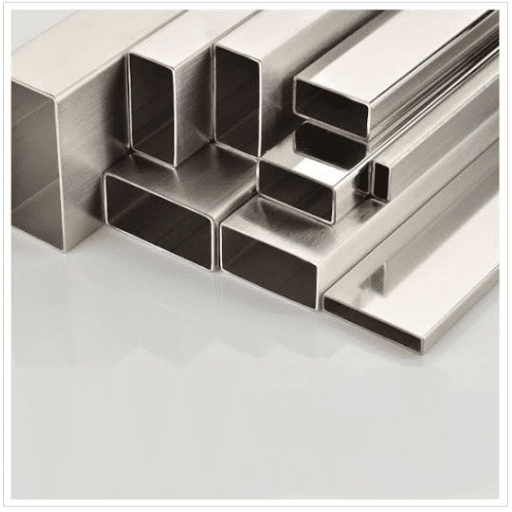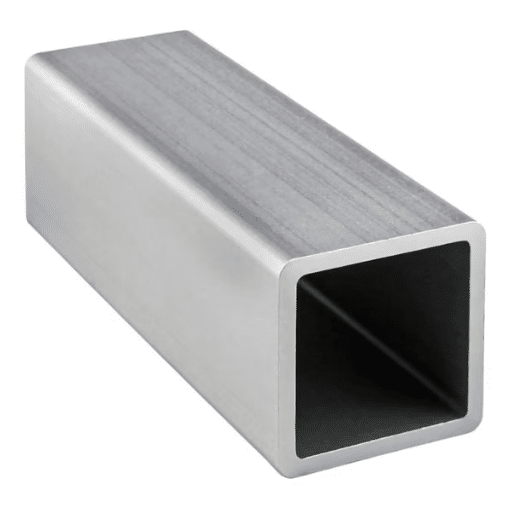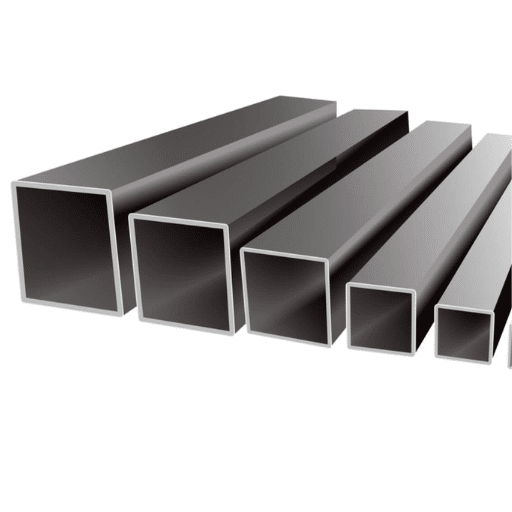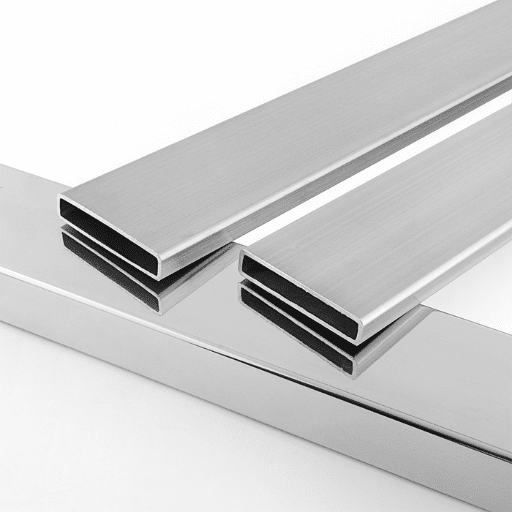
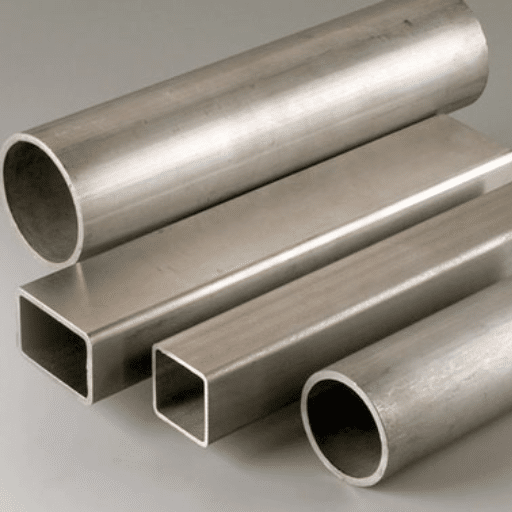
Duplex 2205 rectangular tube is a welded stainless steel hollow section in the austenitic-ferritic grade UNS S32205 (EN 1.4462), ordered to ASTM A554 and specified where a chloride-exposed, load-bearing frame needs roughly twice the yield strength of 316L without going to a heavier section. It is a welded product, not a seamless one, and it comes with real fabrication and design limits that decide whether the premium is worth paying.
The case usually starts the same way. A balustrade or an access frame goes in a few hundred metres from the water. Two or three seasons later the base plates are pitting, the fixings are staining the concrete around them, and the maintenance team is cleaning salt off the rails on a schedule nobody budgeted for. 316L is not failing everywhere in that structure, but it is marginal exactly where salt sits and never dries.
You already know duplex is stronger and more corrosion-resistant than 316L. What most pages skip is the part that decides the order: which standard a duplex rectangular tube actually comes under, what the strength advantage does and does not buy you in a hollow section, why the product is hard enough to make it carry a premium, and how to write a specification that produces a mill test report you can defend.
We form and weld stainless rectangular sections on our own lines in Wenzhou and work to ASTM, EN, and GB standards. This page is written from the mill side, and it tells you where duplex 2205 is the answer and where it is not. For the wider product picture, start with our complete stainless steel rectangular tube guide.
Key Takeaways
- ASTM A554 is the governing standard for a welded duplex rectangular mechanical tube. ASTM A790 and A789, which suppliers often quote, are dimensioned for round pipe and tube only.
- Duplex 2205 delivers roughly twice the yield strength of 316L (about 450 MPa against 170–205 MPa) but almost exactly the same modulus of elasticity. Strength-governed design benefits; deflection-governed design does not.
- A duplex rectangular section is a welded product. Seamless duplex is available as round pipe, not as a rectangular hollow section.
- The premium is a manufacturing premium. Duplex needs about twice the forming load, two to three times the springback of 304/316, and a solution anneal after cold forming.
- Where it does not belong, 2205 is the wrong choice above roughly 300 °C, below about −50 °C, in deflection-governed members, and in mild inland exposure where 316L is already sufficient.
Not sure 2205 is the right grade for your exposure? Send us the chloride level, the service temperature, and the section envelope, and our technical team will confirm the grade, the wall, and the documentation before you commit. Talk to our technical team.
What Is Duplex 2205 Rectangular Tube?

Duplex 2205 rectangular tube, also sold as duplex 2205 box section, is a welded hollow section with a rectangular profile formed from duplex stainless steel strip and sized to an outside dimension across flats. The 2205 grade is a two-phase austenitic-ferritic steel whose roughly equal mix of austenite and ferrite gives it both high strength and high resistance to chloride stress-corrosion cracking.
The Designations: 2205, UNS S32205 / S31803, EN 1.4462
“2205” is the trade name. Depending on which market your drawing was written in, the same grade appears under several designations, and a mill certificate may carry any of them.
| Designation system | Duplex 2205 |
|---|---|
| Common trade name | Duplex 2205 |
| UNS (preferred) | S32205 |
| UNS (legacy) | S31803 |
| EN / W.-Nr. | 1.4462 |
| EN short name | X2CrNiMoN22-5-3 |
| Typical chemistry | ~22% Cr, ~3% Mo, ~5–6% Ni, 0.14–0.20% N, low C |
Specify S32205 rather than S31803 where you have the choice. The two overlap in composition, but S32205 sets a tighter minimum on nitrogen and molybdenum, the element pair that drives both strength and pitting resistance. An S32205 rectangular tube and an EN 1.4462 hollow section are the same product under two designation systems, and a 2205 duplex square tube is the same section with equal sides. The duplex stainless steel guide covers the whole grade family.
Why Duplex 2205 Is Different From 304 and 316L
The difference is not just “more alloy.” Austenitic-ferritic grades sit between the austenitic 300 series and the ferritic 400 series, and they combine properties the austenitics cannot hold at once: yield strength around double that of 316L, and PREN high enough to resist the chloride pitting and stress-corrosion cracking that 316L handles poorly. The trade is lower ductility and a magnetic response. Duplex 2205 is ferromagnetic, unlike 304 or 316L, which matters when a magnetic instrument or a crack-detection method assumes a non-magnetic stainless. For the austenitic side of the decision, our 304 vs 316L rectangular tube comparison owns that call.
Which Standard Governs a Duplex 2205 Rectangular Tube?
ASTM A554/A554M-26, Standard Specification for Welded Stainless Steel Mechanical Tubing, governs a welded duplex rectangular tube. Its scope covers welded austenitic, ferritic and austenitic-ferritic (duplex) stainless mechanical tubing in round, square, rectangular and special shapes as specified by the purchaser, up to 16 in. (406.4 mm) outside dimension, formed from flat-rolled strip and joined by an automatic welding process without added filler metal. A duplex rectangular hollow section, in other words, is an A554 product. Not everyone agrees. Pages ranking for this term quote ASTM A789, A790, A500 and EN 10210 for the same product, and those citations cannot all be right.
ASTM A554: The Standard That Actually Covers This Product
A554 is a mechanical-tubing specification, which is the correct category for a rectangular hollow section. It fixes the grade roster, composition limits, mechanical-property requirements, dimensional and corner-radius tolerances, and the tests that apply. Its grade table includes duplex entries alongside the austenitic ones, reported as S31803, S32205, S32003, S32101, S32202, S32304, S32550, S32750 and S32760. Read the current edition for the exact roster and any duplex-specific supplementary requirement before writing a purchase order against it. The standard’s framework, grade tables and tolerance structure are set out in our ASTM A554 rectangular tube guide.
One footnote deserves a caution. A554’s composition table carries a PREN minimum reported as 41, and that figure applies to the higher-alloy duplex entries, not to 2205. Duplex 2205’s own PREN is approximately 34–36. Write “PREN 41” into a 2205 specification and you will not get a conforming certificate.
Why ASTM A790 and A789 Do Not Apply to Rectangular Sections
A790/A790M covers seamless and welded ferritic-austenitic (duplex) stainless steel pipe, dimensioned to NPS and schedule from ASME B36.19. A789/A789M covers duplex stainless steel tubing for general service, ordered by exact outside diameter and wall thickness, to roughly 9 in. OD. Both are round-product standards: they publish no square or rectangular dimensions. Neither forbids a rectangular section, but neither dimensions one either, so a certificate issued to A789 or A790 cannot describe the rectangular hollow section you bought. A928/A928M, the electric-fusion-welded duplex pipe standard, is round as well. If your product really is a duplex round pipe, that specification is covered on our ASTM A790 duplex seamless pipe page.
Other Standards You Will See Cited (and What They Really Cover)
Several other standards appear on duplex hollow-section listings, and each covers something other than a welded rectangular section. ASTM A500 and EN 10210 are carbon-steel structural hollow-section standards, so neither supplies a duplex grade. EN 10296-2 covers welded stainless mechanical tube of circular cross-section only, which is the correction our rectangular hollow section standards guide makes for the European route. In Europe, a stainless rectangular section is specified as EN 10219-2 for geometry plus EN 10088-2 or EN 10088-4 for the grade, and EN 10088-2 is also where the duplex strip designation X2CrNiMoN22-5-3 is defined. If your project runs on the EN system rather than ASTM, that pairing is the correct one.
Mechanical and Physical Properties of Duplex 2205

The table below compares duplex 2205 with 316L. The figures are typical specification minima for common duplex pipe and tube product forms. The values that apply to your order are those on the standard’s table for the product form and heat treatment you specified, and the heat’s mill test report is the document that governs.
| Property | Duplex 2205 (S32205 / S31803) | 316L | What it means for a rectangular section |
|---|---|---|---|
| Min yield strength (0.2% proof) | ≈450 MPa (65 ksi) | ≈170–205 MPa (25–30 ksi) | Roughly 2× the yield, the main reason to specify the grade |
| Min tensile strength | ≈620–655 MPa (90–95 ksi) | ≈485–515 MPa (70–75 ksi) | About +30%, a smaller gain than the yield gives |
| Min elongation | ≈25% | ≈40% | Lower ductility: larger bend radii, more forming care |
| Modulus of elasticity | ≈190–200 GPa | ≈193–200 GPa | Essentially identical, see the next section |
| Density | ≈7.80–7.88 g/cm³ | ≈8.00 g/cm³ | A small inherent weight advantage even at equal wall |
| PREN | ≈34–36 | ≈24–26 | The corrosion driver, a screening tool, not a guarantee |
| Thermal expansion | ≈13.0–13.7 × 10⁻⁶/°C | ≈16.0–17.0 × 10⁻⁶/°C | Lower, so less thermal distortion and better carbon-steel compatibility |
| Magnetic | Ferromagnetic | Essentially non-magnetic | A commissioning difference where instruments assume 300-series |
| Max service temperature | ≈300 °C | Higher continuous capability | Not a high-temperature product |
| Low-temperature limit | ≈−50 °C | Better low-temperature toughness | Not a cryogenic product, 316L is preferred |
Strength: Yield, Tensile, and Elongation Versus 316L
The headline number is yield strength, where duplex 2205 sits at roughly double 316L. Read the tensile column too, because the gain is smaller: about 620–655 MPa against 485–515 MPa, a margin nearer 30%. The selection argument for 2205 is almost always yielding, not an ultimate-strength one. Elongation, about 25% against 316L’s 40%, is where duplex costs you: it forms and bends less forgivingly, and the grade decision in full belongs to the duplex cluster rather than this page.
Corrosion: PREN, Pitting, Crevice, and Chloride SCC
PREN, the pitting resistance equivalent number, is calculated as %Cr + 3.3 × %Mo + 16 × %N. Duplex 2205 lands around 34–36 against 316L’s 24–26, a gap that shows up as better resistance to pitting, crevice corrosion, and chloride stress-corrosion cracking in marine and process environments. Treat PREN as a screening tool and not a warranty. Weld quality, surface condition, oxygen availability and temperature all affect real performance, as the International Molybdenum Association and the Nickel Institute set out in their duplex guidance. The PREN calculation, critical pitting temperature and chloride SCC behaviour are covered in depth on our duplex corrosion resistance page.
Physical Properties: Density, Modulus, Thermal Expansion, Magnetism
Density is marginally lower than 316L (about 7.80–7.88 against 8.00 g/cm³), thermal expansion is meaningfully lower, and thermal conductivity is slightly higher. Two of these have practical consequences in a structure. The lower expansion reduces distortion when duplex sits alongside carbon steel in a mixed fabrication, and the ferromagnetic response is a real difference at commissioning if a magnetic instrument has been set up for 300-series stainless.
Service Temperature Limits: Where 2205 Stops Working
Duplex 2205 is a moderate-temperature grade. Above about 300 °C, sustained exposure promotes embrittling phases (sigma, chi and alpha-prime) and the material loses toughness and corrosion resistance. Below roughly −50 °C its low-temperature toughness is inferior to 316L. If your frame runs hot or cold, 2205 is the wrong grade before any strength argument begins.
Working through a grade selection against a live exposure? Send us the environment and the operating temperature range, and our technical team will confirm whether 2205, a lean duplex, or 316L is the honest answer.
Strength Versus Stiffness: What Duplex 2205 Actually Does for a Rectangular Section
This is the point that decides whether duplex 2205 saves you money or only costs you more, and it is the one almost no supplier page publishes.
The Modulus Problem: Why Doubling Yield Strength Does Not Double Capacity
Duplex 2205 nearly doubles 316L’s yield strength, but its modulus of elasticity is essentially the same, around 200 GPa. Stiffness, and therefore deflection under a service load, depends on the modulus and the section’s second moment of area, not on the yield strength. So in a member whose size is set by how much it may deflect, duplex 2205 buys nothing over 316L except corrosion resistance. The section that satisfied the deflection limit in 316L is still the section you need in 2205.
When Weight Saving Is Real: Strength-Governed Design
Where design is governed by stress, a pressure case, or a bending or axial member sized on allowable stress, the doubled yield lets you use a much thinner wall. Reported weight savings run to 30–40% wall reduction for 2205 under typical offshore design pressures, and up to about 50% for lean duplex grades. A worked illustration: a DN250 316L Schedule 40S pipe at roughly 6.02 mm wall and 47 kg/m can be replaced by a 2205 Schedule 10S at roughly 4.19 mm and 33 kg/m, about 30% less mass per metre. That substitution is valid only because the case was strength- or pressure-governed. On a deflection-governed member the same swap would not stand up.
When It Is Not: Deflection-Governed Members and the Buckling Trap
Consider a walkway beam in a coastal plant. The span and the live load set a deflection limit, so the engineer sizes the section on stiffness, then specifies duplex 2205 for the corrosion. The frame performs perfectly against the environment, and the weight is unchanged, because the modulus never moved. The premium bought durability, not lightness, and it is worth knowing that before the order rather than after it.
There is a second trap for anyone who takes the weight saving. Thinner walls reduce a section’s resistance to local buckling, so down-gauging to exploit duplex’s strength can hand the governing limit state to buckling where yielding governed before. The section that passes the stress check may still fail a stability check.
Stainless-Specific Design: EN 1993-1-4 and the SCI Section Tables
Stainless, duplex included, has a rounded stress–strain curve with no sharply defined yield point, so carbon-steel design methods and buckling curves do not transfer directly. Stainless-specific design applies: EN 1993-1-4 with its accompanying Design Manual for Structural Stainless Steel, and the SCI publication tables for cold-formed stainless hollow sections, which cover duplex 2205 alongside 304 and 316. US projects use AISC 360 with stainless-appropriate treatment. One boundary to state plainly: the load case, the limit state, the buckling check and the governing code are the engineer’s task. For the section properties themselves, Ix, Sx, radius of gyration and mass per metre, use our rectangular tube weight and section properties chart, which carries the data rather than restating it here.
How Duplex 2205 Rectangular Tube Is Made, and Why It Is a Specialty Product
Competitors present duplex as simply a stronger 316L. It is harder to make than that, and the fabrication reality is the honest reason a duplex rectangular section is a specialty item rather than a stock line.
Forming: Higher Loads, Higher Springback, Work Hardening
Duplex requires roughly twice the forming force of 300-series austenitic strip at the same thickness. It also springs back far more, reported at two to three times the springback of 304L or 316L, with examples of 5–8° against 2–4° on a comparable bend. That springback has to be built into the tooling, and it makes holding the tight across-flats tolerance, straightness and twist that decide fitment harder to guarantee. With elongation around 25% against 316L’s 40%, tight corners and small bend radii carry more cracking risk. How the section is formed and welded in general is covered on our welded rectangular tube page.
Welding: Holding the Ferrite–Austenite Balance Without Filler Metal
Duplex’s properties depend on keeping a balanced austenite–ferrite structure, roughly 45–55% ferrite after welding. Too much ferrite leaves the weld less tough and less corrosion-resistant. Here is the tension A554 creates: it specifies automatic welding without the addition of filler metal, so a mill making an A554 duplex rectangular tube has to hold that phase balance through the autogenous weld parameters alone. That is a genuine difficulty, it is part of why the product is priced where it is, and almost no supplier page explains it. The welding procedure itself, including heat input, interpass control, shielding gas and A923 screening, is set out on our duplex stainless steel welding page.
Solution Annealing and the Temperature Windows to Avoid
After cold forming, duplex typically needs a full solution anneal at roughly 1020–1100 °C followed by rapid quenching to restore its mechanical properties and corrosion resistance. On a continuously welded length of tube this is a substantial process step and a real cost. Two temperature windows must be avoided in processing: 600–900 °C, where sigma phase forms, and 250–550 °C, where 475 °C embrittlement risk rises. Hot forming, where used, runs around 1100–1150 °C.
What This Means for Geometry: Tolerance, Straightness, Twist and Corner Radius
Springback and work hardening do not stay inside the mill. They show up on the finished section as the geometry that decides fitment: across-flats tolerance, straightness, twist and the outside corner radius. A duplex section may need a different corner radius from the 316L section it replaces, and the geometry consequences of that are set out on our rectangular tube corner radius page. The practical takeaway for a buyer is simple: give the mill the fitment requirement, not just the nominal size, and let the tolerance be agreed rather than assumed.
Is Duplex Rectangular Tube Seamless or Welded?
A duplex rectangular hollow section is a welded product. It is formed from duplex strip and welded along a seam, which is what A554 describes. Seamless duplex is available as round pipe and tube, and that is what A790, A789 and A928 cover, but seamless duplex is not made as a rectangular hollow section. The phrase “seamless duplex rectangular tube” appears in supplier listings; it is a listing error rather than a product. Specify it as welded.
Applications: Where Duplex 2205 Rectangular Tube Earns Its Premium
Duplex 2205 pays for itself only where three things coincide: a real chloride load, a load-bearing or structural duty, and a weight or maintenance penalty worth removing. Where all three are present, it earns the premium. Where one is missing, it usually does not.
Offshore, Marine and Coastal Structures
Handrails, balustrades, access platforms, riser supports, maintenance walkways and grating frames on offshore assets and at the coast. These sections are load-bearing and permanently in salt, which is exactly the intersection duplex is built for. Handrail and balustrade specification, including the building-code side, is covered on our rectangular tube for handrails page.
Cranes, Davits and Lifting Equipment in Marine Service
Lifting gear in marine service is where the weight argument is worth the most, because every kilogram removed from a boom or a davit is a kilogram the structure above it no longer carries. This is the application where duplex rectangular sections have a long track record, and it is the case where the yield-strength advantage converts directly into useful payload.
Desalination and Seawater Systems
Intake and outfall structures, brine lines, high-pressure reverse-osmosis support framing and evaporator internals. The seawater process plant is a reference market for duplex, and the rectangular sections in it are frames and supports rather than pipes. Our duplex stainless steel in oil and gas page covers the adjacent process-industry demand.
Coastal Architectural and Infrastructure Work
Balustrades, glass-rail supports, pool fencing and façade framing in the splash zone, and railing on coastal bridges and port infrastructure. In splash-zone work, 316L needs cleaning on a short cycle or begins to pit, while duplex tolerates the exposure with far less intervention.
Chemical, Pulp and Paper, and Wastewater Framing
Chloride-bearing process environments where the structure, not just the pipework, is at risk. The chloride logic is the same: when the frame itself sees the aggressive service, the grade decision moves up.
Where Duplex 2205 Is Not the Right Choice
State this clearly, because it matters more than the sales case. Duplex 2205 is not the right grade for service above roughly 300 °C, where 316H, 321 or a higher-alloy austenitic is the correct answer. It is not the grade for cryogenic service below about −50 °C, where 316L is preferred. It buys nothing in deflection-governed members, as the design section explains. And it is wasted money in mild inland or sheltered exposure where 304 or 316L is already sufficient, because the premium buys no service life you needed. For moderate chloride exposure with the largest weight savings, lean duplex 2101 or 2304 is the sensible middle step, and where 2205’s PREN is not enough, 2507 super duplex is the next grade up.
2205 or 2507? Choosing Between Duplex and Super Duplex for a Rectangular Section
Two families come up when 2205 is short of the duty. Lean duplex 2101 and 2304 sit below it, for moderate chloride exposure and the largest weight savings. Super duplex 2507 sits above it, for high-chloride, high-temperature or sour-service cases where 2205’s PREN and strength are not enough. Both are a grade decision rather than a rectangular-section question, so we keep the comparison off this page: duplex vs super duplex owns the 2205-versus-2507 call, and our super duplex S32750 pipe page covers the higher grade.
How to Specify and Order Duplex 2205 Rectangular Tube

A duplex rectangular section is specified by geometry, grade and the duplex-specific extras the buyer needs. Get all three into the enquiry, and the quotation comes back as something you can compare.
The Order Line: Size × Wall × Grade × Condition × Finish × Corner Condition × Certification
- Size and wall: the across-flats outside dimension × wall thickness, or depth × width × wall for a rectangle, stated in millimetres.
- Grade: name the standard designation, e.g. UNS S32205, not just “2205”.
- Standard, ASTM A554/A554M, or the EN pairing of EN 10219-2 plus EN 10088-2 if your project runs that way.
- Condition: as-welded, or solution-annealed and quenched where the order requires it.
- Finish, as-produced, pickled, brushed or polished; surface state matters to corrosion performance, not only appearance, and the options are set out in our rectangular tube surface finish guide.
- Corner condition: the outside corner radius, or a fitment requirement the radius must satisfy.
- Certification: the inspection document your project requires, plus the duplex-specific testing below.
Documentation: What Belongs on a Duplex Mill Test Report
A duplex order should carry more than a standard chemistry and mechanicals sheet. Ask for the heat-specific chemistry including nitrogen, because nitrogen drives both PREN and phase balance. Ask for phase balance or ferrite content by ferrite meter or metallography, since a certificate reporting only chemistry will not tell you whether the weld held its structure. Where the specification calls for it, add ASTM A923 screening for detrimental intermetallic phases and PMI (positive material identification) on finished sections. The EN 10204 certificate type, Type 3.1 for most project work, should be named on the order rather than assumed. The sourcing and qualification route for duplex from China, including third-party inspection, is covered on our how to source duplex stainless steel from China page.
Lead Time, MOQ and Third-Party Inspection
Duplex is a specialty grade, so plan the lead time around a made-to-order schedule rather than a stock position, and expect a minimum order quantity that reflects a heat rather than a shelf. Third-party inspection, from SGS, TÜV, Bureau Veritas or a project-nominated agency, is normal on offshore and process work and is best arranged at the point of enquiry, because the inspector’s witness points have to be built into the production run. Because duplex is a made-to-order grade rather than a stock one, a duplex 2205 rectangular section is quoted against a confirmed section and wall range, not from a published size list; send the envelope rather than assuming availability, and our technical team will confirm the section and wall it can produce, and the documentation that will accompany the order.
On price, the honest relationship is roughly 1.5 to 2 times 316L per kilogram, driven by the alloy content and by the forming and phase-control steps described above. We do not publish a duplex price per kilogram, because it moves with the nickel and molybdenum markets, the section, the wall and the certification. Send the specification and the number comes back with the quotation.
Frequently Asked Questions
What is duplex 2205 rectangular tube?
It is a welded stainless steel hollow section with a rectangular profile, made from duplex 2205 strip (UNS S32205, EN 1.4462). Duplex is a two-phase austenitic-ferritic steel with roughly double the yield strength of 316L and higher resistance to chloride pitting and stress-corrosion cracking.
Is duplex 2205 stainless steel available in rectangular tube?
Yes, though it is a specialty product rather than a stock line, and many suppliers carry duplex only as round pipe. It is formed and welded to ASTM A554 as a welded rectangular mechanical tube. A duplex stainless steel rectangular tube manufacturer running duplex on the same lines as standard grades can offer a wider section and wall range than a stockist. Confirm availability against a specific order.
Can you get 2205 duplex in square tube as well as rectangular?
Yes. Square and rectangular sections are made the same way and carry the same grade options, and a 2205 duplex square tube behaves identically to the rectangular equivalent of the same wall. The choice between square and rectangular is a geometry decision rather than a grade one; our square vs. rectangular tube comparison covers it.
Is duplex rectangular tube seamless or welded?
Welded. A duplex rectangular hollow section is formed from duplex strip and welded along a seam, which is what ASTM A554 describes. Seamless duplex is made as round pipe and tube, not as a rectangular section, so “seamless duplex rectangular tube” is a listing error rather than a product.
What standard covers duplex 2205 rectangular tube?
ASTM A554/A554M, the welded stainless steel mechanical tubing standard, whose scope covers duplex grades in square and rectangular shapes. ASTM A790 and A789, often quoted for duplex, cover round pipe and tubing only and publish no rectangular dimensions. In Europe, the equivalent is EN 10219-2 for geometry plus EN 10088-2 for the duplex grade.
Is ASTM A554 suitable for duplex stainless steel?
Yes. A554’s scope covers austenitic-ferritic (duplex) mechanical tubing, and its grade table includes duplex entries such as S31803 and S32205. Because it specifies automatic welding without filler metal, holding duplex phase balance under an A554 weld is a manufacturing challenge, which is part of why duplex rectangular tube carries a premium.
Is ASTM A790 the right standard for rectangular tube?
No. ASTM A790 is the duplex pipe standard and is dimensioned to NPS and schedule, so it describes round pipe only. It publishes no square or rectangular sizes. A duplex rectangular section is ordered to ASTM A554 instead.
Is duplex 2205 stronger than 316L?
In yield strength, yes: roughly 450 MPa against 170–205 MPa, about double. In tensile strength, the margin is smaller, near 30%. Duplex also has lower elongation (about 25% against 40%), so it forms less forgivingly and needs larger bend radii.
Does duplex 2205 improve stiffness compared with 316L?
No. The modulus of elasticity is essentially the same, around 200 GPa, and stiffness depends on the modulus and the section’s second moment of area, not on yield strength. A deflection-governed member gains nothing in stiffness from duplex; only its corrosion resistance improves.
How much lighter is duplex 2205 than 316L for the same duty?
For strength- or pressure-governed design, wall reduction of roughly 30–40% is reported, giving a comparable mass saving per metre. The saving depends entirely on the design being strength-governed. A deflection-governed member cannot be thinned on the same basis, because its size is set by stiffness, not stress.
What is the maximum service temperature of duplex 2205?
About 300 °C. Above that, sustained exposure promotes embrittling phases that reduce toughness and corrosion resistance, so duplex is not a high-temperature grade. At the other end, its low-temperature toughness is inferior to 316L below roughly −50 °C.
Is duplex 2205 magnetic?
Yes. Duplex stainless steel is ferromagnetic because of its ferrite content, unlike 304 and 316L, which are essentially non-magnetic. That matters at commissioning if an instrument or a crack-detection method assumes a non-magnetic 300-series grade.
Can duplex 2205 rectangular tube be used for handrails?
Yes, and coastal and offshore handrails are a strong application for it, because the rail is load-bearing and permanently in salt. The rail is specified to the same code requirements as a 316L rail; the difference is the grade and its corrosion performance.
How much more does duplex 2205 cost than 316L?
Expect a duplex 2205 rectangular tube to cost roughly 1.5 to 2 times a 316L section per kilogram. The premium reflects the alloy content and the extra forming and phase-control steps duplex requires. Whether it is worth paying depends on whether the design is strength-governed and whether the chloride exposure justifies the corrosion upgrade.
Conclusion: The Right Grade for the Right Exposure
Duplex 2205 rectangular tube is a specialty product with a clear job, and the job is narrower than the sales copy suggests. It is a welded section ordered to ASTM A554, not to the round-product standards that dominate the search results. It delivers roughly double the yield strength of 316L and better chloride resistance, which matters most where a structural section sits permanently in salt. And its advantage stops where stiffness, high temperature or mild exposure begin.
Four things are worth carrying to your next specification. Name the standard correctly: A554 for the welded rectangular product, and A790 or A789 only for round pipe and tube. Check whether your design is strength-governed or deflection-governed before you bank on a weight saving, because duplex doubles yield strength but leaves the modulus untouched. Expect the premium, and understand it as a forming and phase-control cost rather than a grade markup. And write the duplex-specific documentation into the order: heat chemistry with nitrogen, phase balance, A923 where called for, and PMI.
That last step is where a mill earns its keep on this grade. Send us the exposure, chloride level, and temperature; the load case and the size envelope, and our technical team will confirm whether 2205 is the right grade, what section and wall we can produce, and what documentation will accompany the order, within 24 hours. To see the wider range, visit our stainless steel rectangular tube product page.